
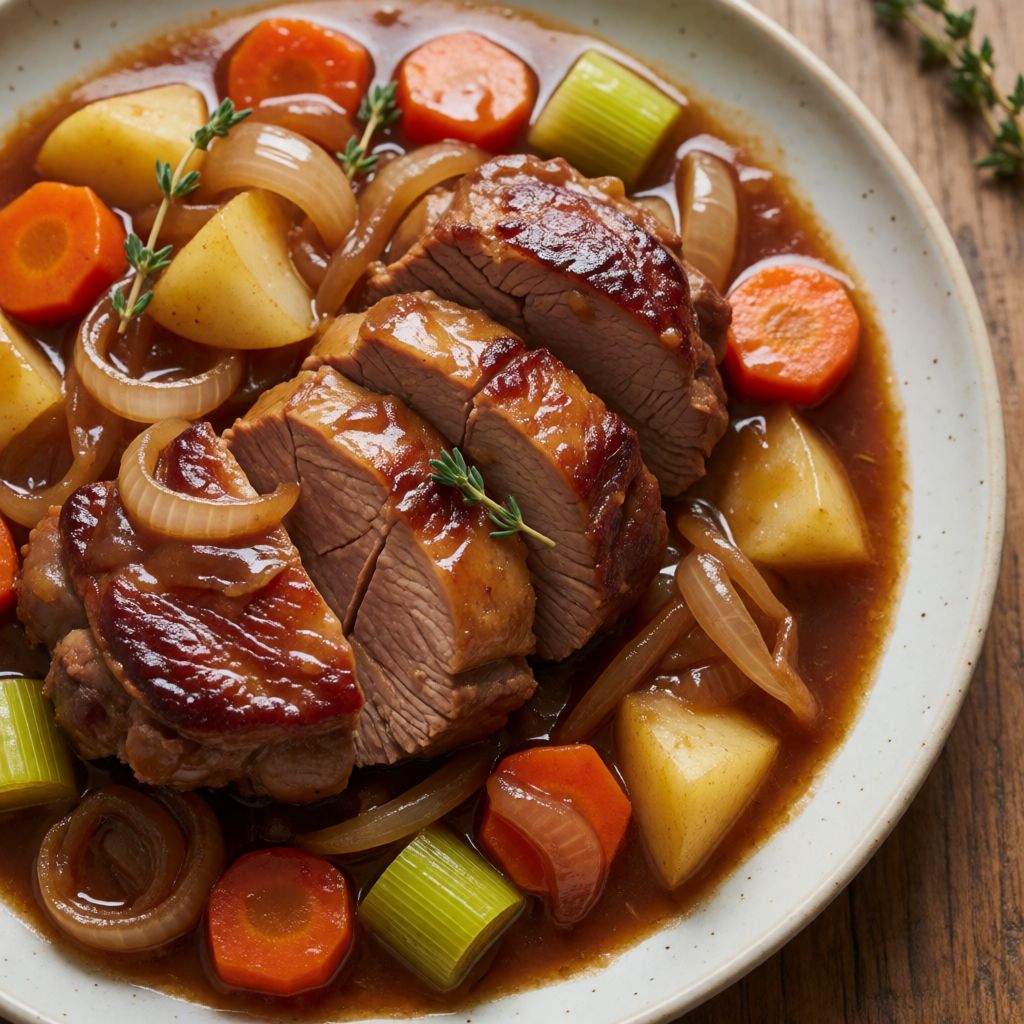
 AI photo
Braised Pork Collar with Apples and Thyme
A slow-braised pork collar with onions, leeks, apple juice and beer, finished with thyme and served with creamy mash.
Labels are worked out automatically from the ingredients and can be wrong. Check the packaging if it matters to you.
Ingredients
- 1 pcs Pork collar
- 2 pcs Onion finely chopped
- 2 pcs Carrot diced
- 2 pcs Leek sliced into rings
- 6 clove Garlic finely chopped
- 5 pcs Black pepper whole peppercorns
- 3 pcs Bay leaf
- 2 pcs Rosemary fresh sprigs
- 1 bunch Thyme fresh
- 400 ml Pressed apple juice
- 400 ml Beer
- 1 tsp Butter for frying
- 2 pcs Carrot finely diced
- 1 pcs Leek sliced into thin rings
- 1 pcs Apple sliced thinly
- 1 tbsp Butter
- Salt
- Black pepper freshly ground
- 2 kg Potato
- 110 g Butter
- 200 ml Milk
- 1 pinch Nutmeg
- Salt
- Black pepper freshly ground
- 50 ml Parsley finely chopped
- 1 bunch Thyme fresh















Steps
Heat the butter in a pot and sear the pork collar on all sides, then remove and set aside on a plate.
Put the onion, carrot, leek, garlic and peppercorns into the pot and fry over medium heat until the onion softens.
Add the seared meat along with the bay leaf, rosemary, thyme, apple juice and beer.
Cover with a lid and braise for 1 1/2 – 2 hours over low heat.
120 minBoil the potatoes in unsalted water until tender.
Warm the milk in a small pan to about 50°C.
Mash the hot, freshly cooked potatoes with butter, then whip with a mixer, gradually adding the warm milk, until the texture is creamy, light and velvety. Season with salt, pepper and freshly grated nutmeg.
Remove the meat from the pot, strain the sauce, discard the strained-out solids.
10 minReturn the meat and sauce to the pot along with the carrot and leek.
Simmer for 10 minutes, add the apple, butter, salt and pepper.
10 minServe sprinkled with fresh thyme and roughly chopped parsley, together with the mashed potatoes.
This is a Sunday roast's cousin that gave up on the oven and got into a pot instead. Pork collar — the shoulder end, the bit laced with fat and connective tissue — goes in whole, seared hard, then left to sit in a bath of apple juice and beer with onion, carrot, leek and garlic until it falls apart. No basting, no watching, no oven timer anxiety. You're not cooking the meat so much as dissolving it.
What decides whether this works is nerve. Not skill — nerve. The temptation with a piece this size is to turn the heat up to "get it done" in forty minutes. Don't. Collagen in collar meat only lets go slowly, somewhere around a bare simmer, the liquid doing no more than trembling. Push the heat and you get meat that's cooked through and still tough — because toughness and doneness are not the same failure. The connective tissue needs time at low heat to melt into gelatine; rushing it just firms up the muscle fibres faster than the collagen can soften, and you end up with something drier than when you started.
Some say braising is just "slow roasting with extra steps" — no, because the liquid is doing active chemical work, not just keeping things moist. The apple juice's sugar and the beer's bitterness and carbonation both break down protein and build flavour as they reduce; a dry braise would just steam the meat.
Pork collar (or "scrag", or shoulder, depending who's behind the counter) is the right cut because of what it's made of, not because a recipe says so. It's marbled with fat and threaded with the connective tissue I mentioned — sinews that would be unchewable in a quick-fried cut like loin. Given low heat and hours, that same tissue becomes the thing that makes the sauce feel rich on your tongue rather than just wet. If your butcher only has loin or a leaner shoulder joint, you can still braise it, but expect a drier result and shorter patience needed — lean meat doesn't reward long cooking, it just toughens.
The onion, carrot, leek and garlic at the start are not "vegetables in the dish" — they're a base that will be strained out and binned. Their entire purpose is to surrender flavour into the liquid: sugars caramelising faintly, garlic mellowing, the raw edge coming off the onion. You're looking for the onion to go from sharp white to soft and translucent, verging toward gold — that's the visual cue, not a clock. If it starts catching and browning hard, your heat's too fierce and you'll get bitterness in the sauce later; turn it down rather than stir faster.
Apple juice and beer together are doing two different jobs that a single liquid wouldn't manage alone. The juice brings sugar and acidity that balance the meat's fat; the beer brings bitterness and a bit of yeasty depth, plus carbonation that helps break tissue down faster than a flat liquid would. If you've no beer in, a dry cider does a similar job — fruit and ferment both. Stock alone will work, but it's a flatter, one-note braise; you lose the bittersweet edge that makes this dish specifically apple-and-pork rather than generic pot roast.
Thyme, rosemary and bay are there for aroma, and they're added whole and fished out later, not chopped into the dish — chopped herbs in a two-hour braise just disintegrate and turn bitter and gritty. Any firm, woody herb works on the same principle: added whole, simmered long, removed before serving. Fresh thyme at the end, added raw, is a different thing entirely — that's for smell, not flavour infusion, so don't swap it for dried at that stage; dried thyme has given up its volatile oils already and won't perfume the plate the way a crushed fresh sprig does.
The mash is simple until you notice what the warm milk is for. Cold milk shocks the starch in hot potato and the result goes gluey — gummy mash is a starch problem, not a potato problem. Warming the milk first means the potato stays at a steady temperature as you incorporate it, so the starch cells release smoothly instead of seizing. Butter first, then milk, is also deliberate: the fat coats the starch granules before the liquid arrives, which is part of why this method gives you something silky rather than wallpaper-paste.
Any neutral oil with no smell of its own can stand in for the frying butter at the start — butter burns at a lower point than most, so if your hob runs hot and you haven't got a feel for it yet, a flavourless vegetable or sunflower oil for the sear is the safer choice, saving actual butter for where its taste matters, which is the mash and the final finish. This feeds six comfortably, with maybe enough sauce left for someone to go back for a second spoonful over the mash — which, let's be honest, is the better half of the plate anyway.