
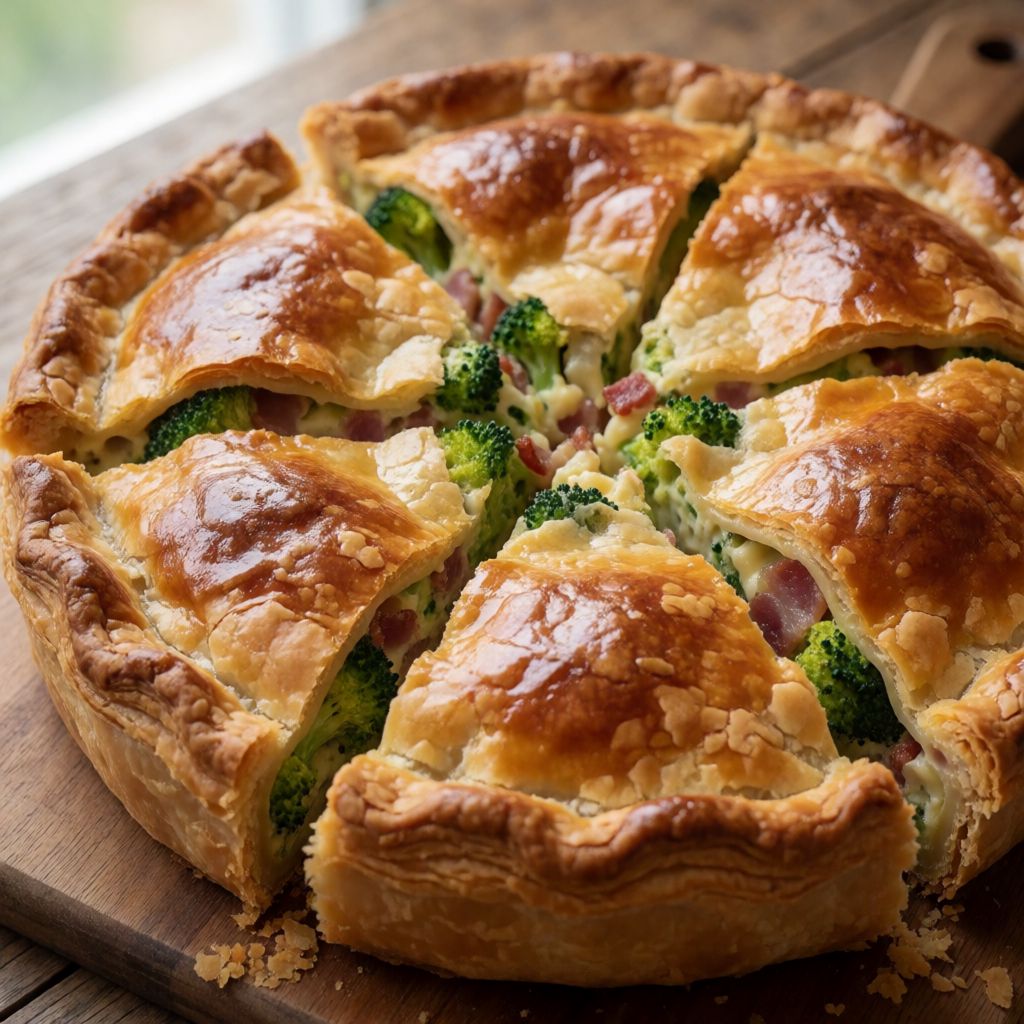
 AI photo
Broccoli and Bacon Pie
A savoury shortcrust pie filled with crisp bacon, broccoli and melted cheddar in a creamy egg custard.
Labels are worked out automatically from the ingredients and can be wrong. Check the packaging if it matters to you.
Ingredients
- 125 g Plain flour
- 50 g Wholemeal flour
- 100 g Butter cold
- 45 ml Water
- 1 tsp Salt
- 100 g Bacon
- 5 pcs Eggs
- 200 ml Crème fraîche 18%
- 100 ml Double cream
- 500 g Broccoli broken into small florets
- 100 g Mature cheddar coarsely grated
- 20 g Butter for frying
- 1 tsp Olive oil for frying
- Black pepper freshly ground, to taste
- 2 pcs Thyme sprigs, for sprinkling













Steps
Mix the plain and wholemeal flour with the salt, then rub in the cold butter until it resembles breadcrumbs.
Add the water, bring the dough together, and let it rest in the fridge for 30 minutes.
30 minRoll out the dough into a greased 24 cm pie tin and prick it with a fork.
Blind-bake the pastry in an oven preheated to 175°C (fan) for 10 minutes.
10 minFry the bacon until crisp, remove from the heat, let it cool and chop it roughly.
Whisk the eggs with the crème fraîche, double cream, salt and pepper.
Add the broccoli florets, bacon and cheese to the bowl, mix and spread over the pre-baked pastry.
Bake the pie at 175°C (fan) for about 35 minutes, until firm and golden.
35 minSprinkle with a little thyme before serving.
This is a quiche with its sleeves rolled up — broccoli and bacon instead of the usual Lorraine bacon-and-onion, and a crust that's half wholemeal so it has some backbone instead of just being a vehicle for butter. What decides whether this works isn't the filling, which is forgiving, it's the pastry and whether you let it rest.
Cold butter rubbed into flour until it looks like breadcrumbs is doing one job: coating the flour grains in fat so they can't easily link up into gluten when the water goes in. That's what makes pastry short rather than chewy. If the butter's soft, or your hands are warm, it smears instead of rubbing in, and you get streaks of melted fat through the dough — the pastry still bakes, but it's tougher and it shrinks more in the oven, because the fat's already partly worked into the flour in patches rather than sitting as discrete pockets that steam and flake apart cleanly.
The 30-minute rest in the fridge isn't laziness-friendly padding, it's letting the gluten you did form — because some mixing is unavoidable, however gentle — go slack again, and letting the fat firm back up after your hands warmed it. Skip it and the dough fights you when you roll it, then shrinks back on itself in the tin like it's trying to leave.
The filling is a custard, not a sauce, and that's the thing to understand about the egg-and-cream mixture. Five eggs plus crème fraîche and double cream set, in the oven, into something that holds a slice shape rather than oozing — the proteins in the egg are what firm up with heat, the cream is there for richness and to stop the custard turning rubbery and dry, the way a custard made of egg whites alone would. Crème fraîche at 18% rather than full cream gives you a bit of sharpness against the cheese and bacon, both of which are already salty and savoury — if you haven't got crème fraîche, soured cream works on the same logic, anything cultured and slightly acidic to cut the richness, though double cream alone will still set fine, just taste flatter.
Broccoli goes in raw, broken into small florets, not blanched — and that's deliberate, not an oversight. The custard bakes for 35 minutes at a gentle oven temperature, and that's long enough and hot enough to cook small florets through from raw, using the moisture already in them plus what's around them in the custard. Blanch first and you risk watery broccoli bleeding liquid into the filling once it's cut, which thins the custard and stops it setting cleanly — keep the florets small, as the recipe says, because that's what lets them cook through in the time the custard needs rather than you having to choose between raw broccoli and an overcooked custard.
Bacon gets fried first and cooled before it goes in — frying renders out its fat and gets it properly crisp, which it won't do sitting raw in a custard in the oven, it'll just go chewy and pale. Cooling it matters too: tip hot bacon straight into whisked eggs and you start cooking the eggs at the edges before the mixture's even in the tin, giving you little scrambled threads through the custard instead of a smooth set. Any smoked streaky or back bacon works; pancetta is the same idea in different clothes if that's what's in your fridge.
Cheddar, mature and coarsely grated, isn't melted into the custard separately — it goes in with everything else and sets through the filling, giving pockets of sharp flavour rather than an even cheese-sauce taste throughout. Mature matters because a mild cheddar brings little beyond salt and stretch; you want the bite. Any firm cheese that grates coarsely and has some sharpness to it — a strong Lancashire, a aged Gruyère — does the same job; a soft or very wet cheese will just melt flat and release water into the custard.
The oven at 175°C fan for the main bake is a temperature chosen to firm the custard through without it puffing, cracking or splitting into curds and liquid — push it hotter and the eggs can overcook at the edges well before the centre sets, which is the usual reason a quiche comes out with a rubbery rim and a wobbly middle. "Firm and golden" is the actual test, not the 35 minutes — a gentle shake of the tin near the end should show the centre barely moving, not sloshing. The minutes given are a floor, because ovens lie about their own temperature more often than people expect.
One thing worth saying plainly: there's no shortcut on the resting time for the pastry, and no shortcut on letting the pie sit a few minutes once it's out before you cut it — the custard is still finishing its set in residual heat, and a slice cut too early collapses rather than holding its edge. Patience here isn't virtue for its own sake, it's just what the egg proteins need to firm up properly rather than weep onto the plate. Serve it the way quiche sits happily in a British kitchen — warm rather than hot, alongside tea, or as the cold centrepiece of exactly the kind of picnic or packed lunch this country invented the concept for.