
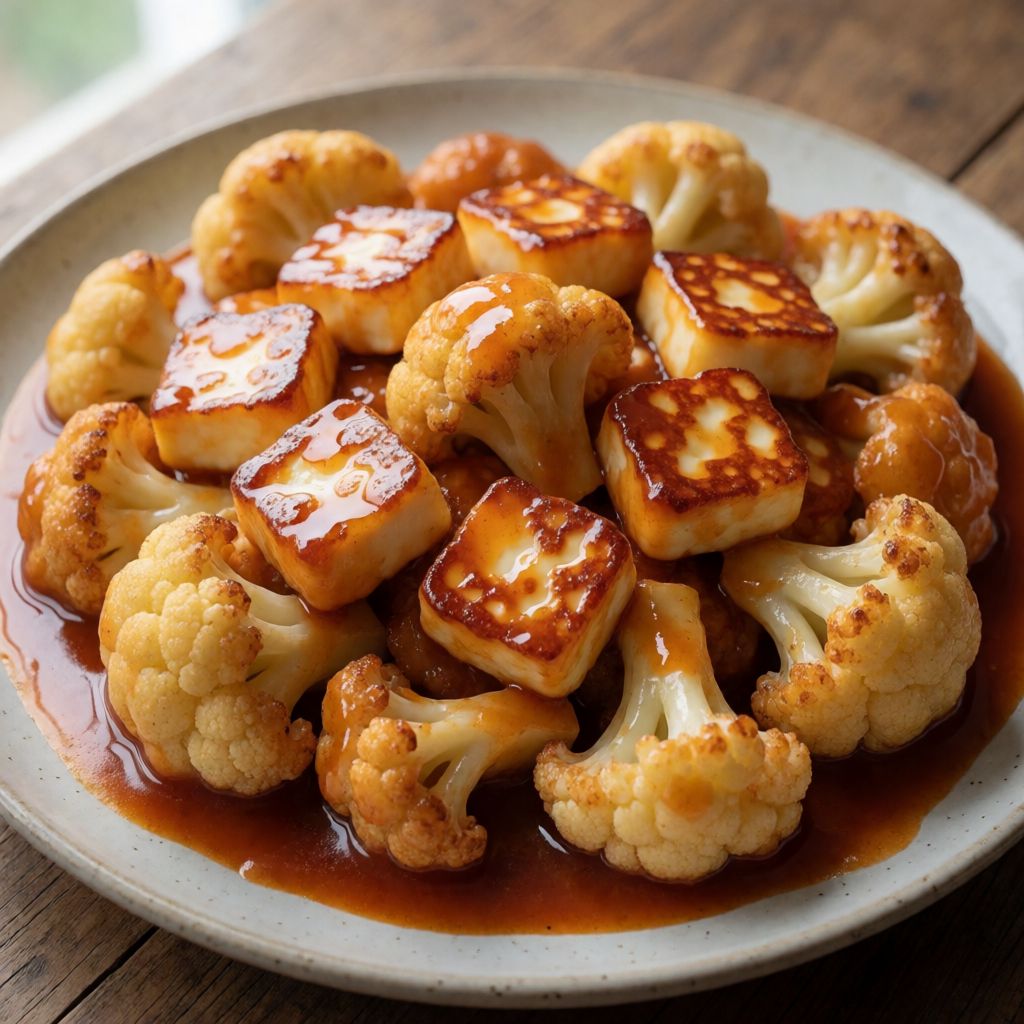
 AI photo
Cauliflower and Halloumi in Sweet and Sour Sauce
A quick sweet and sour stir-fry of cauliflower and halloumi, served over rice and topped with spring onion and sesame seeds.
Labels are worked out automatically from the ingredients and can be wrong. Check the packaging if it matters to you.
Ingredients
- 200 ml pineapple juice
- 1 tbsp apple cider vinegar
- 2 tbsp ketchup
- 1 tbsp brown sugar
- 1 tbsp ginger finely grated
- 1 tbsp soy sauce
- 1 tbsp cornflour
- 250 g halloumi sliced
- 1 pcs onion finely chopped
- 2 clove garlic finely chopped
- 2 pcs bell pepper diced
- 400 g cauliflower broken into florets
- 1 tbsp olive oil for frying
- 300 ml basmati rice
- 3 pcs spring onion sliced into rings
- 1 tbsp sesame seeds toasted in a dry pan













Steps
Mix all the ingredients for the sweet and sour sauce and cook the rice according to the package instructions.
Fry the halloumi slices in a pan with oil until crisp and golden on both sides.
Remove the halloumi from the pan and set aside on a plate.
In the same pan with oil, fry the onion and garlic until soft.
Add the bell pepper and cauliflower and heat everything together for a few minutes.
Add the sweet and sour sauce, stir well and simmer the dish covered for about 15 minutes, stirring occasionally.
15 minStir the halloumi into the dish.
Serve in bowls with rice, sprinkled with spring onion and toasted sesame seeds.
This is a stir-fry dressed up as something else — cauliflower that stays a vegetable instead of turning into mush, squeaky cheese that holds its shape in a hot sauce, and a sauce that is really just a thickened sweet-and-sour glaze built from things you'd otherwise throw in a bin: pineapple juice, ketchup, a spoon of sugar. What decides whether it works is heat management with one pan doing three jobs, and whether you let the cornflour actually do its job before you panic and add more liquid.
Halloumi is the trick here. Most cheeses melt and surrender in a hot pan. Halloumi doesn't, because it's been brined and partly cooked already — the proteins have set too firm to collapse, which is exactly why Cypriots grill it over coals without it running everywhere. Fry it hard enough, hot enough, fast enough, and the outside goes gold and faintly crisp while the inside stays rubbery-soft. Go in timid with a lukewarm pan and you get pale, sweating slices sitting in their own whey — no crust, no contrast, just warm cheese. The oil has to be properly hot before the first slice goes in; you'll hear it, a sharp sizzle, not a quiet hiss.
The sauce is the cheap, clever part — this is essentially a domestic version of the sweet-and-sour sauces that came out of adapting Cantonese cooking to ingredients British grocers actually stocked: vinegar for sharpness, sugar for sweetness, something tomatoey for colour and body, because fresh Chinese plum sauce or rice vinegar wasn't sitting on shelves in most towns. Pineapple juice plus ketchup plus vinegar plus sugar plus soy sauce is that logic exactly — sweet, sour, salty, savoury, built from a supermarket shop rather than a specialist one. The cornflour is not decoration, it's the only thing standing between "sauce" and "flavoured water." Mixed in cold, then heated, it swells and thickens the liquid into something that coats a floret instead of pooling underneath it. Any starch that thickens on heating does the same job — potato starch, arrowroot, even plain flour cooked in a little longer. Skip it and the sauce stays thin no matter how long you simmer, because reduction by boiling alone takes far more time than 15 minutes gives you, and you'll just scorch the sugar instead.
Halloumi itself: look for the kind that's genuinely squeaky when you bite it raw, that's the sign the curd was properly salted and set. If you can't get halloumi, any firm, salty, non-melting cheese works — paneer is the honest substitute, since it's built on the same principle, protein set by acid or heat rather than by rennet alone, so it holds its block shape in a hot pan. Soft mozzarella or a mild cheddar will just weep and vanish into the sauce; don't bother.
The vegetables — onion, garlic, pepper, cauliflower — are frying, not stewing, which is why they go into the same pan right after the halloumi comes out, using the fond and oil left behind rather than starting cold and clean. That residual fat carries flavour you'd otherwise throw away washing the pan between steps. If your hob runs weak and the pan cools too fast when you add the vegetables, give it a minute longer before the sauce goes in — a domestic ring isn't a wok burner, and there's no shame in compensating with patience instead of pretending you have commercial heat.
Ginger wants grating, not chopping, because the fibres run through it and a knife just tears big floppy strands that stay raw and stringy in the finished dish; grating crushes the cell walls and lets the sharp oils actually get into the sauce. Fresh is better than the jarred paste, which is often cut with vinegar and loses its heat fast once opened.
Rice is the plain half of the plate on purpose — basmati holds separate, light grains because it's lower in the starch that makes short-grain rice clump, and a sauce this assertive doesn't need competition from sticky rice underneath it. Spring onion and sesame on top aren't garnish for the photo; the spring onion gives a raw, sharp bite against all that cooked sweetness, and toasting the sesame first — dry pan, a minute or two until they smell nutty rather than dusty — wakes up oils that sit dormant in the raw seed. Skip the toasting and you're just sprinkling on texture with no flavour behind it.
One honest limit of the ordinary flat kitchen: you've got one decent pan, maybe two burners that behave, no wok ring blasting underneath. That's fine — this isn't a dish that needs a kazan's violence. It needs you to not rush the halloumi, not drown the cauliflower, and to trust the cornflour to do quiet, unglamorous work while you wait those fifteen minutes rather than checking it every thirty seconds.