
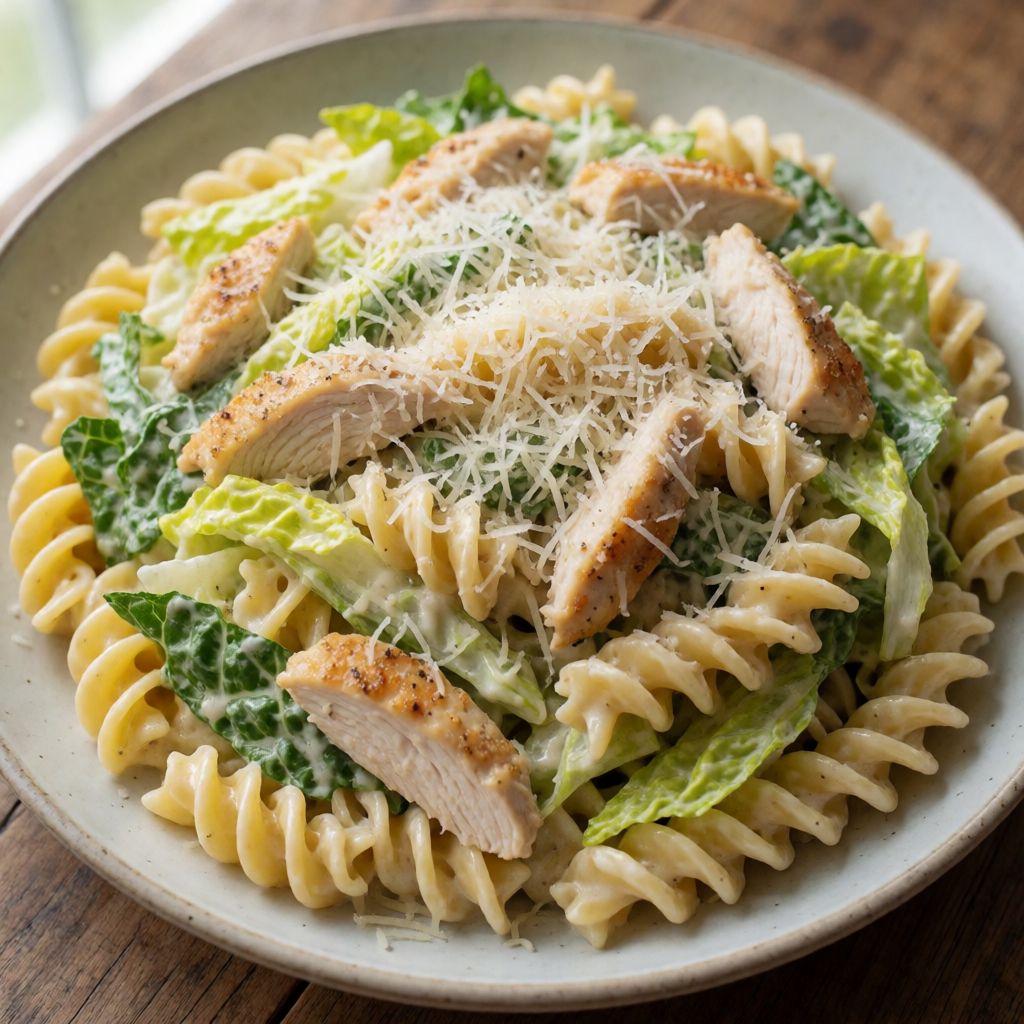
 AI photo
Chicken Caesar Pasta Salad
A hearty chicken Caesar pasta salad, combining pasta, roasted chicken, crisp lettuce, croutons and parmesan in a creamy dressing.
Labels are worked out automatically from the ingredients and can be wrong. Check the packaging if it matters to you.
Ingredients
- 400 g Chicken breast
- 25 g Plain flour
- 300 g Pasta
- 2 pcs Romaine lettuce torn into large pieces
- 50 g Parmesan
- Butter for frying
- Olive oil for frying
- Salt
- Black pepper freshly ground
- 2 pcs Bread slices
- 15 g Butter
- 2 pcs Anchovies fillets, very finely chopped
- 1 tsp Worcestershire sauce
- 75 g Parmesan
- 1 clove Garlic crushed
- 1 tsp Lemon juice
- 100 ml Mayonnaise
- 100 ml Crème fraîche













Steps
Toss the chicken pieces in flour, salt and pepper. Roast in a preheated oven at 180°C (fan) for 20 minutes.
20 minButter the bread on both sides, cut into cubes and dry out on a baking tray in the oven for 5 minutes.
5 minMeanwhile, cook the pasta according to the pack instructions.
Let the chicken cool and dice it. Drain the pasta and rinse with ice-cold water.
Mix the anchovies, Worcestershire sauce, parmesan, garlic and lemon juice until smooth. Stir in the mayonnaise and crème fraîche. Season with salt and pepper.
Put the cooled pasta in a bowl and mix with the dressing. Add the romaine lettuce. Serve with the chicken, croutons and parmesan.
This is a Caesar salad that stopped pretending to be light and became dinner. The lettuce is still there, the dressing is still built on anchovy and parmesan, but now there's pasta soaking up that dressing and chicken sitting on top, and the whole thing eats like a main course, not a starter you have before the real food arrives.
What decides whether it works is the dressing, and specifically whether you treat the anchovy as a seasoning or as a fish course. Two fillets, chopped very fine, dissolved into garlic and lemon juice until you can't see them anymore — that's the point. Some say Caesar dressing tastes "fishy." No — it tastes of salt and depth, the way Worcestershire sauce or soy sauce does, and both of those also contain anchovy, quietly. If you can see or taste the anchovy as fish, you chopped it too coarse or added too much. It should vanish and leave only a savoury backbone behind.
The second thing that decides it: temperature contrast. Hot pasta meeting cold dressing turns the sauce thin and greasy, because mayonnaise and crème fraîche split a little under heat — they loosen, go oily at the edges. That's why the pasta gets rinsed under cold water after draining. Not a hygiene step, a structural one: it stops the starch cooking any further and it drops the pasta to a temperature the dressing can actually sit on without melting.
Chicken breast, floured and roasted rather than fried, is the quiet fix here. Breast meat has almost no fat running through it, so dry heat in a pan turns it tough fast — ask anyone who's overcooked one. A light dusting of flour before it goes in the oven does two things: it seasons the surface, and it gives the meat a thin coat that holds moisture in better than bare flesh does, a bit like the skin would if you'd left it on. Dice it only once it's cool. Hot chicken cut too soon loses its juice onto the board instead of keeping it in the meat — that's not a Caesar rule, that's just meat.
The croutons: buttered bread, cubed, dried out in the oven rather than fried in a pan. This is a domestic-kitchen decision and a sensible one — you've already got the oven on for the chicken, so the croutons go in on the same heat and come out crisp without you standing over a frying pan watching for the second they catch and burn. Butter on both sides rather than oil because butter browns and smells of itself; it gives the crouton a flavour, not just a crunch. If you're out of bread that's gone slightly stale, use what you've got — fresher bread just takes a minute or two longer to dry and crisp, watch for it going from soft to properly rigid when tapped, not for a clock.
The dressing is the actual recipe; everything else is scaffolding around it. Anchovy fillets, chopped to a paste almost, are there for the same reason Worcestershire sauce is there — both carry glutamates, the savoury backbone that makes a cold, creamy dressing taste like it's been cooked rather than just mixed. Parmesan does the same job from a different angle: salt, fat, and that aged tang. If you've got a parmesan rind going spare from a Sunday roast cheese board, grate it in. No parmesan in the house — any hard, aged grating cheese with real bite works, though nothing quite matches parmesan's dryness, which is what lets it dissolve into the dressing rather than clump.
Garlic goes in crushed, not sliced, because you want it distributed through the whole dressing, not biting someone in one mouthful and absent from the next. Lemon juice cuts the richness of mayonnaise and crème fraîche, which together give you a dressing thicker and more stable than classic Caesar's raw-egg emulsion — a kitchen-safe compromise, not a cheat. If you don't keep crème fraîche, soured cream or even full-fat natural yoghurt will do the same job: something cultured and tangy to loosen the mayonnaise's density.
Romaine lettuce, torn rather than cut, because a knife bruises the leaf edge and it browns within the hour; tearing leaves a rougher edge that holds dressing better and doesn't go papery brown on the plate. Any cos-type lettuce with crisp ribs and sturdy leaves — the kind that can carry a heavy dressing without wilting into mush — will stand in. Softer lettuces like butterhead will go limp under this dressing in minutes; they're built for vinaigrette, not this.
Patience matters more than skill in this one. Let the chicken actually cool before you cut it, let the pasta actually sit under cold water until it's lost its heat, and don't dress anything until it's ready to be eaten — the croutons go soft if they sit dressed, the lettuce wilts the same way. This isn't a dish you assemble ahead and leave on the side; it's one you build at the last minute and bring to the table while it still has texture.