
 AI photo
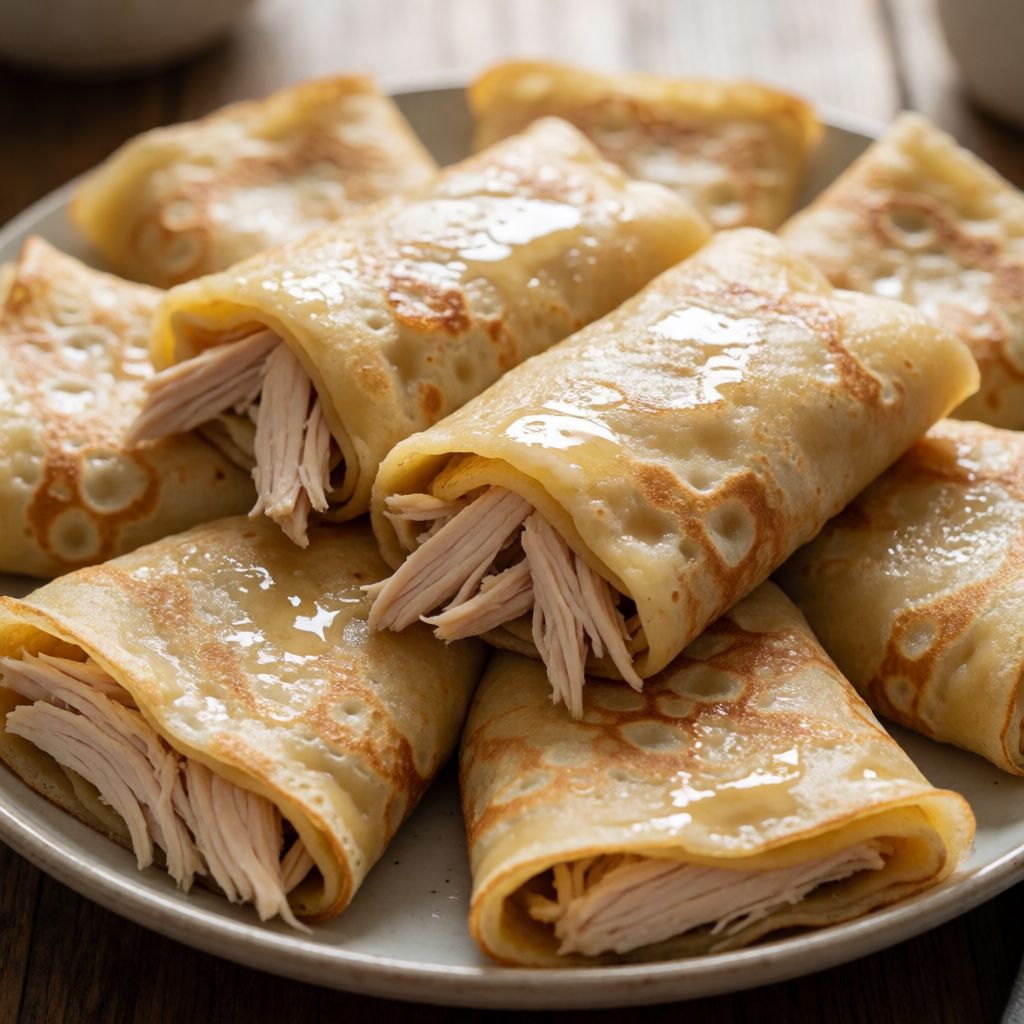
Pancakes with Chicken
Thin pancakes filled with crispy bacon, chicken and a curry-mustard sauce.
Labels are worked out automatically from the ingredients and can be wrong. Check the packaging if it matters to you.
Ingredients
- 3 pcs Eggs
- 300 ml Milk
- 1 pinch Salt
- 100 g Plain flour
- 40 g Wholemeal flour
- 1 tbsp Butter
- 100 ml Crème fraîche
- 2 tbsp Mayonnaise
- 2 tsp Curry powder medium hot
- 1 tsp Dijon mustard
- 1 tsp Sugar
- ½ pcs Lemon finely grated zest and a little juice
- 1 pinch Salt and freshly ground black pepper to taste
- 100 g Bacon
- 400 g Chicken breast cut into thin strips
- 1 tsp Paprika
- 80 g Rocket
- 60 g Spinach
- ½ pcs Cucumber
- 2 pcs Avocado
- 1 tbsp Olive oil for frying
















Steps
Whisk the eggs with the milk, add the salt and the wholemeal and plain flour to make a smooth batter
3 minMelt a little butter or add a little oil to a frying pan, pour in a very thin layer of batter and fry the pancakes one at a time on both sides until golden brown
12 minMix the crème fraîche, mayonnaise, curry powder, Dijon mustard, sugar, lemon zest and lemon juice and season to taste
2 minFry the bacon in a pan until crisp, remove from the pan and set aside on a plate
6 minAdd a little oil to the pan with the bacon fat, add the chicken, sprinkle with paprika, salt and freshly ground black pepper and fry until completely cooked through; turn off the heat and keep the chicken warm in the pan
7 minServe the pancakes with the curry sauce, rocket, baby spinach, cucumber, avocado, bacon and chicken
This is a wrap dressed up as a composed plate: thin savoury pancakes standing in for bread, filled with curried mayonnaise, bacon, spiced chicken, and a fistful of raw green things. It's a fridge-clearing dish with ambitions — the kind of thing you make on a Sunday evening when the roast is a memory and you want something that feels like effort without being effort.
What decides whether it works is the pancake itself, not the filling. You're making a crêpe, not a pikelet — thin enough to fold, strong enough not to tear when it's loaded with cucumber and avocado. Too thick and you're eating a dense carby wrapper; too thin and it splits the second you roll it. The batter needs to run across the pan like water finding its level, not sit in a mound. That's the whole test: tip the pan, see if it moves.
Some say wholemeal flour makes a pancake "heavier" and should be left out. No — it's there for flavour and a bit of structure, a nutty backbone under the eggy milk, and 40g against 100g of plain flour isn't enough to make anything leaden. What actually makes a pancake heavy is too much flour full stop, or a batter that hasn't been given a minute to let the flour hydrate — you get gluey patches instead of an even sheet.
Eggs and milk are the batter's backbone — eggs for structure and colour, milk for thinness and that faint sweetness that makes a savoury pancake taste like something rather than nothing. Whole milk gives you a better set; if you've only got semi-skimmed, it'll still work, just a shade less rich. Butter melted into the pan isn't decoration — it's there because a dry pan tears a thin batter on contact, and butter at the right heat (enough that a drop of batter sizzles the instant it lands, not before) gives you lacy brown spots instead of a pale, sticky first side. If you don't want the taste of butter, any neutral oil does the same mechanical job — sunflower, a flavourless vegetable oil — but you lose the nutty note butter gives at that heat, so it's a trade, not a free swap.
Flour: plain flour alone gives you a smoother, more elastic pancake; wholemeal alone gives you something that tears like a biscuit. Together you get a pancake with just enough give to be rolled without a note of pure white-flour blandness. If you've no wholemeal to hand, use plain throughout — you lose texture, not function.
Crème fraîche and mayonnaise are doing two different jobs in the sauce, not one job twice. Crème fraîche brings acidity and a lighter body; mayonnaise brings fat and cling, so the sauce coats the chicken rather than running off it. Drop one and you either get a sauce too thin to hold onto anything (no mayonnaise) or one too heavy and flat (no crème fraîche — full-fat Greek yoghurt is the honest substitute, it has the tang without the weight). Curry powder here isn't trying to be a curry — it's a seasoning, the same way paprika seasons the chicken rather than defining it. Medium-hot is a choice for balance: hot enough to register against the cool cucumber and avocado, not hot enough to fight the mustard and lemon. The Dijon mustard and lemon zest/juice are the sharpness that stops the sauce being just "creamy" — without them you've made a bland dip, not a dressing. Sugar is a small correction against that sharpness, not a sweetener in its own right — a pinch, not a spoonful of pudding.
Bacon is fried first and removed so its fat stays in the pan — that's the economics of the dish in miniature. You're not wasting a second pan or a second spoonful of oil; you're using what the bacon already gave you to fry the chicken, and the chicken picks up a smoked note it wouldn't get fried in plain oil. This is also why the chicken goes in cut thin: strips cook through fast in shallow fat without drying out, where a thick chunk would either stay raw in the middle or turn to rope on the outside waiting for the centre to catch up. Paprika on the chicken is colour and a mild sweetness-smoke, not heat — if you want heat, that's a different spice, not more paprika.
Rocket, spinach, cucumber, avocado: these aren't filler, they're the counterweight. Bacon fat and mayonnaise are rich; rocket's bitterness and cucumber's water content cut straight through that the way a squeeze of lemon cuts through fried fish. Avocado is the odd one — it's not sharp, it's there for a different kind of richness, a smoothness that sits between the crisp bacon and the creamy sauce rather than against them. Leave any of these out and the dish still stands, but it gets heavier and less alive with each one gone — this is where you can genuinely improvise with whatever salad leaves are in the fridge, as long as something in there is bitter and something is wet and crisp.
Patience here isn't about long cooking — nothing in this dish takes long — it's about the first pancake. It will be thick, pale, slightly wrong, because the pan hasn't found its heat and your wrist hasn't found the right amount of batter yet. Don't judge the method by the first one. By the third you'll know how thin "thin" means in your pan, on your hob, with your batter, and that's not something a timer can tell you.