
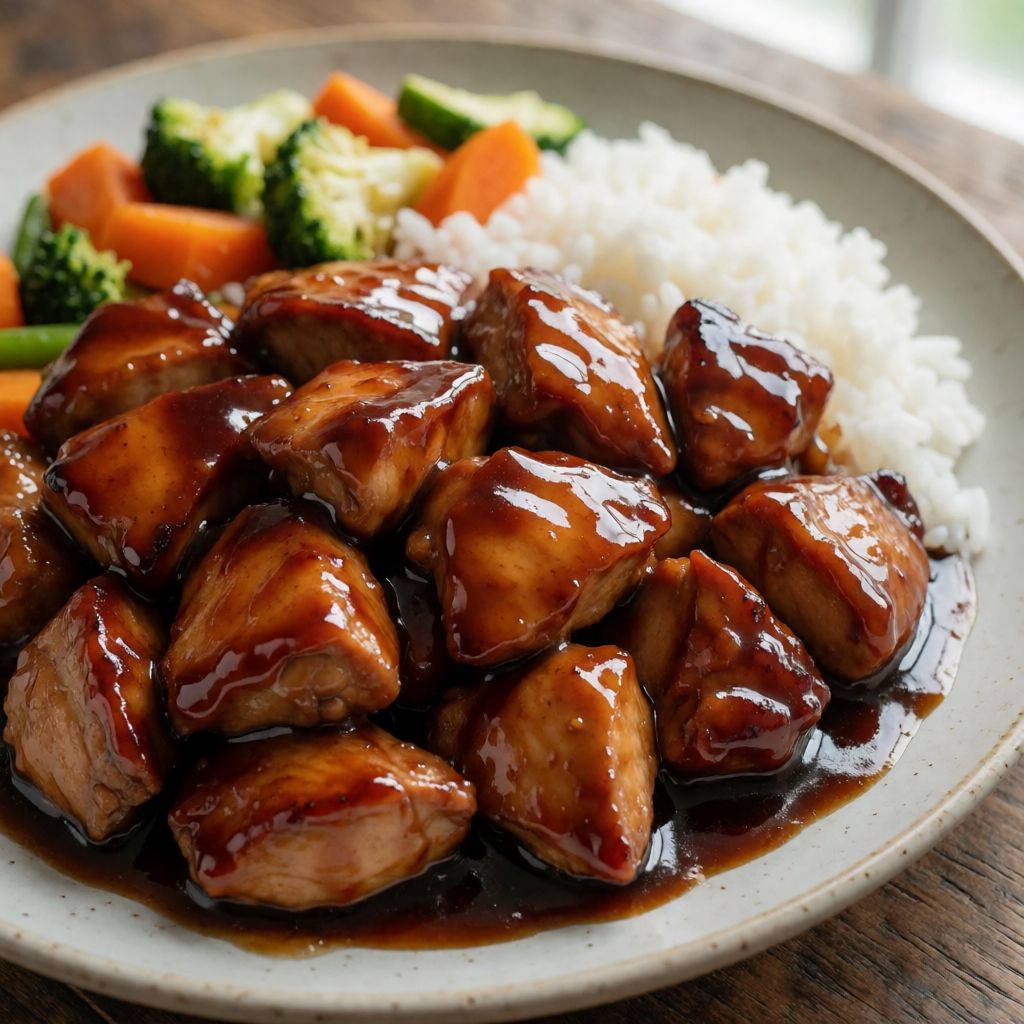
 AI photo
Teriyaki Chicken with Rice and Vegetables
A quick teriyaki chicken with rice, broccoli and edamame, finished with sesame seeds and lime wedges.
Labels are worked out automatically from the ingredients and can be wrong. Check the packaging if it matters to you.
Ingredients
- 400 g Chicken breast cut into cubes
- 6 tbsp Teriyaki sauce
- 2 tbsp Soy sauce
- 2 clove Garlic crushed
- 2 tbsp Brown sugar
- 3 tsp Cornflour
- 2 tsp Ginger freshly grated
- 2 tsp Rice vinegar
- 50 ml Water
- 1 tbsp Sesame oil
- 300 g Basmati rice
- 150 g Edamame shelled
- 1 pcs Broccoli broken into florets
- 2 pcs Spring onion sliced into rings
- 1 tbsp Sesame seeds
- 1 pcs Lime cut into wedges














Steps
Cook the rice in a pot according to the pack instructions while the chicken and vegetables are prepared.
18 minIn a bowl, mix the teriyaki sauce, soy sauce, crushed garlic, brown sugar, ginger, rice vinegar and water, sift in the cornflour and stir to a smooth marinade with no lumps.
2 minFry the chicken in a pan with oil over high heat for 3-4 minutes on all sides.
4 minLower the heat, add the teriyaki marinade and cook for 10 minutes, turning the chicken regularly, until it is golden and fully cooked.
10 minPut the broccoli florets into a pot of boiling, lightly salted water and cook for 1 minute.
1 minAdd the frozen edamame beans, stir, then drain straight away in a colander.
Arrange the rice, broccoli, edamame and chicken on shallow bowls or plates. Sprinkle with sesame seeds and spring onion and serve with lime wedges.
2 min
Teriyaki chicken is basically a glaze experiment dressed up as a dinner. The whole dish stands or falls on one thing: whether that cornflour-thickened sauce turns into a sticky lacquer that clings to the chicken, or whether it stays thin and runs off onto the rice as a puddle. Everything else — the rice, the broccoli, the edamame — is scaffolding around that glaze.
The sequence matters more than any single ingredient. You brown the chicken hard and fast first, not to cook it through, but to build colour and a bit of fond in the pan — that's flavour you cannot get back later once everything's swimming in sauce. Only then does the heat drop and the marinade go in. Some people pour the sauce in at the start to "let it soak in" — no, because the sugar in it will catch and burn before the chicken is anywhere near done, and you'll be scraping bitterness off the bottom of the pan instead of a glaze.
The cornflour is doing real engineering: raw teriyaki and soy are watery, and water doesn't cling to anything. Cornflour swells as it heats, the liquid thickens, and that thickness is what lets the sauce coat each cube of chicken instead of sliding off into a brown slick at the bottom of the pan. Ten minutes on a gentle simmer, turning the pieces, is not an arbitrary number — it's how long it takes the sauce to go from watery to glossy and for the chicken to cook through without the sugars scorching.
Chicken breast, cut into cubes, is the right cut here for a boring but accurate reason: it cooks fast and evenly in small pieces, and this dish has no time for the long, gentle rendering a thigh would want. If you've only got thigh, use it — it's actually more forgiving, since breast dries out the moment you overshoot "just cooked," and thigh doesn't punish you the same way. Cube it roughly even, because the whole glazing step assumes every piece finishes at the same moment.
Teriyaki sauce and soy sauce together aren't duplication — teriyaki is already sweetened and thickened somewhat, soy brings saltiness and backbone without extra sugar, so you're tuning sweet against salty rather than just doubling up. Garlic and ginger are aromatics, not flavour in their own right at this quantity — they perfume the sauce rather than announce themselves, which is why fresh ginger, grated, matters more than ground ginger would: ground ginger tastes dusty and one-note next to the fresh root's brightness.
Brown sugar versus white sugar: brown carries a trace of molasses, which reads as a rounder, slightly caramel sweetness against the saltiness of soy. White sugar will still work — the dish won't collapse — but it'll taste flatter, more one-dimensional sweet rather than that gentle caramel note.
Rice vinegar's job is to stop the sauce being just sweet-and-salty with nothing else going on. A splash of acid is what makes a glaze taste balanced instead of cloying — some cooks skip it thinking vinegar has no place near something sweet, but that's exactly backwards: acid is what makes sweetness taste controlled rather than sickly. If you've no rice vinegar, a squeeze of lime — which you've already got for serving — does the same job, just with a sharper edge.
Cornflour is the thickener, and sifting it into the liquid before it hits any heat is the whole trick: cornflour dropped straight into a hot pan clumps instantly and you get little gummy lumps sitting in thin sauce, which is the classic complaint people have with homemade teriyaki. Mixed cold into the marinade first, it disperses evenly, and only then thickens smoothly once heat hits it.
Basmati rice is chosen for its dryness and separate grains — it won't clump the way a shorter, starchier rice would, which matters because this dish is plated as components side by side, not stirred into a sticky mass. Any long-grain rice does the same job; what you want to avoid is a sticky sushi-style rice, which would turn the whole plate gluey against the glaze.
Broccoli and edamame get the briefest possible cooking — one minute in boiling water, then straight into a colander — because the aim is bright green and a bit of bite, not the grey-green mush that overboiled broccoli turns into. "Lightly salted water" isn't decoration: salted water seasons the vegetable itself in that one minute, where unsalted water would leave it bland no matter what sauce surrounds it. Frozen edamame goes in at the very end precisely because it only needs warming through, not cooking — it's already blanched before freezing.
Sesame oil at the frying stage is there for aroma more than for its cooking properties — it has a low smoke point and scorches if you try to sear hard in it alone, so it's really a flavour addition, used alongside a more neutral oil for the actual high-heat browning, not instead of one. Sesame seeds and spring onion at the end are texture and freshness against all that glossy sauce — crunch and sharpness against sweet and sticky. And the lime wedge isn't garnish for the photo: squeezed over at the table, it's the fresh acid hit that the vinegar in the sauce only hints at, and it wakes the whole plate up again after sitting a minute or two.