
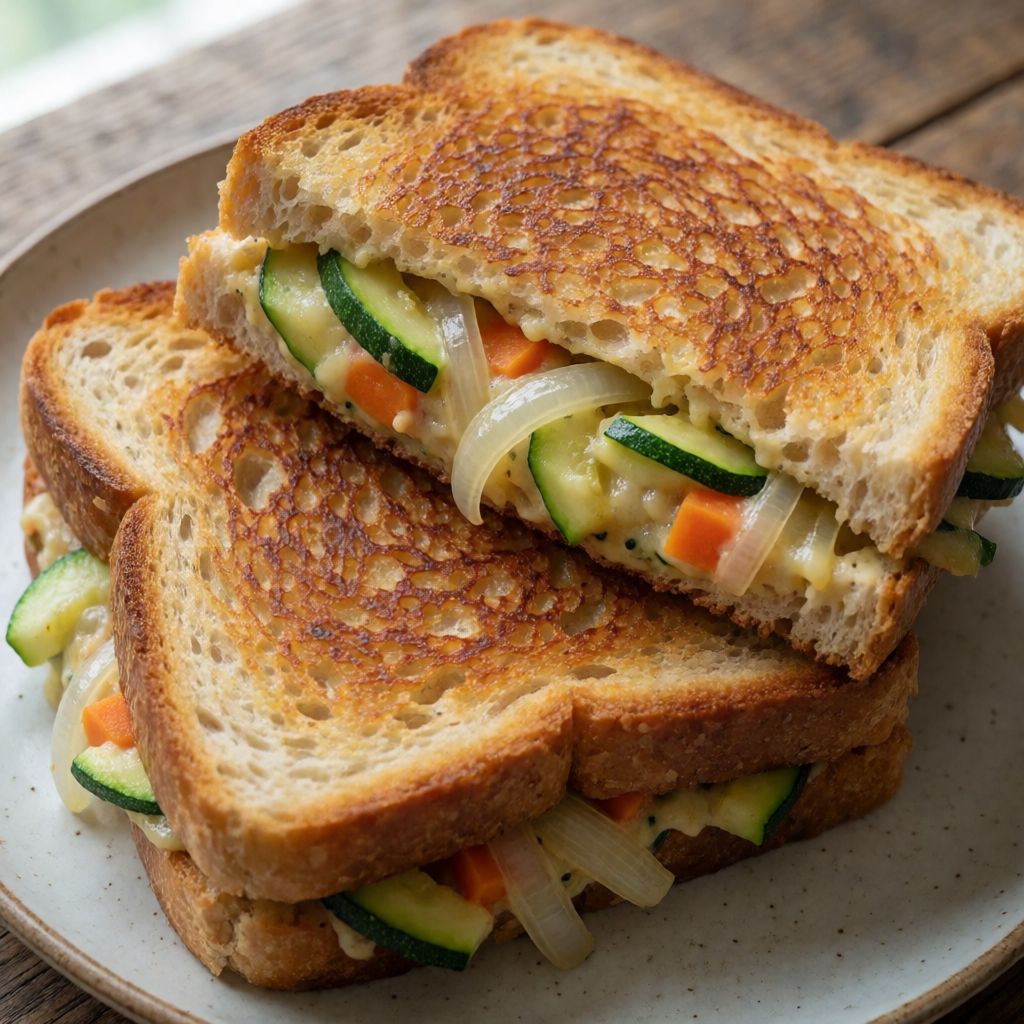
 AI photo
Vegetarian Cowboy Toastie
A hearty lentil and vegetable filling sandwiched between bread and cheddar, then toasted until crisp.
Labels are worked out automatically from the ingredients and can be wrong. Check the packaging if it matters to you.
Ingredients
- 2 pcs Onion thinly sliced
- 30 g Butter
- 1 pcs Onion finely chopped
- 100 g Courgette
- 100 g Carrot coarsely grated
- 2 clove Garlic finely chopped
- 1 tsp Dried thyme dried
- 0.5 tsp Dried rosemary dried
- 400 g Canned chopped tomatoes
- 150 ml Vegetable stock
- 150 g Black beluga lentils
- 100 ml Red wine
- 1 tbsp Cornflour
- 50 ml Double cream
- 20 g Tomato paste
- 20 g Butter for frying
- 2 tbsp Olive oil for frying
- Salt to taste
- Black pepper to taste, freshly ground
- 8 pcs Bread sliced
- 100 g Mature cheddar
- 4 tbsp Sweet chilli sauce
- 1 tbsp Parsley finely chopped

















Steps
Melt the butter in a frying pan over medium heat and add the sliced onion. Cook over low-medium heat until completely softened and starting to caramelise.
10 minTransfer the onion to a bowl and place in the fridge to cool quickly.
8 minFry the chopped onion in a pot with oil and butter for 5-7 minutes until softened.
5 minAdd the carrot, courgette, garlic, thyme and rosemary and fry for about a minute.
1 minAdd the chopped tomatoes, vegetable stock and beluga lentils. Mix the cornflour into the double cream and add it to the pot along with the red wine.
47 minStir, cover with a lid and simmer over medium-low heat for 30 minutes, then adjust the taste with tomato paste, salt and pepper and simmer for a further 15-20 minutes.
17 minSpread a little sweet chilli sauce on half of the bread slices and add a slice of mature cheddar. Spoon over the cooled spiced lentil filling and the caramelised onion, then top with another slice of cheddar and bread.
3 minToast on both sides in a toaster, in a pan with butter, or in the oven at 200°C with fan assistance for about 10-15 minutes, or until the bread is crisp and the cheese has melted.
12 min
This is two recipes wearing one coat. Underneath the bread is basically a ragù — lentils standing in for the mince, built the same way a bolognese is built, with a soffritto, wine, tomato, and a long quiet simmer. On top of that you put cheese, and then you do the thing the French call croque monsieur and the British, with characteristic understatement, call "toastie." The genius of it, if you want to call it that, is economics: lentils are a tenth the price of beef mince, they don't need browning in batches, and they hold a sauce just as well because they're starchy enough to thicken it themselves.
What decides whether this works is not the toasting — that's just heat and cheese doing what heat and cheese always do. It's the simmer. Thirty-plus minutes isn't a suggestion, it's the time it takes lentils to go from gritty to tender without collapsing into mush, and for the tomato's raw acidity to round out into something you'd call savoury rather than sharp. Rush that stage and you'll taste tinned tomato and nothing else, no matter how good your cheddar is.
The second thing that decides it: the filling must be cold, or at least properly cooled, before it goes near the bread. Hot filling against raw bread means steam, and steam means the bread goes soft on the inside before the outside's had a chance to crisp. That's the whole reason step 2 exists — it's not about the onions caring whether they're warm, it's about keeping your bread structurally honest.
Start with the onions, because they're doing something different from every other ingredient here: they're not seasoning, they're building sugar. Low heat, patience, and time turn an onion's natural sugars from sharp and volatile into deep and sweet — that's caramelisation, not just "cooking until soft." Some say you can rush this with a higher flame. No — because above a certain heat the surface sugars burn and turn bitter before the inside has softened, and no amount of stirring saves that. Ten minutes is a floor, not a target; you're watching for the onion going from pale and translucent to the colour of weak tea, soft enough that a strand bends rather than resists.
The lentils want to be black beluga specifically because they hold their shape under a long simmer — unlike red lentils, which disintegrate and would turn this into soup rather than a spreadable filling. If you don't have beluga, puy or green lentils do the same job; just know that red lentils are the wrong tool here, not a lesser version of the right one.
The soffritto — onion, carrot, courgette, garlic — isn't there for bulk. Onion and carrot are the backbone of nearly every European braise because they release sugar and body as they cook down; courgette here is softer, more water than sugar, and mostly there for volume and a bit of lightness so the filling isn't dense as a brick. Thyme and rosemary, dried rather than fresh, are doing what dried herbs always do better than fresh in a long simmer: their flavour is concentrated and oil-based, so it survives thirty minutes of heat instead of fading or turning grassy and bitter the way fresh herbs can under sustained cooking.
The wine and the tomato paste are both reduction tools — wine for acidity and a backbone note, tomato paste for concentrated umami and colour, added near the end because paste wants a short cook to lose its raw, tinny edge without losing its depth. The cornflour-in-cream trick is the one bit of kitchen chemistry worth naming: cornflour on its own, added straight to a hot liquid, clumps because the outside of each granule gelatinises before the inside's had a chance to hydrate. Mixing it into cold cream first spreads the starch out so it can thicken evenly — that's the only reason this step exists, and skipping it is how you end up with floury lumps in your sauce.
For the bread, you want something with a crumb firm enough to hold a wet-ish filling without collapsing — a proper sliced sandwich loaf, sourdough, or any close-crumbed bread. Very open, holey bread lets the filling soak through and you lose your crisp exterior entirely. Cheddar's job is salt, fat, and meltability — any firm, well-aged cheese that melts cleanly will do, though a very young mild cheddar won't give you the same sharpness against the sweet chilli sauce.
As for the toasting itself: a domestic toaster struggles with a filled sandwich this thick, and most ordinary ovens run hotter or cooler than their dial says, so 200°C with fan is a starting point, not a guarantee — go by the cheese, which should be audibly bubbling at the edges and visibly slumped, and by the bread, which should resist a light press rather than give. A frying pan with butter, lid on for a minute to help the heat get through to the middle, is honestly the most forgiving method if you don't trust your oven or your toaster slot's depth. This feeds four generously, or six if you're serving it as a starter rather than the main event — and either way, don't skip letting the filling cool; that's the one shortcut that costs you the whole point of the thing.