
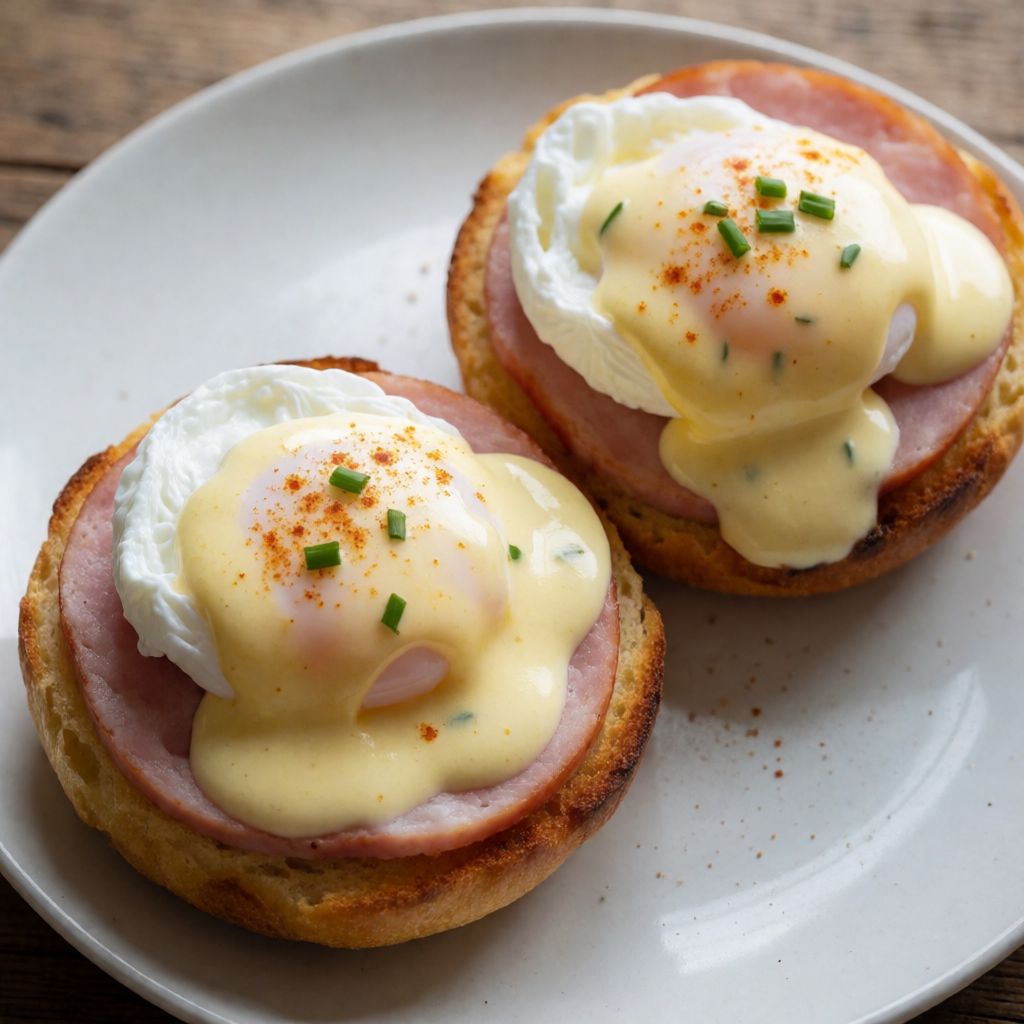
 AI photo
Eggs Benedict
A classic brunch dish of poached eggs and bacon on homemade English muffins, finished with hollandaise sauce.
Labels are worked out automatically from the ingredients and can be wrong. Check the packaging if it matters to you.
Ingredients
- 4 pcs Eggs
- 1 tbsp Apple Cider Vinegar
- 4 pcs Bacon rashers
- 1 bunch Chives finely chopped



English Muffins
- 200 ml Milk
- 15 g Yeast
- 1 tbsp Sugar
- 40 g Butter melted
- 175 g Plain Flour
- 75 g Wholemeal Flour
- 0.5 tsp Salt







Hollandaise Sauce
- 2 pcs Egg Yolks
- 140 g Butter
- 0.5 pcs Lemon juiced
- 1 tsp Dijon Mustard
- Salt to taste
- Black Pepper freshly ground, to taste




Steps
Stir the yeast and sugar into a bowl with room-temperature milk until the yeast dissolves.
Mix in the melted butter, salt and wholemeal flour, then gradually work in the plain flour until the dough is smooth and soft.
Cover the dough with a clean tea towel and chill it in the fridge for 12-18 hours.
Turn the dough out onto a surface dusted with coarse flour and flatten it to about 1 cm thick.
Cut out muffins with a round cutter about 8 cm across.
Cook the muffins in a dry frying pan over medium heat for about 10-12 minutes on each side.
If in doubt whether they are cooked through, finish them in the oven at 175°C for 5 minutes.
Melt the butter in a saucepan over low heat and pour it into a jug, leaving the whey behind in the pan and discarding it.
In a clean saucepan put the egg yolks, a little lemon juice and the Dijon mustard, and whisk thoroughly over the lowest heat.
The pan must never sit on the heat without whisking.
Pour in a little of the butter and mix well, then slowly add the rest of the butter, whisking the sauce constantly.
Season with salt and pepper and remove the pan from the heat.
Bring a pan of water to the boil and crack two eggs, each into a separate cup.
Add the apple cider vinegar to the water and reduce the heat so the water barely simmers at the edges.
Create a small whirlpool in the water with a spoon, slide one egg in, quickly gather it with a slotted spoon and let it cook for 3-4 minutes.
Serve the poached egg on half an English muffin, top with bacon or ham, spoon over the hollandaise sauce and sprinkle with chives.
Eggs Benedict is three separate small engineering problems served on one plate: a yeasted muffin that has to be bread but behave like a biscuit, a poached egg that holds its shape without a shell, and an emulsion of butter and yolk that must not turn into scrambled eggs or a puddle of grease. Get any one wrong and the dish falls apart — literally, in the case of the sauce.
The muffin is the quiet overachiever here. A 12-18 hour cold ferment is not fussiness, it's arithmetic: cold slows the yeast right down, so instead of a fast, gassy rise that leaves big ragged holes, you get a slow one that builds flavour (that faint sourness) and an even, tight crumb — the kind that doesn't shed crumbs into your hollandaise the moment you split it. Some say you can rush this with extra yeast and a warm spot for an hour. You can, but you'll get a flatter-tasting bread with the wrong texture — more sandwich loaf, less muffin. Cooking it dry in a pan rather than baking it from scratch comes from the same economics that gave us crumpets and pikelets: no home oven, a flat-top or girdle over the fire, so the bread had to cook standing up in a ring, browning on two faces only.
Flour: the split between plain and wholemeal isn't decorative. Plain flour gives structure and a soft chew; wholemeal brings bran and a bit of nutty flavour, but bran cuts gluten strands, so too much of it and the muffin won't hold its shape. If you've only got plain flour in the cupboard, use all plain — you'll lose a little flavour, not the bread.
Yeast: fresh yeast (15g here) works faster and gives a cleaner rise than dried, but if that's what you've got, halve the weight — dried is more concentrated. Either way the yeast needs sugar to wake up and milk at room temperature, not fridge-cold, not warmed on the hob: too hot and you kill it before it's started, which is the real reason recipes keep saying "room temperature" instead of a number.
Butter, melted into the dough, is there for softness and a slightly open crumb — without it the muffin toughens as it cools. In the sauce, butter is the main event: 140g for two yolks is a rich ratio, deliberately so, because this sauce is meant to coat and pool, not just glaze. Use unsalted if you can, so you control the final seasoning yourself rather than inheriting whatever the dairy decided.
Eggs do two different jobs and need two different states. The four whole eggs, poached, want to be properly fresh — a tired egg has a thin, watery white that won't gather around the yolk, it'll feather out into ribbons in the pan no matter how good your whirlpool is. The two yolks for hollandaise just need to be yolks; room temperature helps them take in the butter more evenly, so take them out of the fridge a little ahead rather than straight from cold.
Vinegar in the poaching water is a criterion, not a brand: anything mildly acidic that won't leave its own taste behind — cider vinegar, white wine vinegar, even a spoon of lemon juice — speeds up how fast egg white proteins knit together, so the egg holds its shape instead of drifting apart. Don't swap in something sharp and flavoured like balsamic; you'll taste it in the egg.
Lemon and mustard in the hollandaise aren't there to make it "lemony" or "mustardy" — in small amounts they're acid and emulsifier, nudging the yolk-and-butter mixture to hold together rather than separate, and lifting the richness so it doesn't sit heavy. If you're out of Dijon, any smooth mustard with a bit of bite works; skip the lemon only as a last resort, and expect a flatter sauce.
Bacon rashers are the British answer to Canadian back bacon, which is the traditional topping — leaner, closer to ham. Streaky or back bacon both work; just cook it until it's firm enough to hold the egg's weight without going limp under the sauce. Chives at the end are freshness and colour, nothing structural — flat-leaf parsley or even spring onion tops will do if that's what's growing on the windowsill.
Last thing worth saying plainly: this whole dish is patience wearing an apron. The muffin dough needs its 12-18 hours in the cold and there's no shortcut that doesn't cost you flavour or texture. The sauce needs you standing at the hob, whisking, not wandering off to lay the table. Eggs Benedict for four people is really four small timed operations landing on the plate together — plan the sequence, don't rush any one part of it, and the dish holds. Rush it, and you'll know exactly where it went wrong, because each part fails in its own distinct way.