
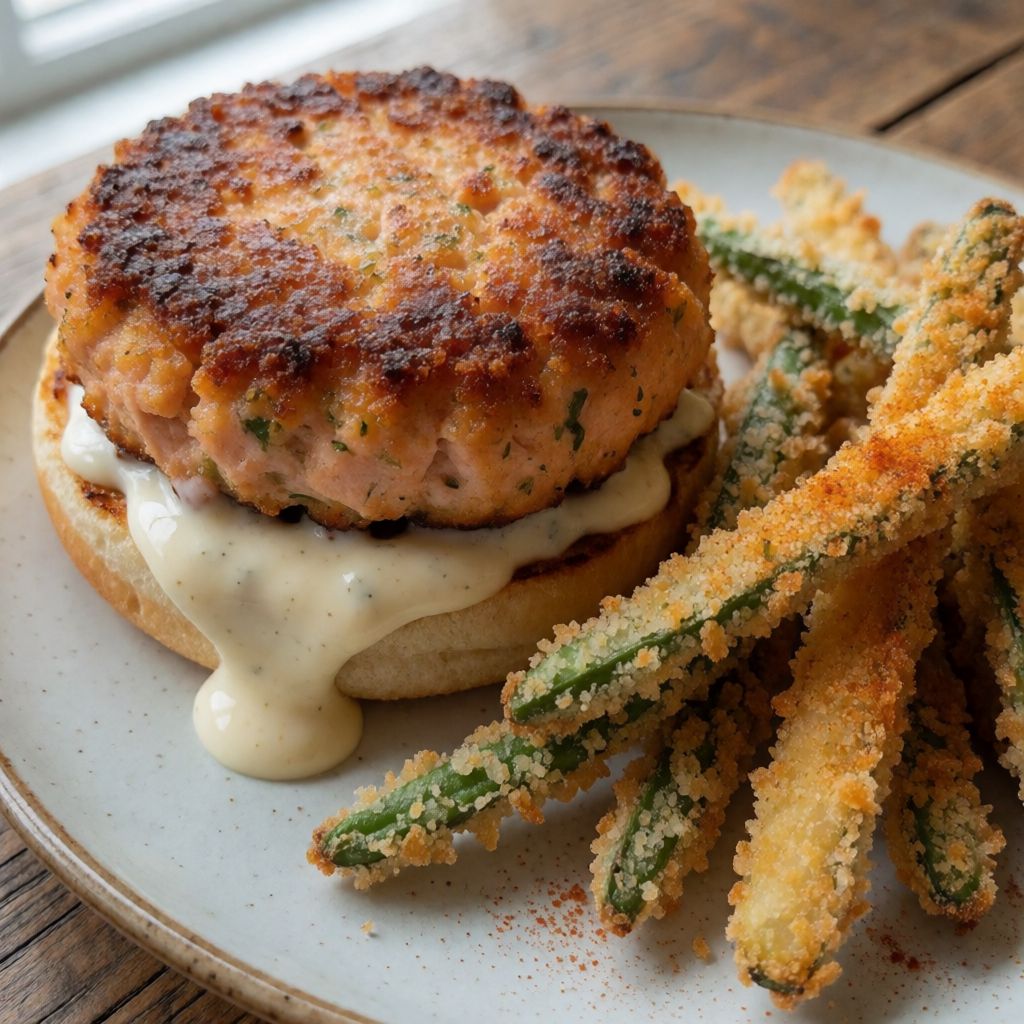
 AI photo
Asian Salmon Burger with Green Bean Fries
A fresh Asian-style salmon burger served with crispy baked green bean fries and a zingy ginger-lime dip.
Labels are worked out automatically from the ingredients and can be wrong. Check the packaging if it matters to you.
Ingredients
- 15 ml Mayonnaise
- 2 pcs Eggs
- 500 g Green beans
- 100 g Panko breadcrumbs
- 1 tsp Smoked paprika
- Salt
- 1 tbsp Red curry paste
- 1 tbsp Soy sauce
- 1 tsp Honey
- 500 g Salmon finely chopped
- 2 pcs Eggs
- 2 pcs Spring onion finely chopped
- 20 g Sesame seeds
- 1 bunch Coriander finely chopped, fresh
- 100 g Panko breadcrumbs
- 3 tbsp Sesame oil for frying
- Black pepper freshly ground
- 100 g Mayonnaise
- 200 ml Crème fraîche 18%
- 2 tbsp Fish sauce
- 2 clove Garlic crushed
- 2 tbsp Ginger finely grated
- 1 pcs Lime finely grated zest
- Black pepper freshly ground
- 4 pcs Burger bun
- 1 pcs Avocado sliced
- 80 g Rocket






















Steps
Beat the eggs with the mayonnaise in a bowl and coat the green beans well in the mixture.
Mix the panko, smoked paprika and salt in another bowl, then coat the green beans evenly in the crumb mixture.
Lay the green beans on a baking tray lined with baking paper and bake in a preheated fan oven at 190°C for about 30 minutes.
Turn the green beans a few times during baking.
Mix the curry paste, soy sauce and honey until smooth.
Add the finely chopped salmon, eggs, spring onion, sesame seeds, coriander and panko, and mix the mixture well.
Shape the mixture into firm patties.
Fry the patties in a pan over medium heat for 2-3 minutes on each side.
Turn carefully so the patties don't fall apart.
Mix the mayonnaise with the crème fraîche, fish sauce, garlic, ginger and lime zest until smooth, then add black pepper to taste.
Toast the burger buns and spread them with the Asian ginger dressing.
Place the rocket on the bottom bun, then the salmon patty and avocado, and cover with the top bun.
Serve with the green bean fries and the remaining dressing for dipping.
This is two dishes wearing one plate: a salmon patty that behaves like a burger but tastes like it wandered in from a Bangkok kitchen, and a green bean that's pretending to be a chip. Neither is complicated. What decides whether it works is restraint at two points — how fine you chop the salmon, and how hot the pan actually is when the patty goes in.
Start with the fish. "Finely chopped" is doing real work in that ingredient line — not minced to paste, not left in chunks you'd expect on a plate with lemon. You want pieces small enough to bind with two eggs and a hundred grams of panko, but still visible, still a bit of bite. Mince it in a food processor and you get a fish cake with the texture of pâté; chop it by hand with a decent knife and you get a burger that holds together and still tastes like salmon, not salmon-flavoured glue. This is the same logic behind a good kofte or a proper beefburger — the mix is only as good as the cut, never the grind.
The green beans are the oven doing the job a deep-fryer used to do, and it's worth saying why that swap works here and doesn't always. A green bean has almost no fat and very little starch, so panko on its skin crisps the moment the surface moisture cooks off — you don't need hot oil to force that, you need dry heat and time. A potato chip needs the fryer because the inside has to cook through before the outside burns. A green bean's "inside" is basically done raw. So the oven isn't a lesser version of frying here — it's the correct tool, not a compromise.
Take the patty mix in order. The curry paste, soy and honey get mixed smooth before the fish goes anywhere near them — that's not fussiness, that's because curry paste doesn't dissolve evenly into cold raw fish; it clumps, and you end up with one bite that's all chilli and three bites that taste of nothing. Stir it into a loose sauce first and every strand of salmon gets an even coat. Same principle as marinating meat: season the liquid, not the solid.
Panko, not fresh breadcrumbs, in both the coating and the patty. Panko is bread dried and flaked rather than ground — it stays hollow and craggy instead of compacting into dense crumb, so it crisps without turning into a wall of fried starch. If you've only got ordinary breadcrumbs, use them, but go lighter — fresh breadcrumbs hold more moisture and will steam rather than crisp, and a soggy coating on a pan-fried patty is the single most common way this dish goes wrong. It's not the fish that lets you down here, it's the crumb.
On heat for the patties: "medium" means hot enough that the surface sears and sets within the first minute, because that sear is what's holding the patty together, not the egg. Egg is a binder for the raw mix, not a glue once it's cooking — the structural job in the pan belongs to the crust. Too low a heat and the outside stays soft while you wait for colour, so when you flip, it falls apart; this is also why you turn it once, with a proper spatula sliding flat under the whole thing, not lifted at an edge. If your crust hasn't set, no amount of careful turning saves you — the fix is heat, not technique.
Sesame oil for frying is there for flavour, not for its smoke point, which is actually lower than you'd want for a full searing heat — so if your pan runs hot, cut it with a neutral oil, anything with no smell of its own: sunflower, groundnut, even a mild rapeseed, which is what you'll find easiest in a British shop anyway. Pure sesame oil straight into a very hot pan will bitter before the patty's cooked through, and that bitterness tastes like burnt nuts, not like a mistake you can blame on the fish.
The dressing is just mayonnaise and crème fraîche carrying fish sauce, garlic, ginger and lime zest — crème fraîche because it has enough acidity and fat to stand up to fish sauce without curdling or turning watery the way single cream would. If you haven't got crème fraîche, soured cream does the same job; Greek yoghurt will too, though it's sharper and thinner, so hold back slightly on the lime. Grate the ginger finely rather than chopping it — a coarse chop gives you fibrous threads that sit unpleasantly on the tongue; a fine grate releases the juice into the dressing and leaves the pulp behind to melt into it.
One more thing worth saying plainly: patience is an ingredient here, same as the panko or the ginger. Don't rush the green beans out of the oven because they look done at twenty minutes — the crumb needs the full stretch to go from "crisp but pale" to properly golden, and pulling them early is the difference between a fry and a bean with crumbs stuck to it. This isn't a fast dish pretending to be fast. It's a Tuesday-night burger that takes a Sunday-roast kind of attention to the details, just not the time.
Four buns, four patties, serves four — don't stretch the mix to five portions thinking you'll save some fish, because the patty-to-bun ratio is what makes it a burger rather than a fish cake on bread, and a thin patty loses the bite that makes the dish work at all.