
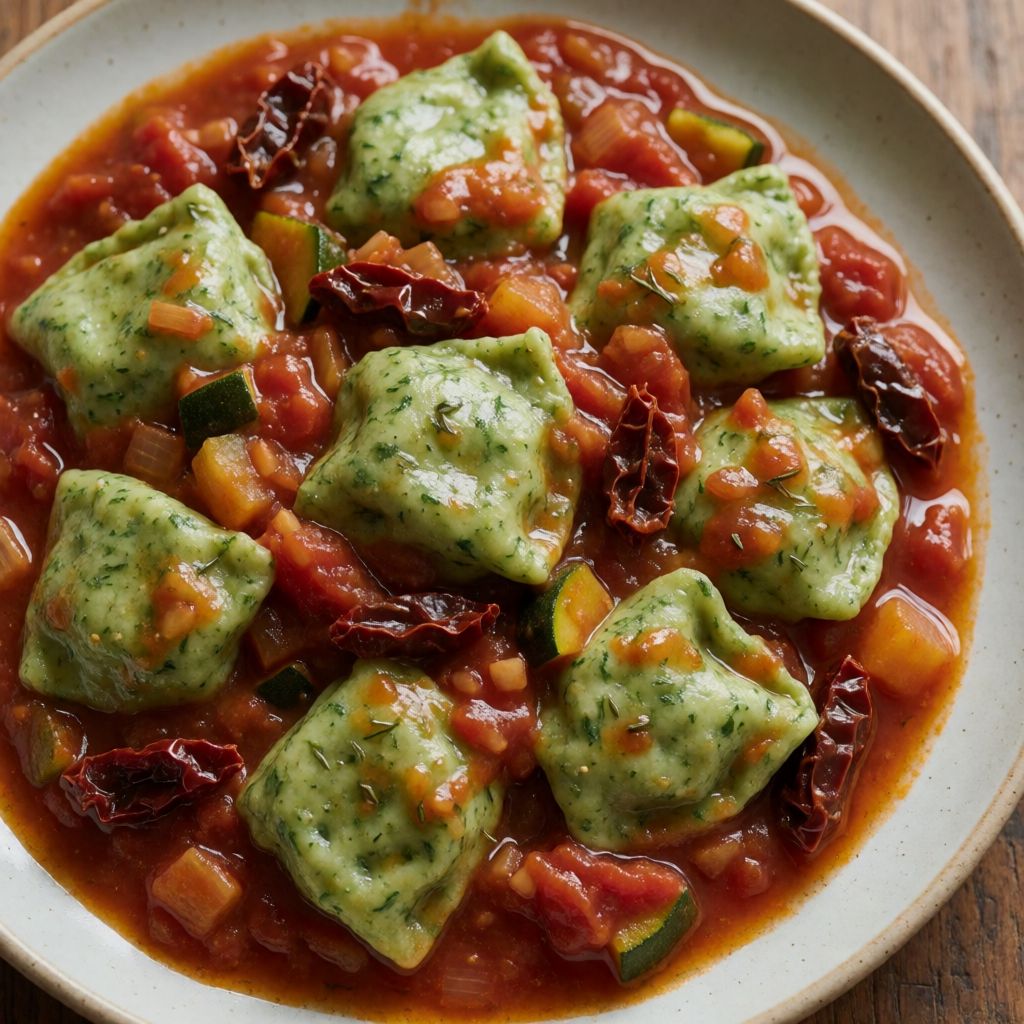
 AI photo
Spinach Malfatti in Spiced Tomato Sauce
Soft spinach and ricotta dumplings simmered in a spiced tomato sauce, finished with Parmesan and basil.
Labels are worked out automatically from the ingredients and can be wrong. Check the packaging if it matters to you.
Ingredients
- 2 pcs Onion finely chopped
- 2 clove Garlic finely chopped
- 1 pcs Courgette coarsely grated
- 800 g Chopped tomatoes tinned
- 1 tbsp Sun-dried tomatoes finely chopped
- 100 ml Vegetable stock
- 1 tsp Dried thyme
- 0.5 bunch Basil finely chopped
- 2 tbsp Olive oil for frying
- Salt
- Black pepper freshly ground
- 400 g Spinach frozen
- 2 pcs Eggs
- 125 g Plain flour
- 100 g Parmesan finely grated
- 250 g Ricotta
- 0.25 tsp Nutmeg
- Salt
- Black pepper freshly ground
- 50 g Parmesan freshly grated
- 1 bunch Basil
















Steps
Fry the onion in a saucepan with the oil until soft.
6 minAdd the garlic, courgette, chopped tomatoes, sun-dried tomatoes, vegetable stock, thyme and basil.
Simmer uncovered for 30 minutes.
30 minSeason with salt and pepper to taste.
Put the spinach into a pan of boiling water and let it boil for about a minute, until softened.
1 minDrain well in a colander and finely chop the spinach.
Put the ricotta, Parmesan, eggs, flour, nutmeg, salt and pepper in a bowl and mix to a smooth, thick mixture.
Add the mixture to the finely chopped, drained spinach and mix well.
Shape small balls and drop them into a pan of water that has just come to the boil.
Reduce the heat to medium so the water barely simmers.
Cook the malfatti for a few minutes until they rise to the surface and stay at the top.
4 minRemove the malfatti with a slotted spoon when they float, and serve in the tomato sauce with plenty of grated Parmesan and fresh basil.
Malfatti means "badly made" — and that's the whole point. Somewhere in a Tuscan kitchen, someone was rolling ravioli, ran short on pasta dough or patience, and just dropped the spinach-and-ricotta filling straight into the water on its own. No wrapper, no crimping, no arguing with dough that won't seal. What you get is a dumpling that's basically the best bit of a ravioli with none of the fuss — and it sits in a tomato sauce that's doing its own quiet work in a separate pan while you shape them.
What decides whether this works isn't the sauce — tomato, onion and garlic simmered down is forgiving, it wants to be good. It's the malfatti holding their shape in boiling water without a pasta skin to contain them. That comes down to drainage and ratio: the spinach must be squeezed properly dry, and the flour-egg-cheese mixture needs to be thick enough to hold a ball shape on a spoon, not slump off it. Too wet, and they disintegrate the moment they hit the water — you'll have spinach soup with cheese curds in it, not dumplings.
The float is your doneness cue, not a stopwatch. Raw malfatti are denser than water and sit on the bottom; as the egg sets and air gets trapped in the mix, they lighten and rise. When they're bobbing at the surface and staying there — not just passing through — they're cooked. Four minutes is a floor, not a deadline: if yours are bigger or colder from the fridge, give them longer and trust the float, not the clock.
The sauce is the easy half, built on economics as much as flavour. Tinned tomatoes exist because fresh ones are only worth cooking down for ten weeks a year in Italy — the rest of the time, tinned (picked and canned at peak ripeness) beats a pale supermarket tomato grown for shelf life, not taste. The sun-dried tomatoes aren't for texture here, they're a concentrate — a shortcut to the deep, almost umami sweetness that would otherwise need another hour of reduction. The courgette is bulk and a bit of sweetness that melts into the sauce rather than announcing itself; if you haven't got one, a grated carrot or a second onion does a similar quiet job. Simmer it uncovered — the open pan lets water evaporate, so the sauce thickens by loss rather than by flour or paste. Covered, you'd just be making warm tomato juice.
Frozen spinach is not the lesser choice here, it's the right one. Fresh spinach is mostly water held up by very little structure; blanching and squeezing fresh spinach loses you most of the volume and all of the convenience. Frozen spinach has already been through that water-loss process at the factory, so you're not fighting a mountain of leaves collapsing in your pan. The one job you cannot skip is squeezing it properly dry after boiling and draining — press it in the colander, then squeeze handfuls in a clean tea towel if you can. Every gram of water left in the spinach is a gram your flour then has to fight to bind, and that's the single most common reason malfatti fall apart in the pot.
Ricotta is the filler, Parmesan is the setter, egg is the glue, flour is the structure — know which job each one does and you know what you can swap. Ricotta needs no flavour of its own, just moisture and mildness, so cottage cheese blitzed smooth or a well-drained curd cheese works at a push. Parmesan brings salt and a savoury backbone that ricotta alone lacks — a vegetarian hard cheese of similar age and dryness substitutes fine, but don't reach for something soft and mild, it won't do the same job. Nutmeg is traditional with spinach and ricotta for a real reason, not decoration: a little warmth cuts the slight metallic, mineral note spinach can have. Go easy — a quarter teaspoon is a background hum, not a flavour.
The flour is your insurance against the whole thing dissolving in the water, so measure it rather than eyeballing — 125g against 400g spinach (post-squeeze weight) and 250g ricotta is a ratio that's been tested to hold. If your squeezed spinach is wetter than it should be, add a spoonful more flour rather than hoping; a slightly firmer mix is a small compromise, a collapsed malfatto is a lost one.
Shape the balls smaller than you think you need to — they swell a little as the egg sets and the flour hydrates further, and smaller ones cook through and float reliably rather than staying raw in the middle while the outside's done. A barely-simmering pan, not a hard boil: a violent boil knocks them against the pan sides and each other, and that's how you get broken malfatti rather than badly-made ones. "Badly made" is a name, not an instruction.
Patience is the ingredient nobody lists — thirty minutes for the sauce to actually reduce, not rush; the nerve to squeeze the spinach properly instead of giving it a token press; the restraint to drop malfatti in a few at a time rather than crowding the pan, where they'll stick to each other before they've set. None of this is difficult. It's just not instant, and pretending it is costs you the texture.