
 AI photo
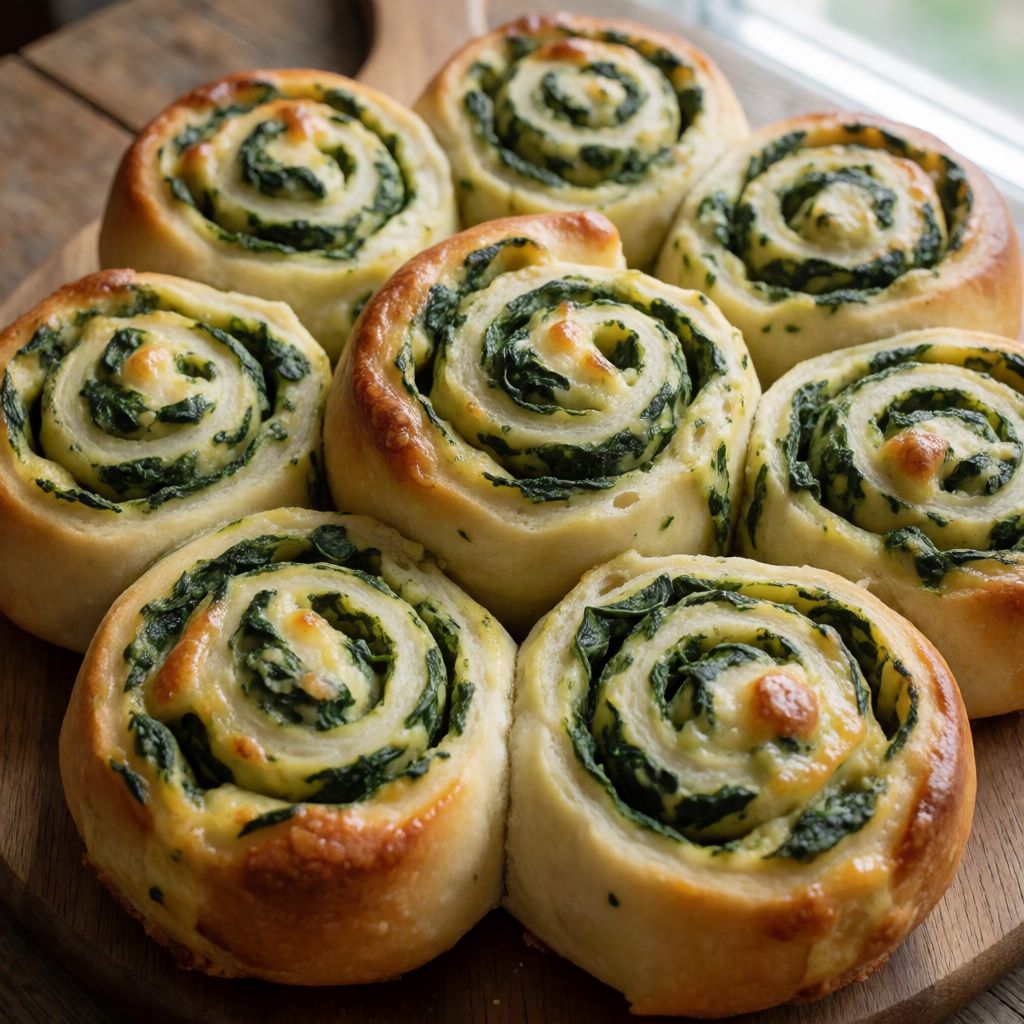
Spinach Pizza Rolls
Soft yeasted rolls filled with spinach, cream cheese and mozzarella, shaped like little pizza swirls.
Labels are worked out automatically from the ingredients and can be wrong. Check the packaging if it matters to you.
Ingredients
- 25 g Yeast
- 200 ml Water room temperature
- 150 ml Yogurt
- 1 pcs Eggs
- 1 tsp Salt
- 1 tbsp Honey
- 100 ml Olive oil
- 150 g Wholemeal flour
- 350 g Plain flour
- 1 pcs Egg for brushing
- 1 pcs Onion finely chopped
- 3 clove Garlic finely chopped
- 200 g Spinach finely chopped
- 100 g Cream cheese
- 1 tbsp Olive oil for frying
- 125 g Mozzarella finely chopped
- Salt to taste
- Black pepper to taste, freshly ground












Steps
Mix the yeast with the water.
Add the yogurt, egg, honey, olive oil, salt and wholemeal flour, mix, then add the plain flour.
Knead the dough, ideally with a mixer on medium speed, for 7-10 minutes, until soft and elastic.
Shape the dough into a ball, place in a bowl and cover with a clean towel.
Leave the dough to rise on the kitchen counter for 1 hour.
Put the onion and garlic in a pan with olive oil and fry until the onion is translucent and soft.
Add fresh or frozen spinach and stir until it wilts or settles down.
Drain off excess liquid through a sieve and return the mixture to the pan.
Add the cream cheese, season with salt and black pepper to taste.
Roll out the dough on a floured surface into a rectangle about ½ cm thick.
Spread the spinach filling and mozzarella over the dough, roll up into a log and cut into pieces about 2 cm thick.
Place the rolls on a baking tray lined with baking paper and shape them by hand into neat, round shapes.
Leave to rise for 30-45 minutes.
Brush the rolls with beaten egg and bake in a preheated fan oven at 180°C for 17-20 minutes, until golden.
Cool slightly on a wire rack.
This is a yeasted dough rolled flat, filled with spinach and cheese, cut like a cinnamon roll and baked into soft, cheesy spirals. It sits somewhere between a dinner roll and a savoury pastry — the kind of thing that disappears from a plate at a Sunday spread faster than you can refill the teapot. What decides whether it works isn't the filling, it's the dough: whether it actually rises twice, properly, with no shortcuts.
The dough has yogurt, egg, honey and olive oil in it — that's a soft, enriched dough, closer to a brioche logic than a lean bread one. Fat and sugar slow the gluten down and keep the crumb tender instead of chewy, which matters here because you want the roll to tear softly, not fight back. Wholemeal flour mixed with plain gives it some backbone and flavour without making the whole thing dense — pure wholemeal would trap too much gas and give you a heavy, flat roll.
The filling is simple on purpose: onion and garlic sweated soft, spinach wilted and then drained hard, cream cheese stirred through for body, mozzarella added raw in pieces for pull. The draining step is the one people skip and regret — spinach holds a shocking amount of water, and if you don't push it out, that water goes straight into your dough during the rise and bake, turning crisp edges into soggy ones and a light crumb into a gummy one.
Yeast first, dissolved in room-temperature water — not hot, not fridge-cold. Yeast is a living thing you're waking up gently; scald it and it dies, chill it and it sulks. Room temperature water gives it enough warmth to start working without any drama. If your kitchen is properly cold in winter, give the bowl a warm spot — near a radiator, not on one — and let time do what heat would otherwise rush.
Yogurt and egg are there for softness and a slight tang, acting a bit like a weak dough conditioner — they keep the gluten strands supple so the baked roll stays soft on day two, not biscuit-dry. Honey isn't for sweetness you'll taste; it's food for the yeast and a touch of colour in the crust when it bakes. Any mild honey works, or a spoon of sugar if that's what's in the cupboard — the yeast doesn't care about the label, only the sugar in it.
Olive oil in the dough coats the gluten strands and slows water absorption, which is why this dough ends up soft rather than chewy. Use any oil with no smell of its own if you don't have olive — a neutral vegetable or sunflower oil does the same mechanical job, though you'll lose the faint fruitiness olive oil leaves behind. Save a proper extra virgin for the pan-frying of onion and garlic if you want flavour there instead, since that's where it actually gets tasted.
The two flours split the job: plain flour brings gluten strength so the roll holds its spiral shape and doesn't collapse into a flat cinnamon-bun mess; wholemeal brings bran, which cuts the strands short and adds a slight nuttiness. Too much wholemeal and the dough struggles to trap gas — the bran is sharp at a microscopic level and nicks the gluten net, hence 350g plain to 150g wholemeal, not the other way round.
Cream cheese binds the spinach so it doesn't slide out when you slice the log, and mozzarella is there raw in pieces specifically so it melts in pockets rather than disappearing into a sauce — that's why it's added separately, not stirred into the hot spinach mixture. If mozzarella isn't to hand, any firm-ish melting cheese with little smell of its own does the job — a mild Cheddar grated works, though it'll bring more colour and a sharper edge to the taste than mozzarella's blandness.
The two rises aren't optional padding, they're the actual engine. The first hour lets the yeast build structure in a forgiving, unshaped mass. The second, shorter rise after cutting and shaping repairs the damage you just did — cutting the log deflates and tears gluten locally, and that 30–45 minutes lets each roll re-puff before the oven sets it. Skip it and you get rolls with a tight, dense bottom half and a domed, airy top — the classic sign of underproofed shaped dough. Judge it by touch, not the clock: press a roll gently, and it should spring back slowly, leaving the faintest dimple, not snap back instantly and not stay sunk.
In a UK kitchen, a fan oven at 180°C is a fair ask of most domestic ovens, but check yours runs true — many run hot by 10–15°C, and a roll that's dark brown at 15 minutes but pale underneath has been fooled by its own crust colour. Golden on top with a hollow-sounding tap, not just brown, is the real tell. These rolls are good warm from the tray on their own, but they also sit nicely alongside a Sunday roast as a bread substitute, or cut smaller as something to go with the tea rather than instead of a meal.