
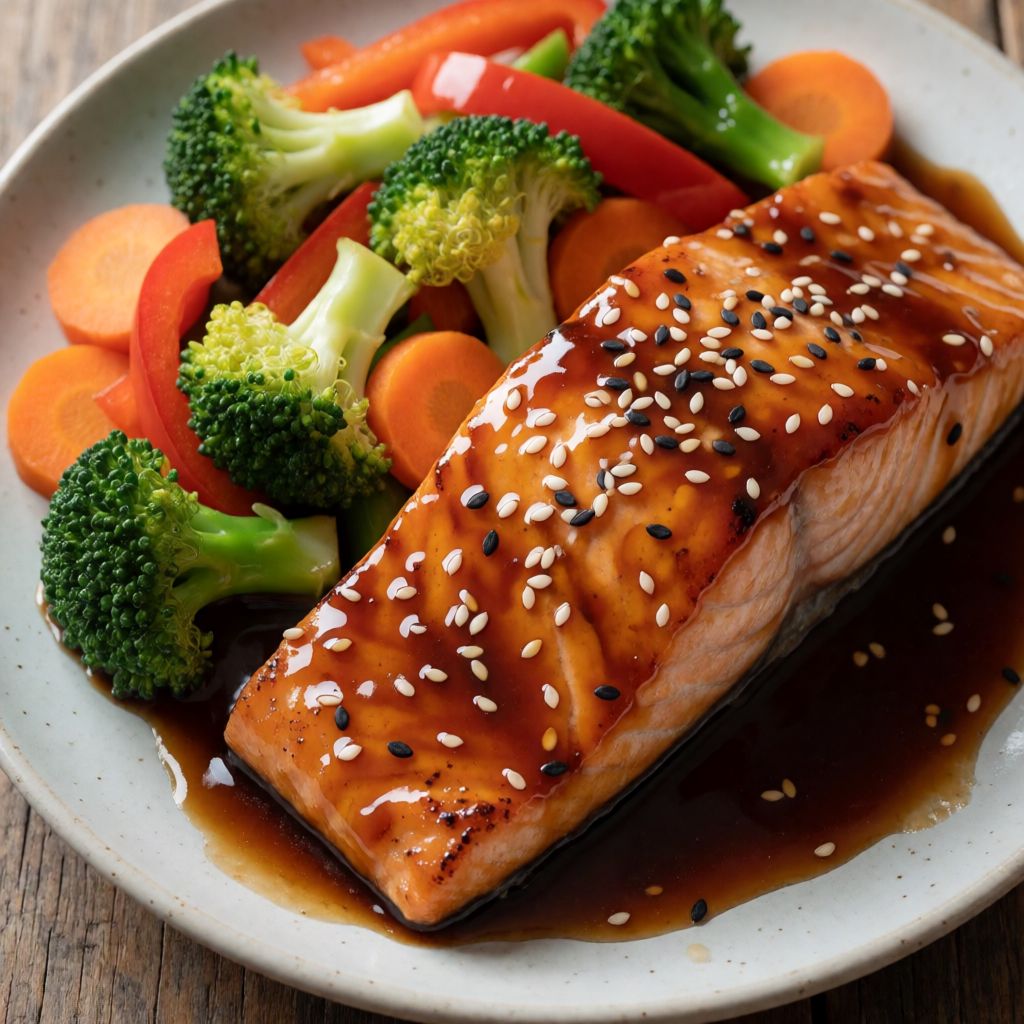
 AI photo
Teriyaki Salmon with Sesame and Vegetables
A quick teriyaki salmon with sesame seeds, stir-fried vegetables and basmati rice.
Labels are worked out automatically from the ingredients and can be wrong. Check the packaging if it matters to you.
Ingredients
- 3 tbsp Teriyaki sauce
- 1 tbsp Soy sauce
- 1 clove Garlic crushed
- 1 tbsp Brown sugar
- 1 tsp Ginger
- 1 tsp Rice vinegar
- 1 tbsp Sesame oil or another oil for frying
- 600 g Salmon cut into 2 cm cubes
- 25 g Sesame seeds
- 4 pcs Carrots cut into thin sticks
- 400 g Pointed cabbage finely shredded
- 400 g Bok choy roughly shredded
- 100 ml Stock
- 1 tbsp Red curry paste
- 1 tsp Soy sauce
- 2 clove Garlic crushed
- 1 tsp Ginger finely grated
- 2 tbsp Sesame oil
- 300 ml Basmati rice
- 30 g Sesame seeds
- 1 pcs Lime cut into wedges
- a handful Coriander fresh, or flat-leaf parsley

















Steps
Cook the rice according to the packet instructions.
Mix the teriyaki sauce, soy sauce, garlic, brown sugar, ginger and rice vinegar for the marinade.
Toss the salmon cubes in the marinade and arrange on a baking tray lined with baking paper.
Bake in a preheated oven at 175°C (fan) for 7-10 minutes, until the salmon is cooked through.
Mix the vegetable stock, curry paste, soy sauce, garlic and ginger for the sauce.
Fry the carrots, pointed cabbage and bok choy in sesame oil over medium heat until the cabbage softens.
Pour the sauce into the pan with the vegetables and mix well.
Season with lime juice.
Serve the teriyaki salmon with rice and the fried vegetables.
Sprinkle with sesame seeds and coriander or parsley before serving.
This is a weeknight plate built from two separate little engines running at once: a quick bake for the fish, a quick fry for the vegetables. They don't need each other until the very end, on the rice. Nothing here wants hours of attention — the whole thing is built on speed, so the only skill is not letting speed turn into carelessness.
What decides whether it works comes down to two moments of restraint. First, the marinade: it should coat the salmon, not cure it. Second, the vegetables: they have to fry, not stew in their own water. Both failures share one cause — too much liquid sitting too long against the food — and in an ordinary flat, with a hob that's never quite as hot as it should be, that happens more easily than you'd think.
Some say marinate the salmon longer, for 'more flavour' — no, because salmon is loose, fatty flesh, nothing like a cut of beef that needs time for salt to travel inward. The soy's salt and the vinegar's acid start working on the surface the moment they touch it. Leave it an hour and you haven't deepened anything — you've lightly cured and dried the outer layer before it ever meets the oven. The short mixing-and-tossing time in this recipe is close to where the marinade earns its keep and should stop.
The vegetables run on a parallel logic. Carrots go in as thin sticks not for looks but for timing — cut that thin, they finish roughly when the cabbage does, instead of staying raw and crunchy in the middle while the leaves have gone limp. Pointed cabbage is shredded fine because it's dense and needs the extra surface to cook through quickly; bok choy is shredded rough because its stalks are already mostly water and collapse fast — treat it like the cabbage and it turns to rag before the carrot's even bent. The real enemy at this stage isn't time, it's crowding. Pile too much into a pan that's really meant for two eggs and a rasher of bacon, and the vegetables release their water faster than it can evaporate — you get a stew, not a fry. Use the widest pan in the cupboard, and if it's still tight, do it in two batches rather than one soggy one.
The sauce — stock, curry paste, soy, garlic, ginger — goes in only once the vegetables already have some bite left in them, so it has to coat rather than simmer them into submission. The lime goes in last, off the heat, because citrus juice loses its brightness the moment it meets serious heat; add it early and you've just cooked out the one sharp note that stops the whole plate tasting sweet and flat.
Teriyaki sauce, out of the bottle, is really just soy, sugar, rice wine and a thickener, sold as a shortcut — there's no shame in that, it's the same logic as keeping a jar of mustard instead of grinding seeds every Sunday. If you don't have it, soy sauce loosened with a spoon of sugar and a splash of sherry or mirin does the same job. The brown sugar in the marinade isn't just sweetness — under oven heat it caramelises on the surface of the salmon, which is where that gloss and slightly darker edge come from; that's also why the tray is lined with paper, because caramelised sugar bonds to metal like glue and you don't want to be chiselling your tray afterwards.
Sesame oil does two jobs here and, strictly, shouldn't do both. The toasted kind is aromatic but scorches and turns bitter quickly, so if you're frying the vegetables in it on real heat, use a light hand or cut it with a flavourless oil — sunflower, groundnut, anything with no smell of its own — and save the pure sesame oil as a finishing drizzle, where its aroma actually survives. The sesame seeds do a similar double duty: toasted in the pan they're a base note, scattered raw at the end they're texture and a last hit of nuttiness.
For the salmon itself, look for a cut with visible fat marbling rather than a very lean, pale piece — at this speed and this heat, fat is what keeps the inside from drying out before the surface has coloured. Garlic and ginger appear crushed in the marinade, where you want a quick, juicy contact, and grated in the sauce, where you want them to disperse evenly rather than sit in clumps. The red curry paste is doing exactly what it sounds like it's doing — borrowing from Thai cooking to punch up a Japanese-leaning sauce — there's no tradition being honoured here, just flavour being borrowed where it's useful, and any chilli-garlic paste you have in the fridge door will stand in for it. Coriander on top is the classic finish, but a good third of people genuinely taste soap in it rather than herb — that's not fussiness, it's genetics — so flat-leaf parsley is a fair swap, not a compromise.