
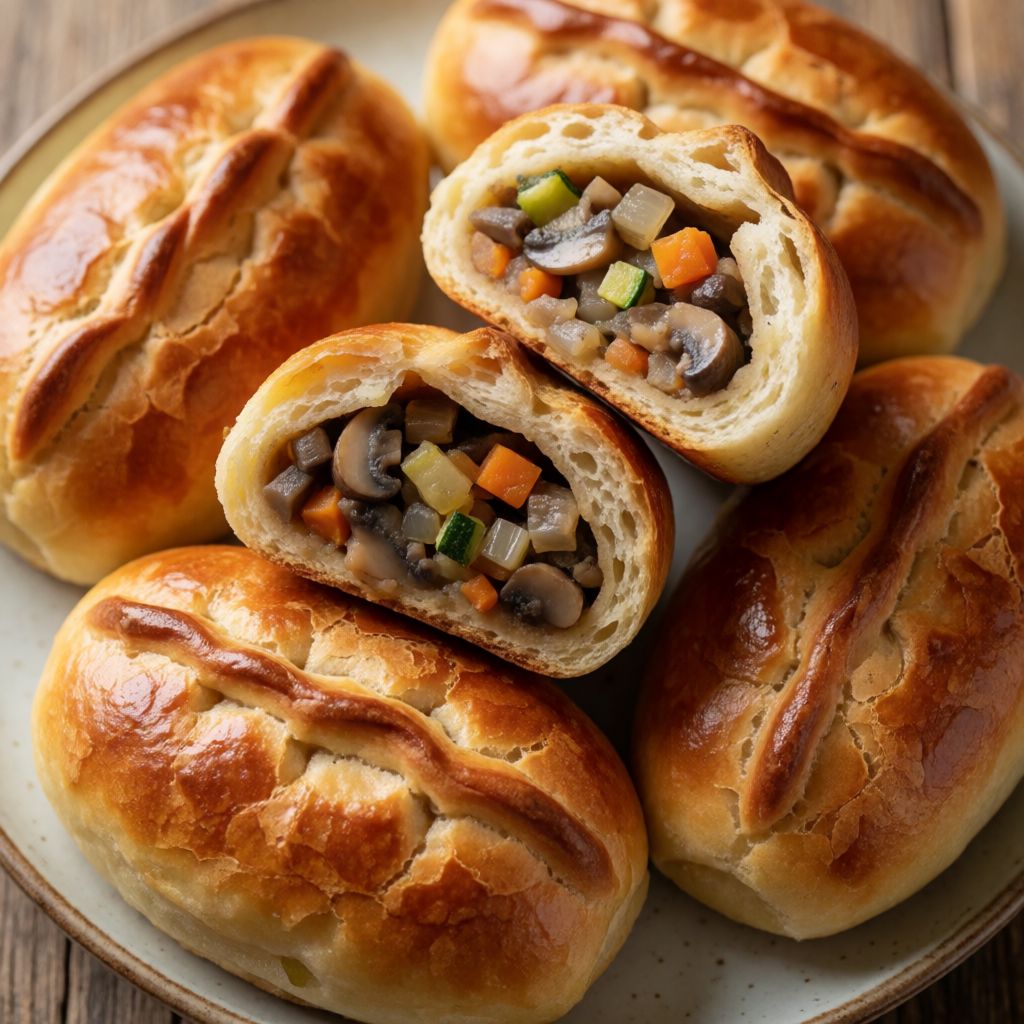
 AI photo
Vegetarian Pirozhki
Soft yeasted buns filled with a savoury mushroom and vegetable filling, sealed and baked until golden.
Labels are worked out automatically from the ingredients and can be wrong. Check the packaging if it matters to you.
Ingredients
- 1 pcs Onion finely chopped
- 150 g Mushrooms very finely chopped
- 2 pcs Carrots coarsely grated
- ½ pcs Courgette coarsely grated
- 1 pcs Celery stick coarsely grated
- 2 clove Garlic finely chopped
- 1 tsp Paprika
- 1 tsp Cumin
- 100 g Tomato purée
- 1 tsp Olive oil for frying
- Salt
- Black pepper freshly ground
- 300 ml Milk
- 25 g Yeast
- 1 tbsp Caster sugar
- 475 g Plain flour
- 50 g Butter
- 1 pcs Egg beaten, for glazing
- ½ tsp Salt for sprinkling
- ½ tsp Dried thyme for sprinkling















Steps
Fry the onion in the oil in a pan for a few minutes over medium heat, stirring, until soft.
5 minAdd the mushrooms, celery, carrots, courgette, chopped garlic, tomato purée, cumin and paprika.
30 minSimmer over medium heat for 30 minutes uncovered, stirring occasionally; raise the heat if the filling has too much liquid.
30 minSeason with salt and pepper.
If the filling is too wet, drain it through a sieve set over a clean bowl (the drained liquid can be used for vegetable stock).
Put the filling in the fridge to cool completely while you make the dough and before assembling the pies.
Dissolve the yeast in room-temperature milk.
Add the sugar, salt and gradually the flour, in small portions, until the dough is soft and elastic enough to knead.
Knead the dough with a mixer for 5 minutes on low speed.
5 minCut the butter into cubes, add to the dough and knead for a further 10 minutes on medium speed.
10 minLet the dough rise in a bowl under a towel on the kitchen counter for 1 hour.
60 minDivide the dough into 14 equal pieces.
Roll out each piece into a circle with a rolling pin, place the cooled filling in the centre and fold the circle in half.
Brush the edge of the dough with water and crimp it all round with a fork.
Place the shaped pies on a baking tray and let them rise for a further 15 minutes.
15 minBrush with the beaten egg, sprinkle with flaked salt and thyme and bake in the oven at 175°C fan for about 16–20 minutes.
18 min
A pirozhok is a bread roll that's decided it wants to be a meal. Soft yeast dough wrapped round a vegetable filling that's been cooked down hard before it ever meets the dough — that order is the whole point. This isn't a pie where raw filling cooks inside pastry; here the vegetables do their cooking in a pan, lose their water, concentrate their flavour, and only then get tucked into dough that's never going to see liquid filling again. Skip that logic and you get soggy, split-bottomed buns instead of something you can eat with your hands on a bus.
What decides whether it works is moisture, twice over. First in the filling — mushrooms and courgette are mostly water, and if you don't drive that off in the pan, it ends up in the dough, and dough does not want extra water once it's already been measured against the milk. Second in the dough itself — this is an enriched yeast dough, closer to brioche than to bread, and the butter worked in late is what gives you a crumb that's soft rather than chewy, the kind that stays good the next day instead of turning to a brick.
"Some say filling must be hot when you wrap it" — no, because hot filling steams the dough from inside while it's trying to rise, and a wet patch in raw dough never fully proofs; it stays gummy even after 20 minutes in the oven. The filling goes into the fridge not for tidiness but because cold filling doesn't fight the yeast.
Onion first, alone in the pan, because onion needs a head start — everything that goes in after it is either wetter (courgette, mushrooms) or tougher (carrot, celery) and would stop the onion from softening properly if they all went in together. You're not browning it hard, just taking it from sharp and raw to sweet and translucent — the colour tells you, not a clock.
Mushrooms chopped very finely matter because mushroom is nearly all water trapped in cell walls; the finer the cut, the faster that water escapes into the pan where you can boil it off, rather than staying locked inside and leaking out later into your dough. The carrot, courgette and celery are grated coarsely instead of chopped for the opposite reason — you want texture to survive the simmer, not vegetable mush. Thirty minutes uncovered is the real engine of this filling: uncovered because a lid traps steam and you'd just be reheating water, not losing it. If after that the pan still looks like soup, raise the heat — don't add more time at a gentle simmer, you'll just overcook the vegetables waiting for water that won't leave at low temperature.
Tomato purée here isn't for acidity so much as body — it gives the filling something to cling to once it's reduced, so it holds together in a spoonful instead of falling apart. Paprika and cumin are the only spices, which tells you this filling is meant to taste of itself, not of a spice cupboard — any single warm spice you like could stand in, but don't stack three or four or you'll lose the vegetables under them.
If, even after the simmer, the filling is still too loose — sieve it. That drained liquid isn't waste, it's vegetable stock, concentrated exactly the way you'd want it for a soup base later. This is just good economics: nothing here with real flavour gets thrown away.
The dough is a milk dough — 300ml milk to 475g flour, enriched with 50g butter and an egg only for the glaze, not inside. Yeast dissolved in room-temperature milk, not warm, not hot: yeast is a living thing and heat above body temperature kills it faster than it feeds it — "some say warm milk wakes the yeast up better" — no, because warm here easily tips into hot in an ordinary kitchen with no thermometer in hand, and dead yeast doesn't rise twice as fast, it just doesn't rise. Room temperature is slower but it's reliable, and reliability beats speed when the alternative is flat pirozhki.
Butter goes in after the first knead, not before, because a dough that's already built some gluten structure can take on fat without the fat coating the flour and stopping gluten forming at all — add butter too early and you get a dough that tears instead of stretching. Ten minutes on medium speed after that is doing real work: this is what makes the final crumb soft rather than dense, and there's no shortcut for it by hand in a home kitchen unless you're prepared to knead far longer than ten minutes and accept it won't be quite as even.
The hour's rise on the counter under a towel is patience as an ingredient, plainly: you can't rush fermentation, and a dough forced to prove in a warm oven "to speed things up" will often overproof unevenly, giving you some pies with big air pockets and others dense. A towel instead of clingfilm is enough — you're stopping a skin forming on top, not sealing anything.
Butter is here for softness and a particular dairy flavour that no oil replicates in enriched dough — if you had none, you'd move toward a plainer bread-like result, which isn't the same pirozhok but isn't a failure either. Olive oil for frying the vegetables, meanwhile, is doing nothing but carrying heat — any neutral oil with no smell of its own does the same job; you'd only reach for a fruity olive oil if you wanted its flavour sitting under the vegetables, which here you don't, since the spices are doing that work.
The second rise, just 15 minutes once shaped, is short on purpose — it's not meant to double the dough again, only to relax it after the stress of rolling and crimping, so the pies don't look taut and tear in the oven. Crimping with a fork after wetting the edge isn't decoration — it's a seal, and a filling this reduced and dry won't leak much even if the seal isn't perfect, which is another reason you cooked the moisture out of it in the first place. Egg wash gives colour and a bit of shine; flaked salt and thyme on top are there because a soft enriched dough, left plain, tastes a little flat on the crust, and a pinch of salt right at the surface wakes it up far more than salt mixed into the dough ever could.