
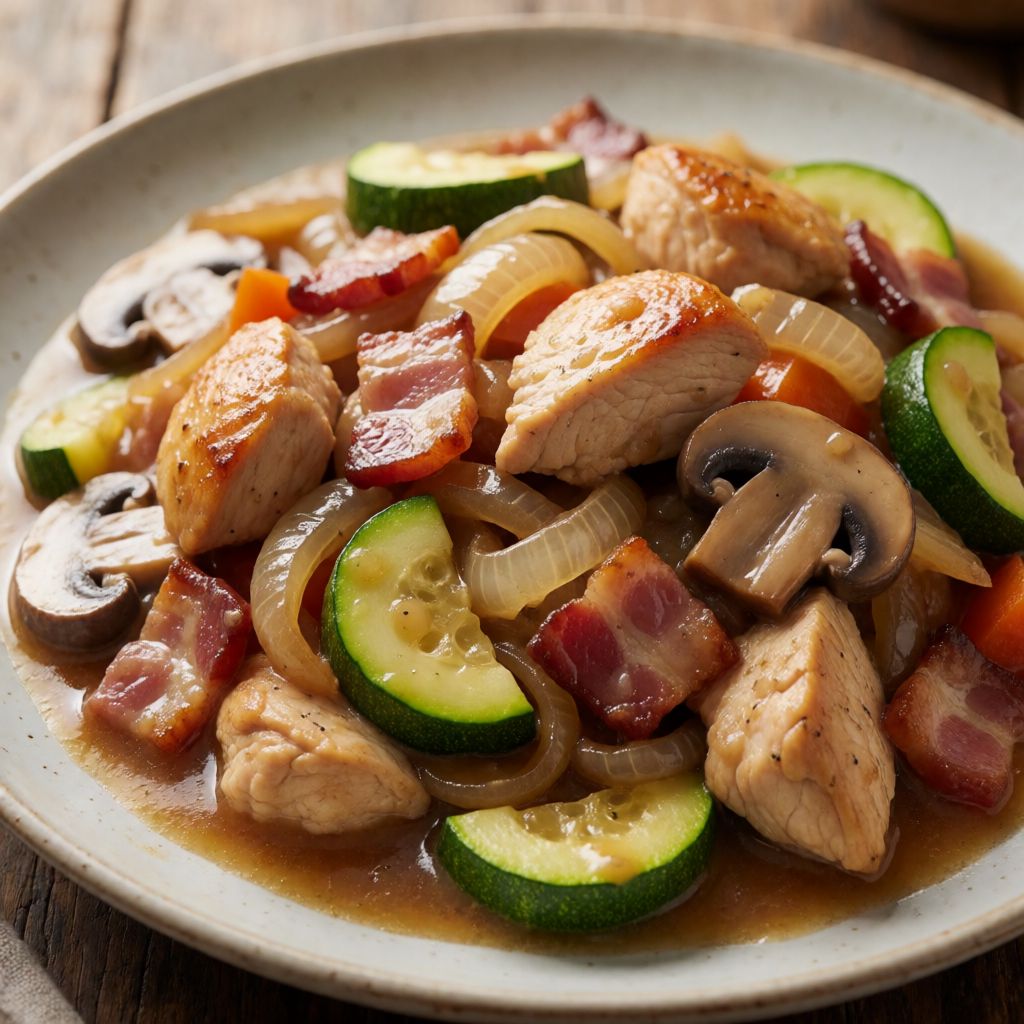
 AI photo
Viking Stew
A hearty bacon, chicken and mushroom stew finished with cream and served over rice.
Labels are worked out automatically from the ingredients and can be wrong. Check the packaging if it matters to you.
Ingredients
- 5 pcs Bacon rashers
- 250 g Mushrooms quartered
- 400 g Chicken breast diced
- 2 pcs Onion finely chopped
- 3 clove Garlic finely chopped
- 300 g Courgette coarsely grated
- 150 g Frankfurter sausages sliced
- 1 tsp Smoked paprika
- 2 tsp Paprika
- 1 tsp Oregano dried
- 1 tbsp Plain flour
- 200 ml Stock
- 100 g Tomato paste
- 400 g Canned chopped tomatoes
- 2 pcs Bell pepper finely diced
- 150 ml Double cream
- Salt to taste
- Black pepper to taste, freshly ground
- 300 ml Basmati rice cooked according to packet instructions
- 1 bunch Parsley roughly chopped




















Steps
Fry the bacon until crisp in a sauté pan or casserole dish. Set aside on kitchen paper.
Add oil and fry the mushrooms and chicken over high heat, stirring, until golden.
Lower the heat, add the onion and garlic and cook until the onion softens. Chop the bacon more finely and add it with the courgette, sausages, smoked paprika, paprika and oregano. Stir together.
Mix the flour with the stock, then add it with the tomato paste and chopped tomatoes. Cover and simmer the stew for 15 minutes. Meanwhile, cook the rice according to the packet instructions.
15 minAdd the finely diced pepper, then season with the cream, salt and freshly ground black pepper.
Serve with the rice, scattered with the chopped parsley.
What was changed
The whipping cream was swapped for Double cream, the cream British shoppers normally use.
"Viking Stew" has nothing to do with Vikings — it's a name that sells, not a history lesson. What you're actually making is a bacon-and-tomato stew padded out with three kinds of meat and a vegetable (courgette) that's there to disappear into the sauce, not to be noticed. It's a fridge-clearing dish dressed up with smoked paprika, and once you see it that way, the whole thing makes more sense.
What decides whether it works is the order you build flavour in, not the list of what goes in. Bacon fat first, then the chicken and mushrooms seared hard in it, then the aromatics softened down — each stage leaves something behind in the pan that the next stage picks up. Skip a stage or do them in the wrong order and you get meat and vegetables that taste of themselves, sitting in a red sauce, instead of a stew that tastes of the whole pan.
The other thing that decides it: don't crowd the chicken and mushrooms when you brown them. A domestic hob doesn't have the power of a professional burner, and a crowded pan drops its heat the moment the ingredients go in — you get grey, boiled-looking chicken releasing water instead of chicken that's actually taken on colour. If your pan is small, do it in two batches. Patience here is an ingredient, same as the paprika.
Bacon is the base, not a topping. You fry it first for its fat, which is actually smoked pork fat doing the job that lard or dripping did for your grandmother's cooking before bottled oil was cheap and everywhere. Frying it to crisp and setting it aside, then chopping it back in later, means you get both: a flavoured fat to cook everything else in, and crunchy bits of bacon scattered through the finished stew instead of soft, flabby rashers that went soggy the moment they hit tomato. Some say bacon should go in whole and stay in — no, because rashers left whole in a wet stew just steam, they never crisp twice.
The chicken breast is diced small on purpose, because breast meat has almost no fat of its own and dries out if you give it time it doesn't need. It goes in with the mushrooms over a high, searing heat — not to cook it through, just to colour the outside before it joins the long simmer later. Mushrooms quartered, not sliced, so they hold shape and release their water into the fat rather than drowning instantly; quartered mushrooms in a hot, ungreasy-enough pan will brown at the edges before they go limp. If your mushrooms are watery and the pan is crowded, they'll boil in their own liquid and you'll get grey mushrooms — not a disaster, just not what you paid the paprika for.
Onion and garlic go in once the heat drops, because garlic burns in seconds at searing temperature and turns bitter — that's the defect you're avoiding, not just "don't let it go brown". You're looking for the onion to turn soft and translucent, going from sharp white to a gentler, almost sweet look; that's doneness you see, not a clock you watch. The courgette is grated coarsely and added raw at this stage specifically so it melts into the sauce over the long simmer rather than staying in crunchy batons — it's there as body and moisture, not as a vegetable you're meant to bite into and recognise.
Flour mixed with the stock before it goes in, not flour dusted into the pan — that's the whole trick to a smooth, not-lumpy sauce. Flour thrown straight into a hot, fatty pan clumps the second it meets liquid; mixed first into cold stock, it disperses evenly and thickens gently as everything simmers. Tomato paste and canned tomatoes are the acid and the body of the sauce — tinned tomatoes work better here than fresh ones out of season, because British supermarket tomatoes in winter are mostly water and no flavour, and tinned ones were picked ripe and cooked down at the factory, which is exactly what you want in a stew that simmers.
Smoked paprika and plain paprika are doing two separate jobs, not one job twice — smoked paprika brings a dried, fire-and-wood note that no amount of fresh pepper gives you, and plain paprika is there mostly for colour and a gentler pepper warmth underneath it. If you've only got one, use the smoked and use less of it — it's the stronger of the two, and more forgiving to dose down than to fake with the sweet kind.
The cream goes in dead last, off anything resembling a hard simmer, because cream and vigorous heat split — the fat separates from the liquid and you get little grease pools instead of a glossy sauce. Stir it in, let the residual heat warm it through, and that's it. If you don't have double cream, use something with enough fat to survive gentle heat — crème fraîche works, single cream doesn't, it hasn't got the fat to hold together. Rice needs no special treatment here; it's there to carry sauce, cooked however the packet tells you, and the parsley at the end is freshness against a stew that's been simmering and doesn't have much green left in it by the time it's done. This feeds four — a normal weeknight portion, not a Sunday roast's worth of ambition, which is rather the point of a dish that uses up bacon ends, a stray pack of frankfurters and whatever vegetables are going soft in the drawer.