
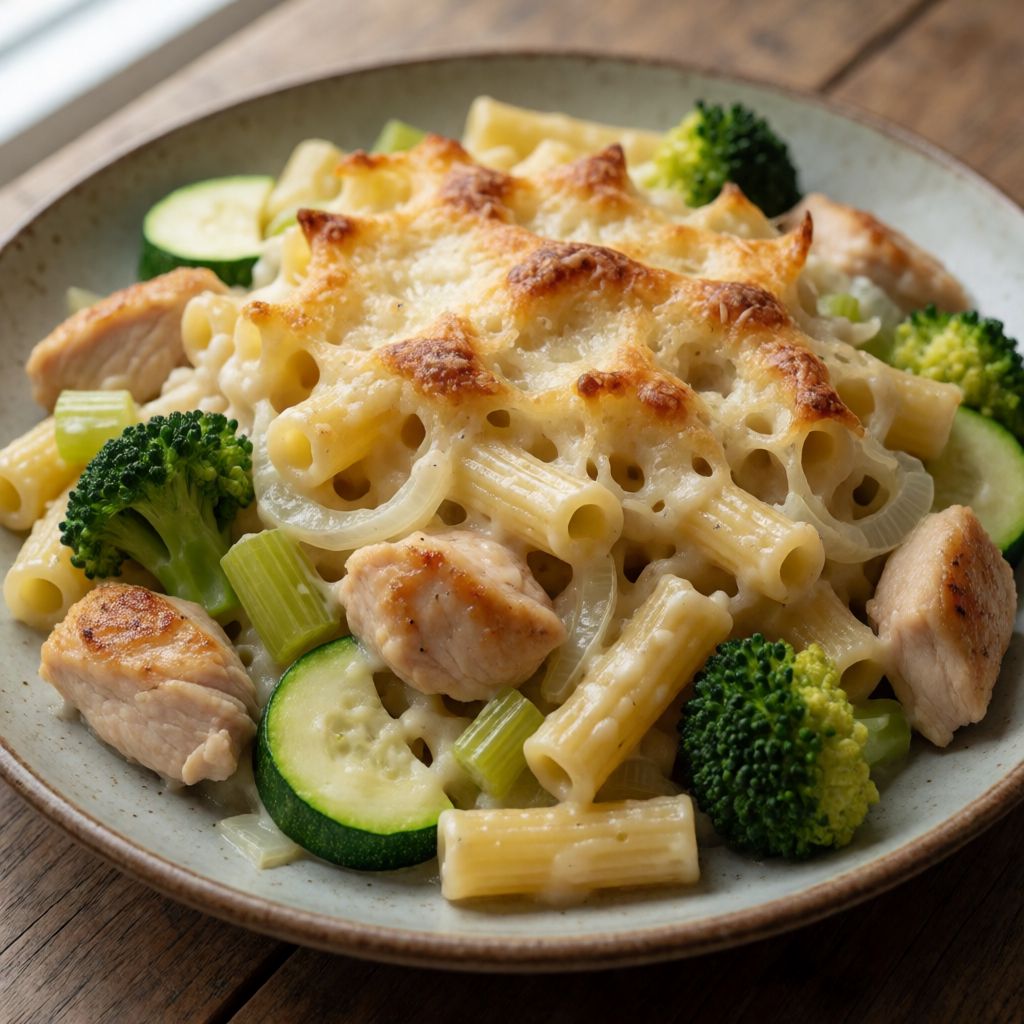
 AI photo
Baked Pasta with Chicken and Vegetables
A comforting baked pasta with chicken, courgette, celery and broccoli in a creamy cheese sauce.
Labels are worked out automatically from the ingredients and can be wrong. Check the packaging if it matters to you.
Ingredients
- 400 g Chicken breast diced
- 1 pcs Onion finely chopped
- 3 clove Garlic crushed
- 2 pcs Courgette coarsely grated
- 3 pcs Celery coarsely grated
- ½ pcs Broccoli broken into small florets
- 500 g Pasta
- 200 g Tomato halved
- 80 g Spinach
- 1 bunch Basil fresh
- Salt to taste
- Black pepper to taste, freshly ground
- 15 g Butter
- 25 g Plain flour
- 200 ml Milk
- 120 g Mozzarella fresh
- 75 g Parmesan freshly grated
- 40 g Breadcrumbs
- 50 g Parmesan freshly grated


















Steps
Heat a sauté pan with oil and quickly fry the chicken, stirring constantly, until golden.
4 minReduce the heat and fry the onion and garlic with the chicken until the onion softens.
3 minAdd the courgette, celery and broccoli and mix well.
4 minBoil the pasta in salted water until it is 2-3 minutes short of fully cooked.
3 minDrain the pasta over a bowl, keeping the water for the sauce.
1 minPour 200 ml of the pasta water into the pan with the chicken and bring the sauce to the boil.
Let the sauce simmer gently for 5 minutes while you make the cheese sauce.
5 minMelt the butter in a pan and whisk in the flour for the cheese sauce.
2 minPour in the milk, whisking, then add the mozzarella and Parmesan.
2 minStir the cheese sauce until it is creamy and smooth, season with salt and pepper and remove from the heat.
2 minMix the pasta into the pan with the vegetables and chicken.
1 minAdd the cherry tomatoes, spinach and basil and season well with salt and pepper to taste.
1 minSpoon half the pasta mixture into a greased ovenproof dish, then half the cheese sauce, then the rest of the pasta and sauce.
2 minMix the breadcrumbs with the grated Parmesan and sprinkle evenly on top.
1 minBake in a preheated fan oven at 190°C for 15 minutes.
15 min
This is a one-dish compromise: a pasta bake that borrows the logic of a roast dinner — meat, veg, a sauce to bind it, a crust on top — and squeezes it into an oven dish instead of three separate pans. What decides whether it works isn't the oven at all. It's what happens before the oven: how far you cook the pasta, how you make the two sauces meet, and whether the vegetables still have some bite left when everything goes in the dish.
Start with the chicken going in hard and fast, into a pan that's actually hot — you want the surface to seize and colour, not weep grey liquid and steam. That's the whole point of "quickly, stirring constantly": a crowded pan or a timid heat turns frying into poaching, and poached diced chicken in a bake goes dry and stringy by the time it's baked again. Once it's coloured, you can afford to drop the heat for the onion and garlic — now you're building flavour, not sealing it in.
The vegetables go in grated and small on purpose. Courgette and celery, grated rather than diced, cook in minutes and release just enough moisture to loosen the pan without turning to mush — because they're going to cook twice more: once here, once in the oven. If you dice them chunky instead, they'll still be raw-crunchy after baking, or you'll overbake everything else trying to soften them. Broccoli stays in small florets for the same reason — surface area is what gets it tender in a short time.
The two sauces are doing different jobs and that's why there are two. The pan sauce — chicken fat, onion, garlic, a cup of starchy pasta water — is there for seasoning and moisture, to stop the dish drying out and to carry flavour through the vegetables. Pasta water specifically, not plain water, because the starch in it is what makes a thin liquid cling rather than pool. The béchamel-with-cheese is structural: it's what sets, just enough, in the oven, and holds the layers together instead of leaving you with wet pasta floating in liquid at the bottom of the dish. Skip the flour-and-butter roux and go straight to cheese-and-milk, and you get a sauce that splits under oven heat — the roux is cheap insurance, not tradition for its own sake.
On the chicken: breast, diced, because it cooks fast and takes colour well in a short sear — exactly what step one wants. Thigh works too, arguably better for staying moist through a second cooking, if you don't mind trimming it yourself. What you don't want is pre-cooked or frozen-and-thawed chicken thrown in wet; it won't colour, it'll steam, and you lose the fond at the bottom of the pan that half the sauce's flavour comes from.
Mozzarella and Parmesan are there for two different textures, not one flavour doubled. Mozzarella melts and stretches — it's the "cheese pull" people photograph — but on its own it's bland and watery. Parmesan is the opposite: barely melts, but it's where the salt and the savoury depth live. Use one without the other and you either get a sauce with no backbone, or one that's grainy and doesn't bind. Any firm, aged, hard grating cheese stands in for the Parmesan — a strong mature cheddar will do, it'll just taste more British roast-dinner and less Italian trattoria, which, given where this dish already sits, is no crime.
The breadcrumb-and-Parmesan top is the one part of this dish doing a job your plate and napkins can't: it's the lid you don't have. A proper kazan or a heavy pot holds heat and moisture in under a tight-fitting lid; your ordinary oven dish, uncovered, loses moisture upward the whole time it bakes. The crumb crust catches and browns before the top layer dries out — it's a sacrificial layer, not decoration. If you've no breadcrumbs, dried-out bread blitzed in a blender does the same job; cornflakes crushed by hand do it in a pinch, oddly well.
Spinach and basil go in raw, right at the end, off the heat or barely on it — because both wilt in seconds, and cooked-to-death spinach turns to dark sludge with none of its own taste left, just bitterness. Tomatoes halved rather than whole for the same reason heat works on them faster: more cut surface, quicker to soften and release a little juice without turning to mush before the dish even reaches the oven.
Fifteen minutes in the oven at a temperature hot enough to brown breadcrumbs and set a sauce is your lower bound, not a deadline — ovens lie about their own temperature more often than any other appliance in the kitchen. You're watching for the top going from pale to gold-brown in patches and the sauce visibly bubbling at the edges of the dish, not clock-watching through the glass door. This feeds four properly, more like five if it's flanked by bread and a salad — the kind of thing you'd put on the table on a weeknight when nobody has the patience for a roast, but everybody still wants the shape of one: meat, veg, sauce, something crisp on top. That patience, by the way — giving the chicken its minute undisturbed, letting the roux cook out before the milk goes in — is as much an ingredient as anything on the list. Rush it and the dish still comes out of the oven looking right. It just won't taste like it.