
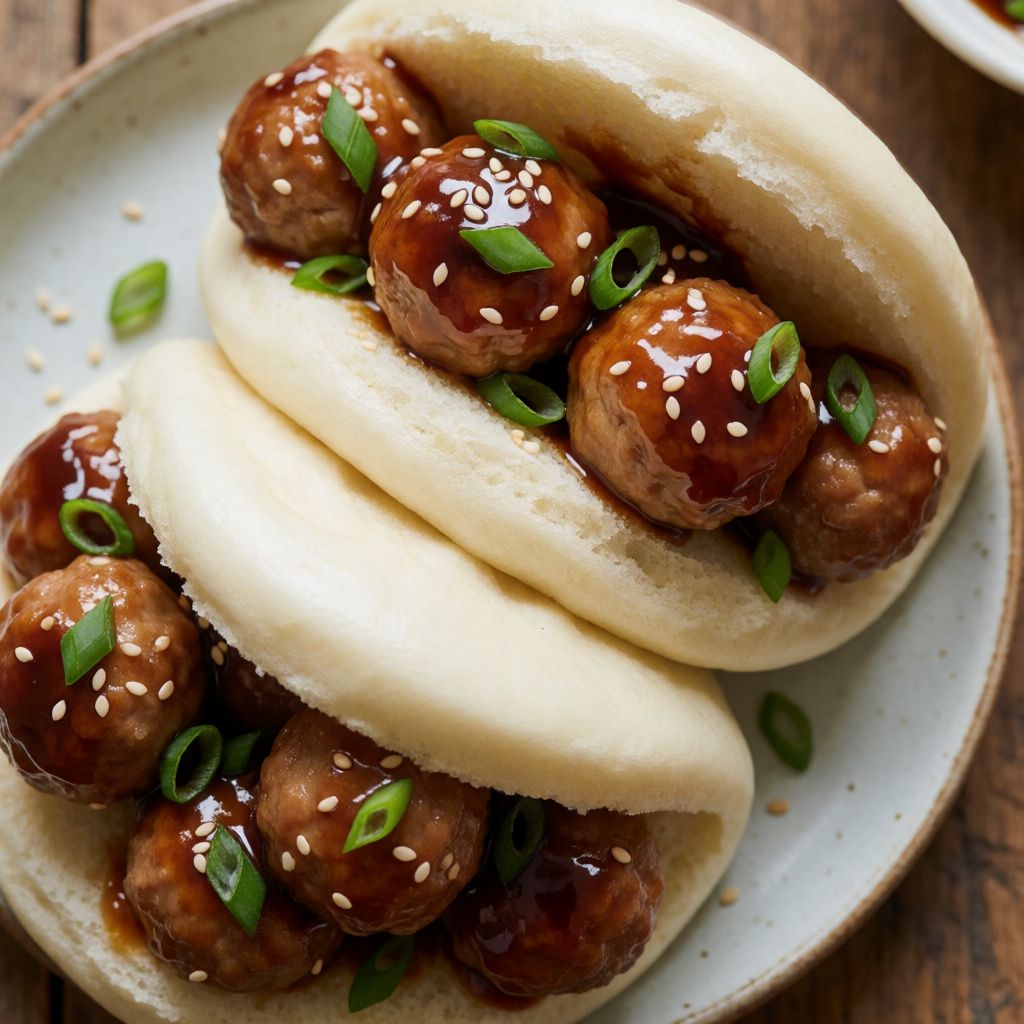
 AI photo
Bao Buns with Asian Chicken Meatballs
Soft steamed bao buns filled with juicy Asian-style chicken meatballs and crisp vegetables, finished with a sticky glaze.
Labels are worked out automatically from the ingredients and can be wrong. Check the packaging if it matters to you.
Ingredients
- 200 ml Water
- 10 g Yeast
- 1 tbsp Sugar
- 50 g Butter melted
- 1 tsp Salt
- 400 g Plain Flour
- 400 g Chicken Mince
- 2 pcs Spring Onion finely chopped
- 1 bunch Coriander finely chopped
- 1 tbsp Ginger finely grated
- 2 clove Garlic crushed
- ½ tsp Red Chilli finely chopped
- Salt
- 1 tbsp Sesame Oil
- 2 tbsp Soy Sauce
- 1 tbsp Brown Sugar
- 100 ml Apple Juice
- 1 pcs Lime juiced
- 2 pcs Carrot cut into thin strips
- 1 pcs Cucumber cut into thin strips
- 2 pcs Spring Onion thinly sliced
- 1 bunch Coriander
- 1 tbsp Sesame Seeds


















Steps
Stir the yeast into the water, then add the sugar, melted butter, salt and half of the flour. Knead the dough, gradually adding the remaining flour, until smooth and elastic.
10 minLeave the dough to rise in the fridge overnight, or for 2 hours on the kitchen counter.
120 minDivide the dough into eight equal pieces and roll each into a round flat bun. Brush one side with oil and fold in half so the oiled side is on the inside.
5 minLeave the buns to rise for 30 minutes.
30 minSet an Asian-style steamer over a pan of boiling water. Line the base with perforated parchment, place a few buns in and steam them for 20-25 minutes.
25 minMix the chicken mince with the spring onion, coriander, ginger, garlic, red chilli and salt. Add the chilli to taste, and if it turns out too hot, you can leave it out altogether.
5 minShape small chicken meatballs and fry them in a pan with oil for 7-8 minutes, turning often, so they brown evenly. Check they are cooked through and set aside on a plate.
8 minCombine all the ingredients for the sticky sauce in a clean pan and bring to the boil, stirring, until it reduces slightly and thickens.
3 minAdd the chicken meatballs to the pan with the sauce and toss to coat them in the glaze. Lower the heat and let them simmer gently in the sauce until it clings to the meatballs.
4 minFill each bao bun with greens and chicken meatballs, drizzle with sriracha and sprinkle with chilli flakes, sesame seeds, spring onion and fresh coriander.
5 min
Bao is a dumpling that got ambitious. Flour-and-water dough, leavened, folded instead of sealed shut, then cooked by steam instead of in the oven. No oven means no crust — that's not a limitation, that's the whole point. Steam keeps the surface soft and slightly tacky, like skin, which is exactly what you want to wrap around a hot meatball and some crunchy raw vegetable.
What decides whether it works is the dough's hydration and the steamer's patience, not the filling. The filling is forgiving — chicken, ginger, garlic, chilli, all things that taste of themselves and each other easily. The bun is not forgiving. Too wet and it collapses into a gummy pancake; too dry and it steams into something you could use as a doorstop. You're aiming for a dough that's soft enough to stick slightly to your fingers but still holds its own shape when rolled.
Some say you need a bamboo steamer and a wok to make bao properly. No — you need something that holds steam in and keeps condensation off the buns. A wide pan with a lid, a metal colander set over it, even a heatproof plate balanced on a rack inside a saucepan with a tea-towel-wrapped lid to stop drips falling back onto the dough — all of that works. The bamboo steamer is just the cheapest widely available version of "a vented box that holds steam," because that's what bamboo markets sold rice and buns out of for centuries. It's tradition by economics, not magic.
The yeast dough runs on a small amount of sugar and a lot of patience. Sugar feeds the yeast, nothing more — don't expect sweetness in the finished bun. The overnight fridge rise is the better option of the two given, not because cold is magic, but because a slow rise gives the gluten time to relax and develops a rounder flavour than yeast rushed along on a warm counter for two hours. If your kitchen is cold anyway — most UK kitchens in winter are — the fridge option costs you nothing extra in waiting, it just moves the waiting to overnight.
Flour: plain flour here, not strong bread flour, because you want a soft chew, not an elastic one. Too much gluten development and the finished bun turns rubbery under steam instead of pillowy. Butter in the dough is a UK habit rather than a traditional Chinese one — most bao doughs use a flavourless oil or lard. Butter works fine and gives a faint richness; if you want it closer to the original, swap it for a neutral oil with no smell of its own — sunflower, vegetable, groundnut — anything that won't compete with the ginger and garlic later.
Chicken mince needs the aromatics worked through it evenly before shaping, because this is a mild meat that carries whatever you give it and nothing of its own. Ginger and garlic are there for pungency, spring onion and coriander for green freshness, chilli only if you want heat — and the recipe's own advice to taste and adjust the chilli is worth taking seriously, since dried chilli heat varies wildly batch to batch and there's no fixing an overheated pan of meatballs later.
The sauce — soy, brown sugar, sesame oil, apple juice, lime — is a glaze built the same way every East Asian sticky sauce is built: salt, sweet, acid, reduced until the sugars thicken it rather than any flour or cornflour doing the work. Apple juice is an easy British-shelf stand-in for the fruit sweetness and faint acidity you'd otherwise get from rice vinegar plus a touch of pineapple or mirin; if you've got rice vinegar and a spoon more sugar, that's closer to the source. Watch the pan near the end, not the clock — "reduces slightly and thickens" means it coats the back of a spoon and clings rather than runs. Go past that point and the sugar catches and turns bitter; there's no rescuing a burnt glaze, only starting again.
Carrot and cucumber strips aren't garnish for the eye — they're the crunch the soft bun and soft meatball both lack. Cut them thin enough to bend without snapping; that's your doneness cue for "thin enough," not a ruler measurement. This dish feeds four as a proper plate of three or four buns each, fewer if you're serving it alongside something else off a Sunday spread, more if this is the whole meal and people are hungry.