
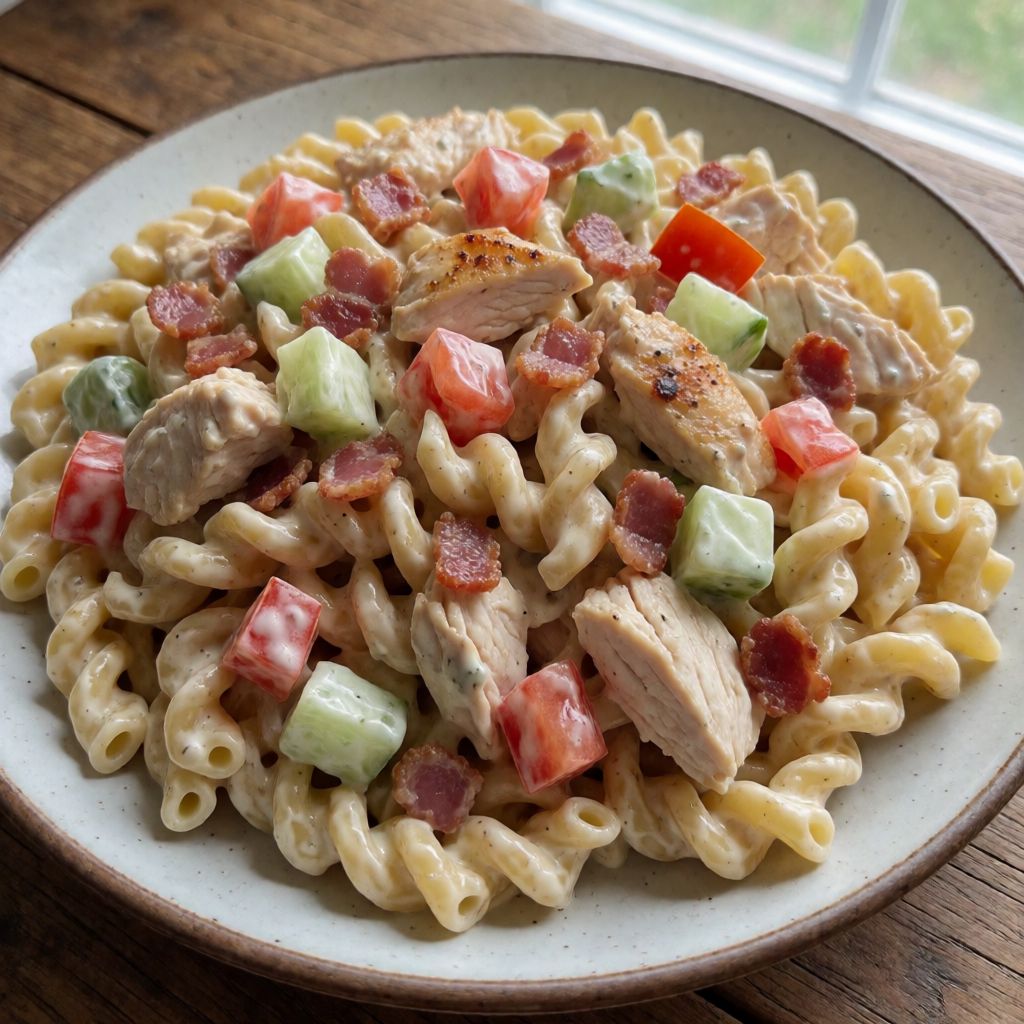
 AI photo
BBQ Chicken Ranch Pasta Salad
A hearty pasta salad with barbecue chicken, crispy bacon, fresh vegetables and a tangy homemade ranch dressing.
Labels are worked out automatically from the ingredients and can be wrong. Check the packaging if it matters to you.
Ingredients
- 400 g Chicken breast diced
- 100 ml BBQ sauce
- 75 g Bacon
- 400 g Pasta
- 200 g Tomato halved
- 1 pcs Cucumber halved and sliced
- 100 g Sweetcorn
- 100 g Mature cheddar diced
- 120 g Rocket
- 2 bunch Basil fresh
- 2 pcs Avocado diced
- 0.5 tsp Chilli flakes
- Salt
- Black pepper freshly ground











For the ranch dressing
- 100 ml Buttermilk
- 100 ml Greek yoghurt
- 3 tbsp Mayonnaise
- 1 tsp Dijon mustard
- 2 tbsp Chives finely chopped
- 1 clove Garlic crushed






Steps
Mix the chicken with the BBQ sauce in a bowl and leave to marinate briefly.
15 minMeanwhile, cook the pasta according to the packet instructions until al dente.
10 minFry the bacon in a large pan until crisp, then chop roughly.
6 minAdd oil to the same pan with the bacon fat and fry the BBQ chicken over medium heat, stirring, until cooked through.
8 minPut the pasta in a large bowl and mix with half the ranch dressing and the bacon.
2 minAdd the BBQ chicken, tomatoes, cucumber, sweetcorn, cheddar, rocket, avocado and basil to the pasta.
2 minSprinkle with chilli flakes, coarse salt and freshly ground black pepper. Serve with the remaining ranch dressing.
1 minFor the dressing: mix the buttermilk, yoghurt, mayonnaise, mustard, chives and garlic in a bowl until smooth, tangy and slightly runny. Season with salt and pepper to taste.
2 min
This is not really a pasta salad. It's two dishes that happen to share a bowl: a hot BBQ chicken and bacon fry-up, and a cold ranch-dressed salad. The thing that decides whether it works is temperature management — if you tip hot chicken straight onto rocket and avocado, you get wilted leaves and warm, grey avocado inside a minute. So the mechanism is: cook hot, cool it down a touch, then marry it with cold.
Some say a pasta salad is just leftover pasta with mayonnaise thrown at it. No — because the pasta here is doing a specific job: it's starchy and porous while warm, which means it drinks dressing instead of just wearing it on the surface. That's why you dress the pasta while it's still warm, not once it's gone cold and sealed itself up. Cold pasta tossed in dressing afterwards tastes of dressing sitting on top; warm pasta tossed in dressing tastes of dressing all the way through.
The BBQ sauce on raw chicken before it hits the pan is sugar going into a hot pan, and sugar burns before meat cooks. That's the whole argument for marinating briefly rather than long, and for keeping the pan watched rather than left — a few minutes of attention saves you scraping black flecks off good chicken. The bacon fried first, in the same pan, earns its fat: that fat is what the chicken then cooks in, carrying a smoke note through instead of you having to find it in a bottle.
Feeds four as a main, generously — this is a dish for a table, not a lunchbox portion, and it sits well for a Sunday when the roast has been and gone and nobody wants the oven on again.
Doneness here is mostly visual, not a clock. The chicken is done when it's gone from translucent pink to opaque white right through — cut the biggest piece if you're unsure, there's no shame in checking, a thermometer is a want not a need in a home kitchen. The bacon is done when it's stiffened and gone from pink-grey to a deep rust-brown at the edges; if it still bends like rubber, it's not crisp, it's just hot. The pasta is done at al dente — a bite with a thread of resistance in the core, not a crunch — and that's non-negotiable here because it carries on softening slightly as it sits in warm dressing afterwards. Cook it a shade under where you'd normally stop.
Chicken breast is the lean, fast-cooking choice — it takes the BBQ sauce's sugar and char well because it's thin enough to cook through before the sauce burns. Thigh would work too and forgives overcooking better, if you've got it spare from a roast. The BBQ sauce itself: any thick, tomato-and-vinegar-based one does the job: the sugar for a sticky glaze, the acid to cut the fat. Don't use a thin, vinegary hot sauce in its place — wrong texture, it won't cling.
Pasta shape matters less than people think, but something with a bit of surface — fusilli, penne, farfalle — grabs the dressing better than a smooth tube. Straight spaghetti in a salad like this is a myth-sized mistake: it clumps and slides the toppings straight off.
The ranch dressing is built on acidity and fat in balance: buttermilk and yoghurt for tang and thinness, mayonnaise for body, mustard for a sharp edge that stops it tasting flat. No buttermilk in the fridge — which is likely, nobody keeps it on hand for its own sake — thin the yoghurt with a splash of milk and a squeeze of lemon; you're rebuilding the same acid-and-thin profile, not chasing the name. Garlic goes in crushed, not chopped, because you want it to disappear into the dressing rather than turn up as a bite.
Avocado and rocket go in last and ideally once the hot components have had a minute or two off the heat — this is the whole point of building the dish in the order given, not habit for its own sake. Cheddar diced rather than grated holds its shape and gives you a bite of cool, sharp dairy against the sweet BBQ chicken instead of melting into a film over everything. Tomatoes halved, not diced, so they don't collapse into watery mush and thin out your dressing — nobody wants a soggy salad, and a soggy salad is almost always tomatoes crying their juice into the bowl.
A note on patience, because it's doing real work in this dish even though nothing here takes long: the fifteen minutes the chicken sits in BBQ sauce is a small thing, but skip it entirely and the sauce just sits on the surface of the meat in the pan rather than having started to grip it. Fifteen minutes isn't a ritual, it's a chemical head start, and it's cheap to give.