
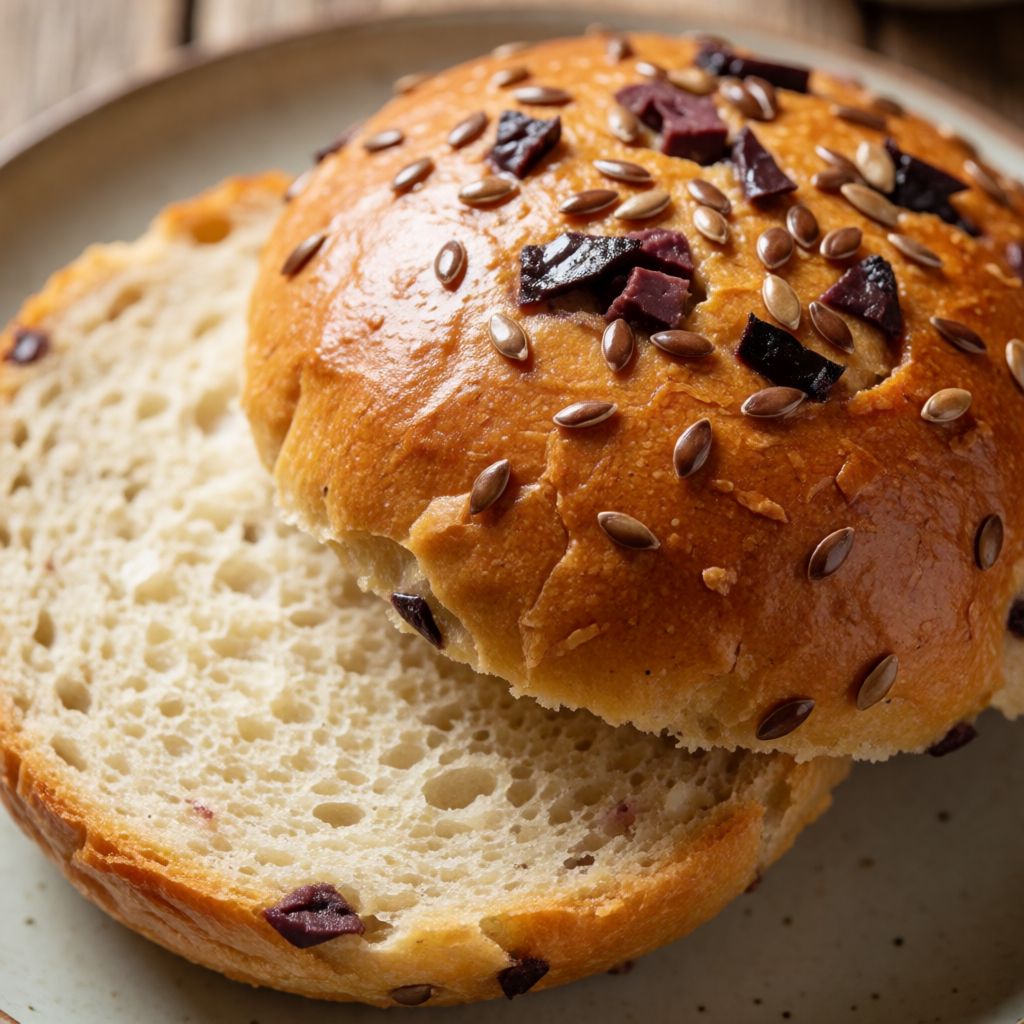
 AI photo
Homemade Burgers
Homemade burger buns and beef patties, finished with cheddar, crispy bacon and fresh salad trimmings.
Labels are worked out automatically from the ingredients and can be wrong. Check the packaging if it matters to you.
Ingredients
- 300 ml Water
- 25 g Yeast
- 1 tsp Salt
- 2 tbsp Olive oil
- 3 tbsp Flax seeds
- 150 g Olives roughly chopped
- 100 g Wholemeal flour
- 400 g Plain flour
- 1 tsp Olive oil for brushing
- 1 tsp Salt
- 150 g Mature cheddar
- 4 pcs Bacon rashers, fried until crisp
- 125 g Salad leaf mix
- 2 pcs Tomato sliced
- ½ pcs Cucumber sliced
- 1 pcs Red onion
- 2 tbsp Mayonnaise
- 2 tbsp Ketchup














For the patties
- 600 g Beef mince
- 3 tbsp Sun-dried tomatoes finely chopped
- 1 tsp Worcestershire sauce
- 1 pcs Egg
- ½ tsp Smoked paprika
- 1 clove Garlic crushed
- 1 pcs Bacon rasher, fried until crisp and finely chopped
- 1 tsp Salt
- 2 tbsp Butter for frying







Steps
Mix the water with the yeast in a bowl, then add the olive oil, flax seeds, olives, salt and wholemeal flour, until the ingredients come together.
5 minGradually add the plain flour until the dough can be kneaded on the worktop. The dough should be soft, elastic and may stick a little.
10 minLet the dough rise in the bowl for 30 minutes.
30 minKnock back the dough, shape into 10 buns and let them rise on a baking tray lined with baking paper for 90 minutes.
90 minBrush the buns with olive oil and sprinkle with flaked salt so the buns turn golden.
2 minPut the buns in a preheated fan oven at 250°C, immediately lower the temperature to 200°C and bake for 15–18 minutes.
18 minLet the buns cool on a wire rack.
Put all the patty ingredients in a bowl (sun-dried tomatoes, finely chopped bacon, egg, paprika, garlic, salt) and mix well together.
5 minShape into 4 patties and press them flat.
Fry the patties in butter over medium heat.
5 minTurn the patties and fry for a further 4-5 minutes.
5 minJust before the patties are done, place a slice of cheese and crispy bacon on each patty.
1 minAssemble the burger with cheese, bacon, lettuce, tomato, cucumber, onion rings, mayonnaise and seasoning herbs.
3 min
A burger is two separate engineering problems wearing one name: a bread that has to be soft enough to bite through without tearing the meat out the back, and a patty that has to stay juicy despite being cooked hot and fast and flat. Most of what goes wrong with homemade burgers happens because people treat it as one recipe instead of two.
The bun here is an olive bread dragged into a burger shape — flax seed, chopped olives, a slug of wholemeal flour for backbone. That's not decoration, it's structure: wholemeal flour has more bran and more gluten-disrupting bits in it, so it gives the crumb a slightly open, chewy character instead of the cottony squash of a plain white bun. Olives bring salt and fat right into the dough, which is why the dough itself carries more flavour than a shop bun ever will — you're not relying on the filling alone to carry the whole sandwich.
The patty's whole job is to be a slab of meat that doesn't turn into a hard disc. Everything mixed in — egg, Worcestershire, paprika, sun-dried tomato, that crisped bacon chopped fine — is there to either bind, season, or add fat and moisture back into mince that's going to lose a lot of both to a hot pan. Flat and wide means more surface hits the metal, which means a crust forms fast — that crust is what you want, because it's flavour, and it's also what keeps the juice in rather than letting it weep straight out into the pan.
Start with the yeast and the water. 25g of fresh yeast in 300ml is a generous amount for home baking — it's there to force a proof in realistic domestic time, not for some artisanal slow-ferment reason. Some say yeast has to go into warm water to "wake up" — no, because yeast at room temperature works fine, it just works slower; what actually kills it is water hot enough to feel uncomfortable on your wrist, because that denatures the proteins that make it function at all. Don't chase warmth, just don't scald it.
The two proves matter for different reasons. The first 30 minutes, in the bowl, builds the gluten network and gives the flax and olives time to sit inside the dough rather than just be mixed through it. The second prove, 90 minutes after shaping, is the one people cut short, and it's the one that decides whether your bun is a bun or a biscuit. A bun that hasn't had its second rise bakes dense and tight — it won't give under your teeth, it'll push back. You're looking for the dough to visibly swell past its shaped size, not for a clock to run out; 90 minutes is where it usually gets there in a normal UK kitchen, but a cold flat in January will need longer, and an airing cupboard or near a radiator will get you there quicker. Patience here isn't a virtue, it's an ingredient — rush the second prove and no amount of good flour fixes it afterwards.
The oven step — blasting at 250°C then dropping to 200°C — is doing a specific job: a short spike of very high heat sets the crust fast, giving you that gloss and colour, before the inside has time to overbake. Most home fan ovens won't actually hit a true 250°C evenly, and that's fine; get it as hot as it goes, and judge doneness by colour — deep gold, not pale — and by sound, a firm tap on the base should feel hollow, not soft. The olive oil and flaked salt brushed on before baking aren't about taste alone; oil helps the surface brown via the same sugar-browning reaction that makes toast go golden, and without it you get a dull, matte crust.
On flour: wholemeal plus plain is a balance, not a rule carved in stone. Wholemeal alone gives you a bun too heavy to bite through cleanly; all plain flour gives you a bun with no character of its own, which is the entire point of baking your own instead of buying one. If you want to swap the olive oil in the dough for something else, the only real criterion is that it shouldn't fight the olives for attention — a neutral vegetable oil works, a strongly flavoured one doesn't.
For the patty, mince at 600g for four burgers is 150g a head, which is a proper pub-style portion, not a thin motorway-services disc. The egg and the finely chopped bacon are both binders and both flavour, which is efficient but also means you can't skip one and expect the same texture — drop the egg and the patty is more likely to crack at the edges as it cooks, because there's nothing holding the structure together once the fat starts rendering out. Butter for frying rather than a flavourless oil is a deliberate choice: butter browns and smells of itself, and at the temperature you're frying a burger — hot enough that it hits the pan with a proper sizzle, not a quiet fizz — that browning butter flavour transfers straight into the crust of the meat. If your butter is burning rather than browning, your pan is hotter than the patty needs; that's a hob problem, not a recipe problem, because gas rings and induction plates both run hotter at a given setting than people expect.
Cheddar melting onto the patty in the last minute isn't timing for its own sake — do it too early and the cheese scorches before the meat's done; too late and it sits as a cold slab on top. A loose foil tent, or even your pan lid if you've one that fits, traps enough heat to melt it through without extra cooking time. Everything in the final assembly — leaves, tomato, cucumber, red onion, mayonnaise, ketchup — is seasoning and crunch, there to cut through the richness of bacon, cheese and butter-fried beef, and it's the one part of this whole thing where substitution is genuinely just preference. This feeds four, properly, as a meal rather than a snack — and if you're cooking for a Sunday that isn't a roast, this is a reasonable thing to put in its place.