
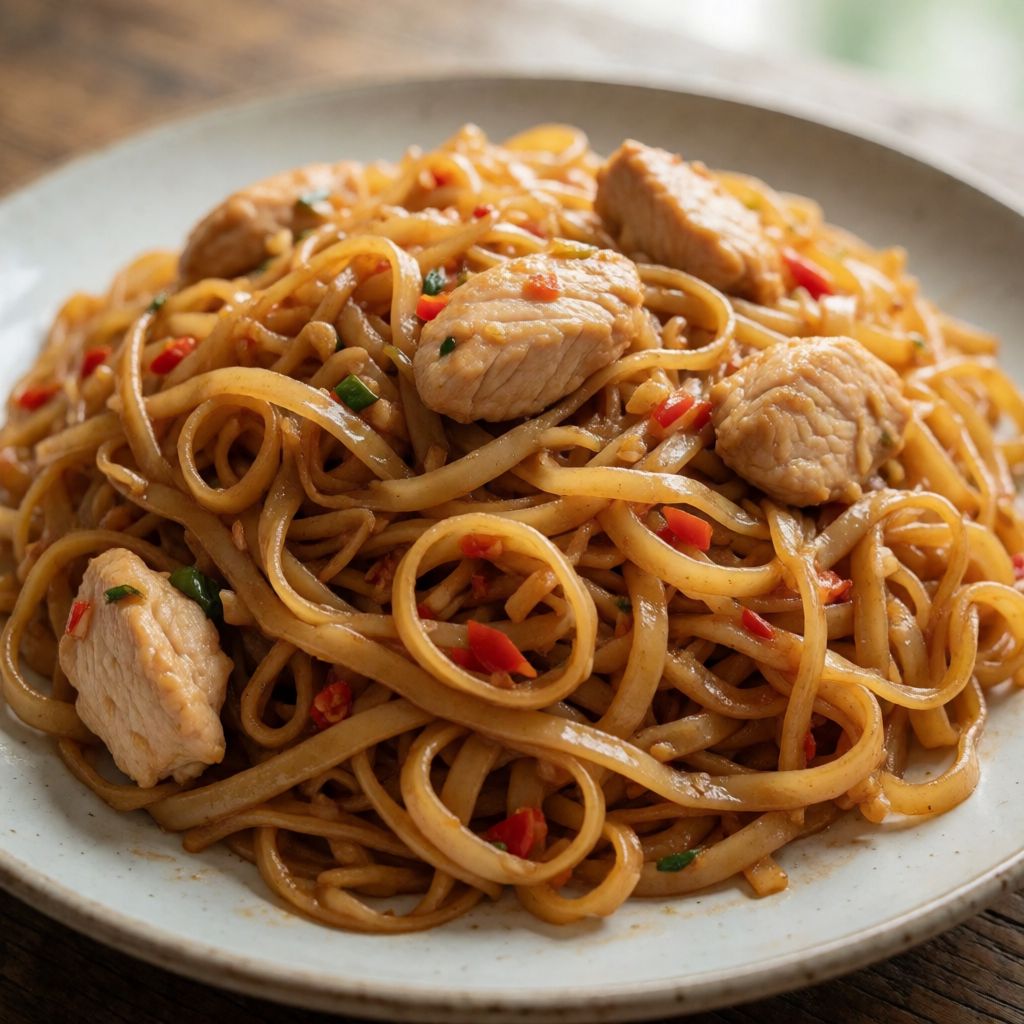
 AI photo
Chicken Pad Thai
A quick weeknight chicken pad Thai with a tangy, savoury-sweet sauce.
Labels are worked out automatically from the ingredients and can be wrong. Check the packaging if it matters to you.
Ingredients
- 3 clove Garlic finely chopped
- 2 pcs Shallots finely chopped
- 1 tbsp Ginger finely grated
- 1 tsp Chilli flakes
- 250 g Chicken breast sliced into strips
- 400 g Rice noodles
- 4 pcs Eggs
- 4 pcs Spring onions sliced into rounds
- 200 g Bean sprouts
- 3 tbsp Sesame oil
- 3 tbsp Fish sauce
- 2 tbsp Rice vinegar
- 2 tbsp Sugar
- 1 tbsp Soy sauce
- 2 tbsp Tamarind paste add more to taste
- 1 bunch Coriander fresh
- 2 pcs Lime cut into wedges
- 50 g Peanuts roughly chopped
- 1 pcs Red chilli finely chopped











Steps
Cook the noodles or soak them according to the packet instructions. If boiling, cut the time by 2 minutes, then rinse under cold water so they don't stick together.
2 minMake the pad Thai sauce: mix the fish sauce, rice vinegar, soy sauce and sugar, then gradually add the tamarind paste, tasting as you go, until you like the flavour. Stir until smooth and set aside.
2 minHeat the oil in a wok or large frying pan, add the shallots, garlic, ginger, chilli flakes and chicken, and stir-fry quickly until the chicken is browned.
7 minAdd the noodles to the pan and stir-fry quickly, tossing a few times. Add a little more oil if needed so the noodles don't stick.
3 minPush the noodles and chicken to one side, add a little oil and crack the eggs into the pan. Let them cook for half a minute, then mix the eggs through the chicken and noodles.
1 minAdd the pad Thai sauce, bean sprouts and half the spring onions. Toss everything together and serve on plates with the remaining spring onions, fresh coriander, chopped peanuts, lime wedges and finely chopped red chilli.
Pad Thai isn't a sauce poured over noodles — it's a dish built on one wok's worth of heat doing four different jobs in sequence, fast enough that nothing sits and sweats. That's the whole mechanism. You brown chicken, you fry noodles, you set egg, you toss everything in a sharp-sweet-salty-sour sauce — and if any of those stages drags, you get something soggy and grey instead of something glossy with separate, distinct bites.
What decides whether it works is heat retention, and that's where your kitchen and a Bangkok street stall part ways. A kazan or a carbon-steel wok over a roaring gas ring holds its heat when you dump in cold noodles; a domestic hob, even on its hottest ring, loses heat the moment the pan fills up, and a wide shallow pan loses it faster than a tall one. So work in a pan that's as heavy as you own, don't crowd it, and don't be shy with the heat — this is one of the few dishes where "too hot" is rarely your problem; "not hot enough" is.
Some say pad Thai needs a wok or it isn't real pad Thai. No — it needs speed and a surface that doesn't drown the food in its own steam. A wide frying pan does that job in a London flat well enough, as long as you don't pile everything in at once and let it stew.
Sourness, sweetness, salt, and a little heat from the chilli — that balance is tasted, not measured off a spoon, because tamarind paste varies brand to brand in strength. The recipe tells you to add it gradually and taste; that instruction is doing real work, not padding.
Noodles first, because timing them wrong is the single most common way to ruin this dish. Dried rice noodles keep cooking in their own residual heat and steam even after you've drained them — so you pull them before they're fully done, then shock them under cold water. That cold rinse isn't fussiness, it's physics: it stops the cooking dead and washes off surface starch, which is exactly what makes noodles clump into a solid brick in the bowl. Skip it, and by the time they hit the hot pan they're already overcooked and gluey.
The sauce — fish sauce, vinegar, soy, sugar, tamarind — is built the way a vinaigrette is built: salt and sour and sweet balanced against each other before anything touches heat, so you're tasting and adjusting a liquid, not guessing at a finished dish. Tamarind paste is the one genuinely essential, least substitutable item here; it's what gives pad Thai its particular sour-fruity edge, not sharp like vinegar, rounder. If you can't find it, a mix of lime juice and a spoon of brown sugar gets you into the right territory, though it won't taste identical — don't expect it to.
Garlic, shallots, ginger, chilli flakes go in before the chicken because they're aromatics, not the main event — they need a few seconds in hot oil to release their smell into the fat, and if you throw them in alongside raw chicken they'll just steam in the meat's released moisture and turn bitter rather than fragrant. The chicken itself: sliced into strips so it cooks through in the time it takes to brown on the outside — thick chunks would force you to choose between raw centre and leathery crust.
Oil: sesame oil is specified for its own smell, which is part of the dish, not incidental — but if you don't have it, any oil with no flavour of its own (sunflower, groundnut, a flavourless vegetable oil) will do the actual job of frying, you'll just lose that particular background note. Don't use olive oil; it has its own strong character and it smokes at lower heat than you want here.
The egg step — pushing noodles aside, cooking the egg half-set before folding it through — exists to stop you making scrambled egg mixed into noodles instead of egg woven through them in ribbons. Half a minute alone, undisturbed, lets it set enough to hold its shape when you start folding; stir it the second it hits the pan and you just get crumbs.
Bean sprouts and half the spring onions go in right at the end, with the sauce, because they're there for crunch and freshness, not for cooking — a minute in a hot pan with the rest of the toss is enough to warm them through without wilting them limp. The peanuts, lime, coriander, raw chilli, and the second half of the spring onions never go near the heat at all; they're finished at the table, by each person, which is also how you let someone with no tolerance for chilli actually eat the dish. This serves four — reasonably, with some appetite — and it doesn't improve with waiting. Have everyone sitting down before you start the final toss.