
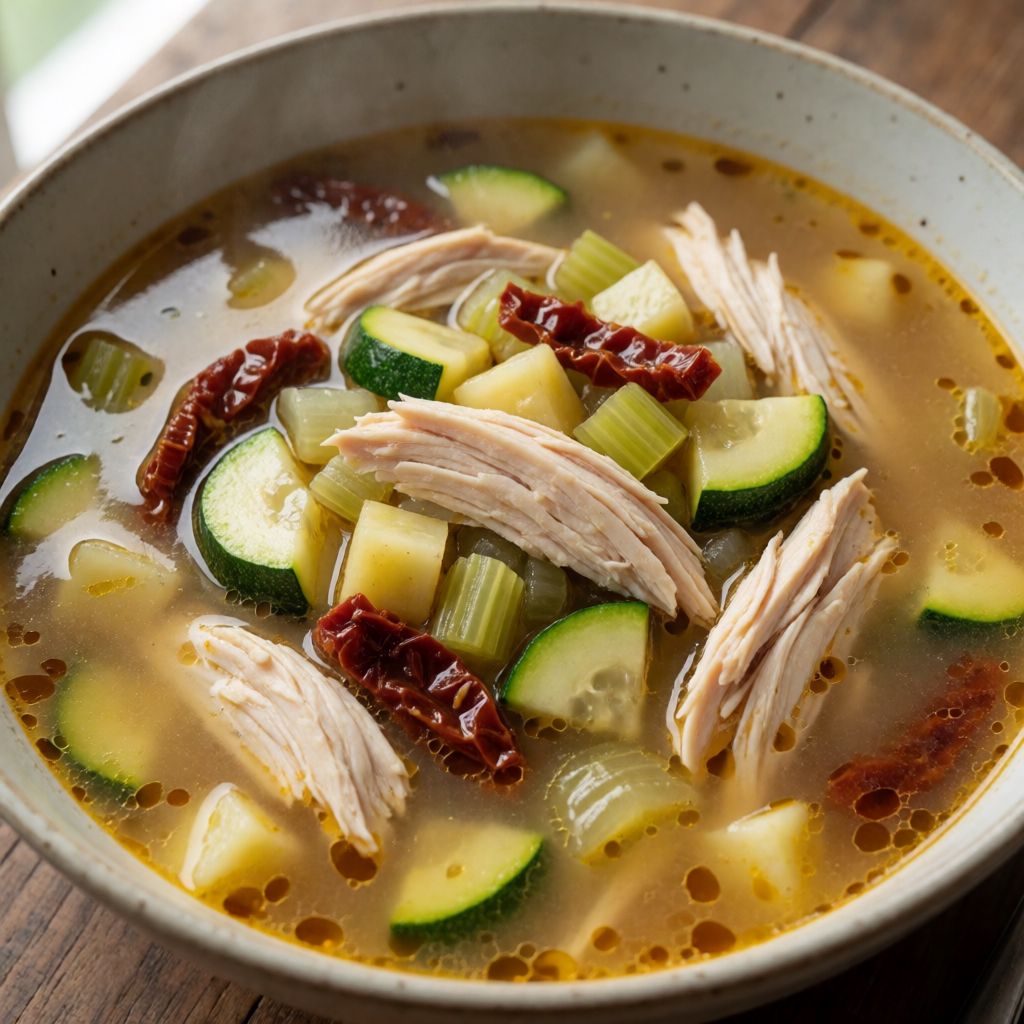
 AI photo
Chicken and Vegetable Pasta Soup
A hearty chicken soup with pasta, courgette and tomatoes, finished with cream and Parmesan.
Labels are worked out automatically from the ingredients and can be wrong. Check the packaging if it matters to you.
Ingredients
- 1 pcs Onion finely chopped
- 3 clove Garlic finely chopped
- 2 pcs Celery stalks, finely chopped
- 1 pcs Courgette coarsely grated
- 30 g Sun-dried tomatoes finely chopped
- 400 g Chicken breast diced
- 0.5 tsp Dried rosemary
- 0.5 tsp Fennel seeds
- 2 tsp Dried oregano
- 1 tsp Smoked paprika
- 50 g Tomato purée concentrated
- 3 pcs Chicken stock cubes
- 400 ml Vegetable stock
- 400 g Chopped tomatoes tinned
- 300 g Pasta
- 100 ml Double cream
- 1 pcs Broccoli broken into small florets
- 1 tbsp Olive oil for frying
- Salt
- Black pepper freshly ground
- 75 g Parmesan
- 1 bunch Fresh oregano a handful, fresh
















Steps
Fry the onion, garlic and celery in olive oil over medium heat until soft.
Add the courgette, sun-dried tomatoes and chicken breast, and fry over high heat, stirring, until the meat is browned.
Add the spices, tomato purée, chicken stock, vegetable stock and chopped tomatoes.
Bring to the boil, add the pasta and simmer the soup for 10-15 minutes, until the pasta is almost cooked.
Add the broccoli and double cream, season well with salt and pepper, bring back to the boil and remove from the heat immediately.
Serve in deep bowls with freshly grated Parmesan and a sprinkling of oregano.
This is not really a soup. It's a sauce that got ambitious and decided to feed itself — a Bolognese-minded base thinned out with stock, carrying both pasta and chicken in the same pot. That's the whole logic: one vessel, two starches of flavour (meat and tomato), cooked fast and hard at the start, then stretched out gently at the end. If you try to treat it like a delicate soup — low heat throughout, everything added at once — you get grey chicken and mush. If you treat it like a sauce that's allowed to be wet, it works.
What decides success is the order of two heats, not the list of vegetables. First: onion, garlic, celery go in gentle, because their job is to dissolve into sweetness, not to catch colour. Then the heat jumps — courgette, sun-dried tomato, chicken go in hard and fast, because the chicken needs a seared edge before it ever sees liquid, or it boils instead of browning and turns to wet cotton. Some say chicken breast in a soup is always going to be dry no matter what — no, because the problem isn't the cut, it's dumping raw diced breast into simmering stock, where it poaches slowly and tightens like a fist. Sear it hard first, in a pan hot enough that it hisses, and the outside sets before the inside overcooks.
On the vegetables: onion, garlic and celery are the base trio because together they give sweetness, sharpness and a faint bitter green note — pull any one out and the soup tastes flatter, not wrong, just thinner. Celery especially earns its place here; it's the ingredient British cooking quietly forgets, used to softness as background rather than bite. Courgette, grated coarsely rather than diced, is there to collapse — it has almost no flavour of its own, it's water and bulk, softening fast and thickening the sauce slightly as it breaks down. If you don't have it, a handful of grated carrot does a similar bulking job, though it brings its own sweetness along.
Sun-dried tomatoes are doing something tinned tomatoes can't: concentrated, oily, slightly leathery sweetness that tinned tomato — mostly water and acid — doesn't have. They're a shortcut to a flavour that would otherwise need hours of slow reduction. If you've none, a spoon more tomato purée and a pinch of sugar gets you close, though you lose the chew.
The spice line — rosemary, fennel seed, oregano, smoked paprika — reads like an Italian sausage rub, and that's exactly the trick: these spices are borrowed from the flavour of pork sausage to make plain diced chicken taste like it's carrying more fat and character than it actually has. Fennel seed in particular is the giveaway; it's rare in tomato soups but constant in Italian sausage. Smoked paprika does a similar job of faking depth — a whisper of char without anything actually being smoked.
Stock cubes plus fresh vegetable stock is belt-and-braces seasoning as much as flavour — three cubes is a lot of salt, so go easy with the salt pot afterwards and taste before you add any. Tomato purée, the concentrated kind in a tube or small tin, is not the same as passata or ketchub-style sauce — it's meant to be cooked out briefly in the fat before liquid goes in, so its raw sourness mellows; if all you have is a thinner tomato sauce, use more of it and less of the tinned tomatoes to keep the balance.
Pasta: anything short and sturdy — penne, fusilli, small shells — holds its shape in a simmering liquid better than long strands, which turn to string. If you're assembling this ahead and reheating (easy to do on a weeknight after a Sunday roast has used up your patience for Sundays), expect to add a splash of stock or water when you warm it through, because the pasta keeps drinking.
Double cream is UK shorthand for cream with enough fat (gather round 48%) to survive heat without curdling easily — if you're substituting, go for something with real fat content, not a "light" cream or milk, which split far more readily against acidic tomato. Parmesan at the end is salt and umami, grated fresh rather than the ready-grated kind, which tends to clump rather than melt into warmth. And the fresh oregano at the very end, scattered rather than cooked, is there for the smell as much as the taste — dried oregano gives earthy backbone through the cooking, fresh oregano gives you a top note when it hits your nose at the table, something dried herb can't do once it's been simmering for twenty minutes.