
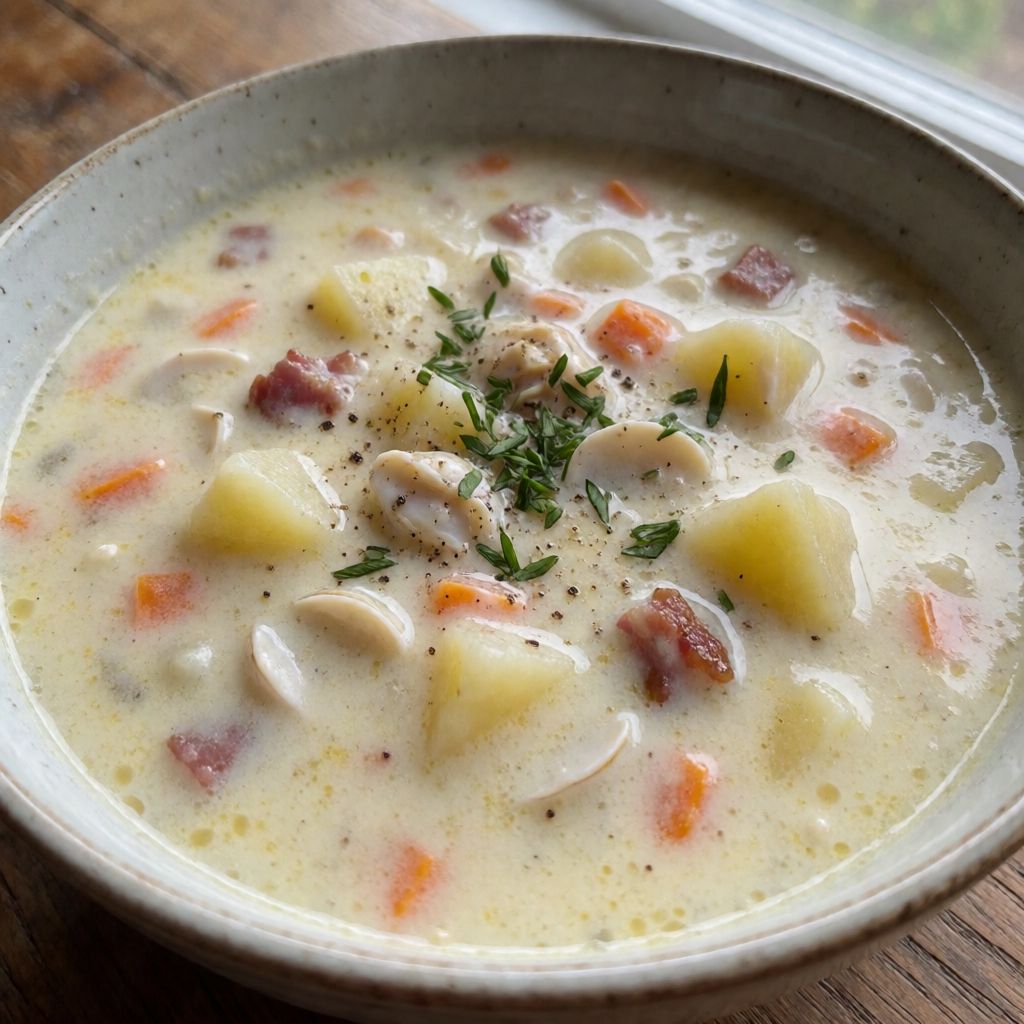
 AI photo
Clam Chowder
A creamy clam soup with bacon, potatoes and fresh herbs.
Labels are worked out automatically from the ingredients and can be wrong. Check the packaging if it matters to you.
Ingredients
- 1 kg Clams
- 100 g Bacon
- 50 g Butter
- 1 pcs Fennel finely chopped
- 2 pcs Carrot peeled and diced
- 700 g Potato peeled and diced
- 3 pcs Onion finely chopped
- 3 clove Garlic finely chopped
- 4 pcs Thyme sprigs, finely chopped
- 2 pcs Rosemary sprigs, finely chopped
- 5 pcs Sage leaves
- 2 pcs Bay Leaf
- 100 ml White Wine
- 200 ml Double Cream
- 300 ml Milk
- 400 ml Stock
- Salt to taste
- Black Pepper to taste
- 1 bunch Parsley for garnish
- 1 bunch Chives for garnish


















Steps
Clean the clams by rubbing them under a gentle stream of water, but do not soak them.
Discard any cracked shells, and tap open ones lightly on the worktop or press gently — if they do not close, discard them.
Steam the clams in the white wine in a covered pot for about 5-6 minutes, until opened.
Once the clams have opened, remove the pot from the heat and strain the clams through a sieve into a bowl, keeping both the liquid and the clams.
Fry the bacon in a large pot in the butter until lightly crisp, add the onion and fry until soft.
Add the finely chopped garlic, bay leaves, potatoes, carrots, fennel and the finely chopped fresh herbs to the pot.
Let the soup simmer until the potatoes are soft.
If you like, blend the soup for a creamier texture, or serve it as it is.
Add the clams, warm through and season the soup well with salt, pepper and extra spices if you like.
Ladle the soup into large deep bowls and sprinkle with finely chopped parsley.
Clam chowder is a soup built on a trick: you don't make clam stock, the clams make it for you, in five minutes, and then you build everything else to protect that stock rather than compete with it. Bacon fat and butter are the engine room, onion the sweetness, potato the body, and the clams go back in only at the very end, for warmth, not for cooking. Get that order wrong — clams in too early, simmered along with the vegetables — and you get rubber. That's the whole mechanism of the dish, and once you see it, the "list of steps" stops mattering.
What decides whether it works is restraint at two points. First, the steaming liquid: that pale, briny juice at the bottom of the bowl after you strain the clams is more valuable than the clams themselves — it's the sea, concentrated, and if you pour it away because it "looks like washing-up water" you've thrown out the soup's spine. Second, the moment the clams go back in. A clam is cooked the instant it opens in the steam. Everything after that is just making it tougher. So the final step isn't cooking — it's reheating, gently, until the clam is warm through, not until it's "done," because it already is.
Start with the fat: bacon rendered in butter, not oil, because here you want two things oil can't give you — the smoke and salt of cured pork running through the whole pot, and the slight nuttiness of butter solids browning underneath it. If you're out of bacon, use pancetta or even a smoked streaky rasher chopped fine; the point isn't the specific cut, it's "cured, smoky, fatty pork," and anything matching that criterion will do. Vegetarian clam chowder is a contradiction in terms, so there's no honest substitute here — skip the dish instead.
Onion, garlic, fennel and carrot are the aromatic base, and the order they go in follows a rule: alliums first, until they turn from sharp white to soft and sweet — that's the sugar in them coming forward as the harsh sulphur compounds cook off — and only then the denser vegetables, which need longer, gentler heat to break down without catching. Fennel is doing a quiet job here: its faint aniseed note is the thing that makes a cream-and-potato soup taste like it belongs to the coast rather than to a Sunday roast gravy. If you can't get it, celery gets you closer than nothing at all, though you lose that edge.
Potato is the body of the soup, not a side thought — 700g against four servings is a deliberate ratio, because potato starch is what thickens the broth as it breaks down, doing the work that flour or cornflour would do in a lazier recipe. Dice it even, because an uneven dice means some pieces turn to mush while others stay raw at the centre — and "soft" here means a piece bends and yields under a knife tip without resistance, not a fixed number of minutes. Waxy potatoes hold shape better if you want visible chunks; floury ones collapse faster and thicken the broth harder if you're after that route — either is fine, just know which you're choosing.
The liquid trio — stock, milk, double cream — is layered for a reason. Stock carries savoury depth, milk carries volume and a gentler dairy note, and cream is there purely for richness and the silky coating on the tongue that milk alone won't give you. Some cooks will tell you cream must simmer long and hard to "cook out the rawness" — no, the opposite: cream and milk both can split or taste scorched if boiled hard, especially once there's acid from the wine in the pot, so they want gentle heat once they're in, never a rolling boil.
White wine in the steaming liquid is there to acidify and brighten what would otherwise be a flat, purely savoury broth — it's doing for the clam liquor what a squeeze of lemon does for fried fish. If you don't drink or don't keep wine in, a splash of cider vinegar in water gets you the acid, though not the aromatics; it's a fair trade, not a perfect one.
And the herbs — thyme, rosemary, sage, bay — are there in modest, chopped quantities precisely so they season rather than dominate; four sprigs of thyme finely chopped disappears into the pot, a whole stalk thrown in whole would leave you fishing out twigs and overpowering the clam. This is a dish that rewards patience more than skill: the fifteen minutes you spend dicing potato evenly, the restraint not to rush the onions, the willingness to let the clams just sit in warm soup rather than cook them twice — none of that shows up as a technique you can photograph, but it's the entire difference between a good bowl and a tired one.