
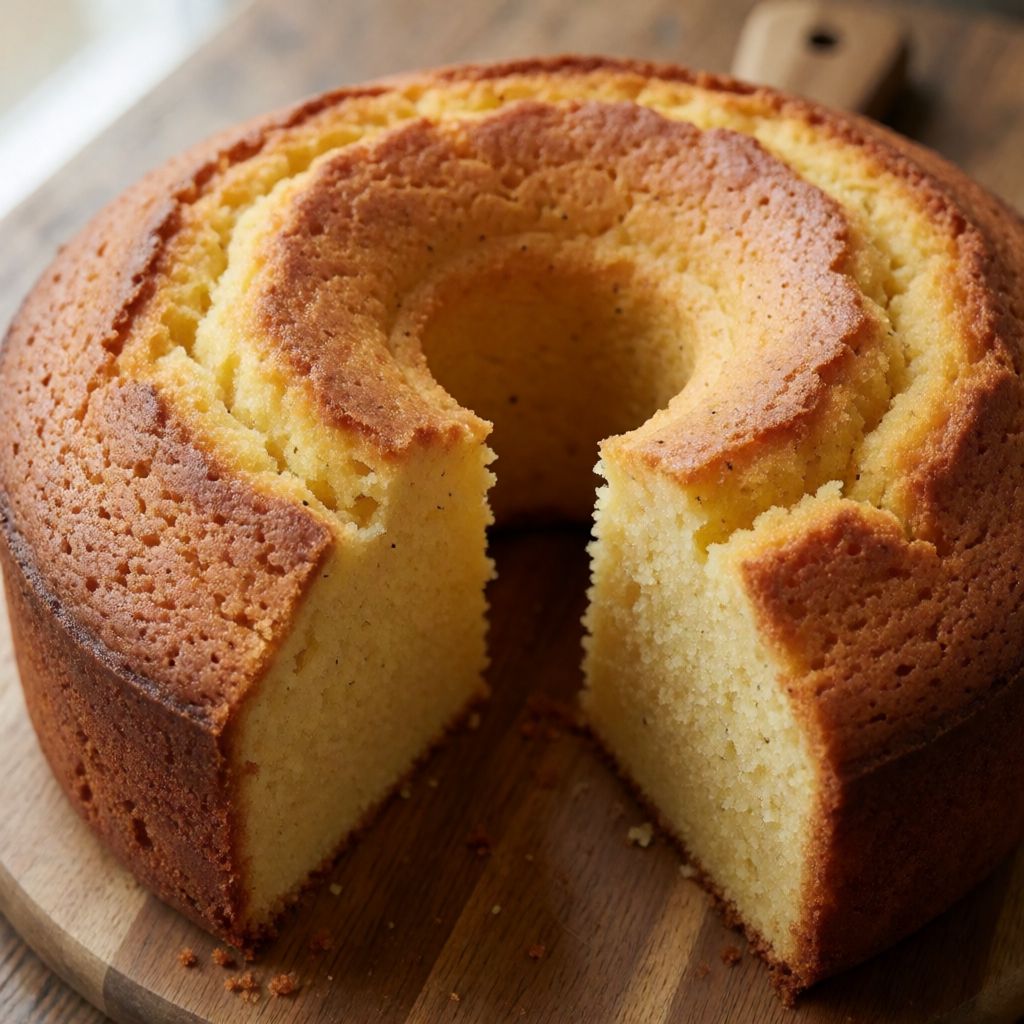
 AI photo
Danish Sand Cake
A buttery Danish-style loaf cake, flavoured with vanilla and lemon zest.
Labels are worked out automatically from the ingredients and can be wrong. Check the packaging if it matters to you.
Ingredients
- 0.5 pcs vanilla pod
- 200 g caster sugar
- 1 pcs lemon finely grated, zest only
- 200 g butter soft, at room temperature
- 4 pcs eggs
- 2 tsp baking powder
- 200 g plain flour







Steps
Slice the vanilla pod lengthways, carefully scrape out the seeds with a knife and mix them into the sugar.
5 minBeat the vanilla, sugar, lemon zest and butter together until light and fluffy.
5 minBeat in the eggs one at a time.
5 minMix the baking powder with the flour and sift it into the batter.
2 minGently fold the batter together.
2 minAdd fruit, nuts, chocolate chips or berries to the batter, if you like.
Spoon the batter into a greased tin, about 10 x 25 cm, lined with baking paper.
5 minBake the cake in a preheated oven at 175°C (fan) for about 45 minutes.
45 minLet the cake cool slightly on a wire rack.
10 min
This is sand cake — "sandkage" if you want the Danish of it — and the name tells you exactly what you're chasing: a crumb fine and short enough that when you break it, it doesn't tear like bread, it shears like wet sand holding its shape in a bucket. No raising agent tricks here beyond a modest 2 teaspoons of baking powder; the real lift comes from what you do in the first five minutes with butter and sugar, and everything after either protects that work or wrecks it.
What decides whether it works is almost entirely mechanical, not magical. You're beating air into fat — butter at proper room temperature, soft enough to dent with a thumb but not greasy and separating — and every air bubble you force in there now is a bubble that expands in the oven later and holds the crumb open. Skip that stage, or rush it cold, and no amount of baking powder rescues you; you get a dense, close-grained brick that's still called cake only out of politeness.
Some say you must have a stand mixer for this, that a hand whisk or wooden spoon won't get the butter "fluffy." No — because what you're after is visible: the mixture pales from yellow toward cream, and it gains volume you can watch with your eyes, somewhere around five minutes either way. The tool doesn't matter; the state does. What matters more is temperature — cold butter won't trap air, it just gets pushed around and stays dense and waxy.
The vanilla pod and lemon zest aren't flavour afterthoughts, they're worked into the sugar before anything else for a reason: sugar crystals are abrasive, and rubbing zest and seeds through them releases the aromatic oils far better than stirring them into a wet batter later would. If you've only got vanilla extract, a teaspoon stirred in with the eggs does the job, though you lose the fleck of black seed that tells people this wasn't out of a bottle. For the zest, any thin-skinned citrus works — the criterion is oil in the skin, not sourness in the juice — but grate only the coloured layer; the white pith underneath is just bitter and inert.
Butter is doing two jobs — flavour and structure — so there's no neutral-oil substitute here the way there might be in a loaf cake; this is a butter cake by definition. If you must swap, a baking margarine of similar fat content will aerate, but you lose the flavour that gives the cake its name recognition, and honestly at that point you've made a different, lesser cake. Let it come properly to room temperature rather than microwaving it soft — melted patches whip to a different, greasier texture than evenly softened butter.
The sugar is caster, not granulated, because finer crystals dissolve and cream into the butter faster and more evenly — coarse sugar leaves grittiness and undissolved pockets that show up as dense spots in the baked crumb. If all you have is granulated, pulse it briefly in a food processor; it won't hurt you to use it as is, it'll just take longer to cream properly and you'll want to watch for that paling, fluffy texture rather than trust the clock.
Flour and baking powder get sifted together and folded in gently, not beaten, and this is where patience actually becomes an ingredient rather than a platitude. All the air you built into the butter earlier is fragile; vigorous mixing now knocks it straight back out, and you'll have done five minutes of careful creaming for nothing. Fold with a light hand until you just can't see dry flour — a few seconds of restraint undoes none of your earlier work.
Some say baking powder is what gives sand cake its rise, full stop — no, because if that were true you wouldn't need to cream the butter at all, you'd just stir everything together like a quick bread. The baking powder is a top-up, a small insurance policy for the bubbles the butter-and-sugar stage already built; it reacts with the oven's heat and finishes the lift the creaming started, it doesn't originate it.
In a British kitchen the one honest limit is the tin and the oven. A proper loaf or terrine tin around 10 by 25 cm gives you the tall, dense-but-light slab this cake wants; too wide a tin and it bakes out thin and dry before the centre sets properly. Line it with baking paper not for the cake's sake but for yours — sand cake's high butter content means it will stick stubbornly to bare metal, and this isn't a cake you can coax out in one piece with hope alone.
"Fan 175°C" is doing real work in the recipe as written — fan ovens run hotter and more even than the still-air setting, so if your oven doesn't have a fan option, add roughly ten to fifteen degrees and expect the top to brown a touch faster, meaning you may want a loose foil cover for the last stretch. Doneness isn't really about the 45 minutes, which is your floor, not your finish line — it's a skewer coming out clean from the centre and the top springing back when you press it rather than leaving a dent. A kitchen with no probe thermometer and no magic trick to borrow just needs you to actually test it rather than trust the oven's digital clock.
Cooling on a wire rack for those ten minutes matters more than it looks — lift it straight onto a solid plate while it's still hot and the trapped steam condenses against the base, turning the bottom crust soggy. A wire rack lets air circulate underneath; if you don't own one, two forks laid across a baking tray, cake balanced on top, does the same job in a pinch.