
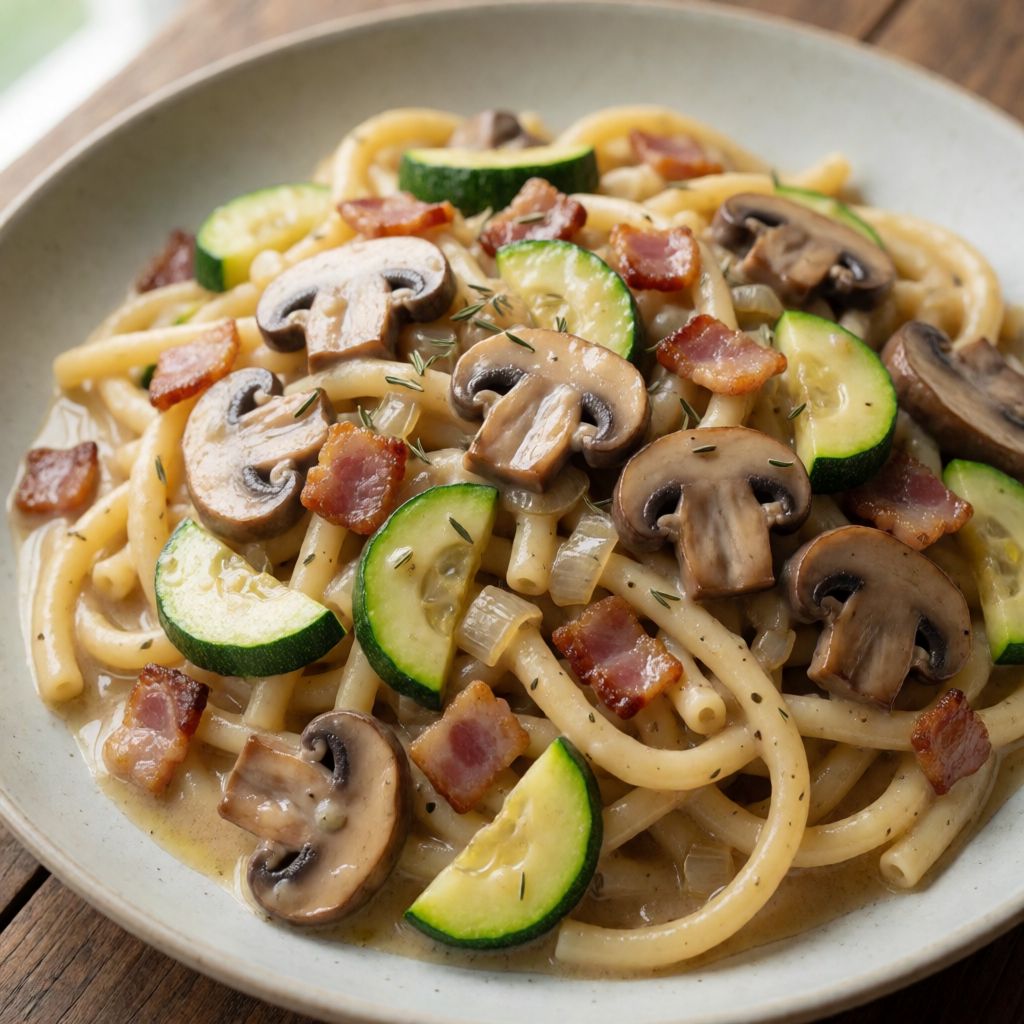
 AI photo
One-Pot Pasta with Mushrooms and Bacon
A simple one-pot pasta with mushrooms and crispy bacon, everything simmered together in one pot.
Labels are worked out automatically from the ingredients and can be wrong. Check the packaging if it matters to you.
Ingredients
- 400 g Pasta
- 250 g Mushrooms cut into quarters
- 1 pcs Onion finely chopped
- 3 clove Garlic finely chopped
- 1 pcs Courgette coarsely grated
- 2 tsp Dried thyme
- 1 tsp Oregano dried
- 2 tbsp Rosemary finely chopped, fresh
- 1 tsp Chilli flakes
- 50 g Bacon fried until crisp and cut into cubes
- 1 l Stock
- 100 ml Double cream
- Salt
- Black pepper freshly ground
- 50 g Parmesan freshly grated
- 2 bunch Basil leaves only, fresh














Steps
Put all the ingredients into a large pot and mix well.
Cover with a lid, bring to the boil, stir well again and leave to simmer for 10-12 minutes, until the pasta is perfectly cooked.
12 minServe sprinkled with finely chopped basil.
This is the dish that convinces people pasta needs a separate pot of boiling water, a colander, and a sink full of starchy steam — and then quietly proves them wrong. Everything goes in raw and cold at once: pasta, mushrooms, bacon, stock, cream, herbs. One pot, one heat source, one washing-up. What decides whether it works is not flavour — the flavour is almost impossible to get badly wrong, stock and bacon fat and parmesan will carry you — what decides it is whether the liquid and the pasta finish together. Too much stock and you're left simmering out the excess after the pasta's already soft and bloated, losing the structure that makes it a dish and not a soup. Too little and the pasta scorches to the bottom before it's cooked through, because unlike a pot of boiling water, this liquid is also being asked to turn into sauce.
The mechanism is simple once you see it: pasta cooked this way releases its starch straight into the stock instead of into a sink's worth of discarded water. That starch, plus the cream and the fat the bacon left behind, is what thickens into sauce by the time the pasta's done — you're not making a sauce and boiling pasta as two jobs, you're making one job do both. This is also why "throw it all in and walk away" works here but wouldn't work with a delicate fish or a quick stir-fry: pasta is forgiving of a rough boil, mushrooms and courgette release their own water and feed the pot rather than needing careful searing.
Mushrooms cut into quarters, not slices — slices lie flat against the hot base of the pot and that's exactly where scorching starts; quarters have less surface contact, bob around more, and hold their shape instead of turning to rag by the time the pasta's ready. Any mushroom will do here, the firmer the better, because what you want from them is bulk and a savoury backbone, not delicacy. Chestnut mushrooms over button if you can — more flavour for the same cook.
The bacon is fried separately first and added crisp, not raw — this matters more than it looks. Raw bacon simmered in liquid for twelve minutes goes grey and rubbery, never crisp, because it never gets hot enough or dry enough in a pot full of stock to render and brown. Fry it first, get the fat out of it and into the pan, then the fat goes into the pot with the bacon — that fat is doing real work in the final sauce, it's not decoration.
Courgette grated rather than diced is there to dissolve, not to be noticed as a vegetable on the plate. Grated, it has huge surface area, breaks down in the simmer, and gives up its water into the pot — one more thing pretending to be sauce by the time you're done. If you don't have courgette, any high-water vegetable that collapses fast — grated carrot, a handful of frozen peas added at the very end — does a similar job, though peas should go in with less time to cook or they turn to mush.
The herbs are split between dried and fresh for a reason that isn't fussiness: dried thyme and oregano go in at the start because dried herbs need time and heat to open up — their flavour is locked in oils that need the full twelve minutes to leach into the liquid. Fresh rosemary, finely chopped, goes in too because rosemary is tough and woody and can take the heat without turning bitter. Basil, by contrast, is reserved raw for the top at the end — basil loses its whole point under heat, it turns from bright and green to flat and vaguely spinach-like within minutes of cooking. If you've only got dried basil, use it earlier with the thyme, not as a garnish — it won't do the same job but it'll at least not be wasted.
The cream and parmesan are the finish, not the base — cream added to a boiling stock can split if you're unlucky with a very aggressive boil, so once it goes in near the end, ease the heat rather than force it, you want the cream folding in, not fighting a rolling boil. Parmesan melts into this and thickens it further; if you're out, any hard, salty, grating cheese will do the same mechanical job — Grana Padano, even a mature cheddar in a pinch, though you lose that specific nuttiness.
Stock here isn't flavouring, it's the entire cooking liquid for the pasta, so use one with actual body — a good chicken or vegetable stock, homemade or a decent cube dissolved properly, not a thin dishwater version, because this liquid has to reduce down to sauce thickness and if it started weak it'll finish weak too, no matter how long you leave it.