
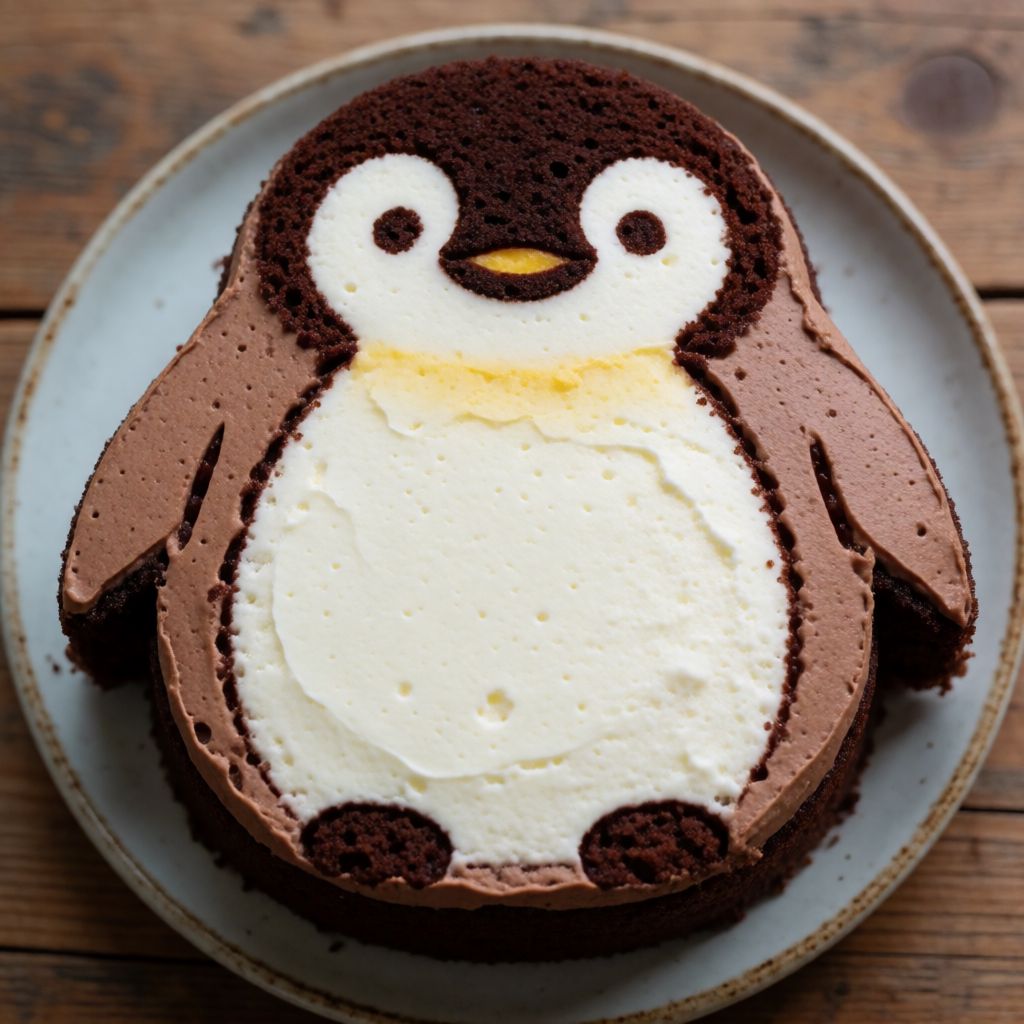
 AI photo
Penguin Cake: Chocolate Sponge with Milk Cream
A chocolate sponge cake layered with milk custard cream, chocolate-hazelnut filling and a dark chocolate glaze.
Labels are worked out automatically from the ingredients and can be wrong. Check the packaging if it matters to you.
Ingredients
- 4 pcs Eggs
- 90 g Caster sugar
- 1 tsp Honey
- 40 g Cocoa powder
- 40 g Plain flour
- 8 g Baking powder
- 250 ml Milk
- 20 g Cornflour
- 60 g Caster sugar
- 40 g Condensed milk
- 1 tsp Vanilla extract
- 300 ml Double cream
- 6 g Gelatine
- 200 g Chocolate-hazelnut spread
- 400 g Dark chocolate











Steps
Break the eggs into a bowl and whisk with an electric mixer together with the sugar and honey, until the mixture is pale and fluffy.
12 minGently fold in the sifted flour, cocoa powder and baking powder. Mix carefully until smooth.
Pour the batter into a 24 cm tin, greased with butter and dusted with flour.
Bake in a preheated oven at 170°C.
28 minRemove the sponge and let it cool on a wire rack.
In a bowl, mix the cornflour and sugar.
Gradually pour in the warm milk, whisking.
Place over low heat and stir until the cream thickens.
Add the condensed milk and vanilla extract, then leave to cool, covered with cling film pressed directly onto the surface.
Soak the gelatine in cold water.
Dissolve the softened gelatine in 50 g of warm double cream in the microwave, or warm gently if you prefer.
Stir the cream and gelatine together with a fork and let cool slightly.
Cut the cooled sponge into two equal layers.
Grease the sides of a springform ring tin with butter and line with a strip of baking paper standing 10 cm higher than the rim.
Place the first sponge layer on the base of the tin.
Whip the remaining double cream until thick, then fold in the cooled milk custard cream.
Whip again and fold in the cream with dissolved gelatine.
Pour in half of the cream, level it and place in the freezer.
20 minSpread the chocolate-hazelnut spread evenly over the set cream.
Cover with the second half of the milk cream and smooth well.
Cover with the second sponge layer and place the cake in the freezer.
20 minRemove the cake from the tin and place on a wire rack.
Melt the roughly chopped dark chocolate over a bain-marie.
Pour the chocolate over the cake, letting the glaze drip down the sides and spreading it evenly.
Chill the cake for 2 hours so the shape and flavours settle.
120 min
What was changed
Vanilla extract was swapped because UK shops rarely stock vanillin sachets, so vanilla extract is used instead.
This isn't really a cake, it's an engineering problem dressed up as dessert. You've got a soft sponge, a loose cream, a slick of hazelnut spread, and a poured chocolate shell all stacked on top of each other, and the only thing stopping it collapsing into a brown puddle is temperature and timing, in that order. The freezer isn't a shortcut here — it's the structural beam. Without it, the whole thing is wet cream trying to hold up more wet cream.
What decides whether this works is whether you treat the two freezer rests as real instructions and not a suggestion to tidy the kitchen. Twenty minutes isn't a number you trust blindly — you trust what the surface tells you: a skin that doesn't dimple when you touch it, a cream that's gone matte and firm rather than glossy and wobbling. Pour chocolate glaze onto a soft cream layer and it won't sit as a shell, it'll sink in, pull the cream with it, and you'll get a grey marbled mess instead of a clean dark coat.
The other thing that decides it is the collar of baking paper standing proud of the tin. People skip this because it looks like fuss — no, because the cream is taller than the tin once you've layered custard-cream, spread, and more cream, and a springform ring alone will give you a flat-topped puck with cream oozing over the sides as you build. The paper is doing the job a taller mould would do if you owned one, which most people don't.
Start with the eggs and sugar. Twelve minutes with a mixer isn't arbitrary patience for its own sake — whisking at this length is what dissolves the sugar into the egg and traps air as tiny stable bubbles, which is the only raising agent doing real work in a flourless-feeling sponge this thin on flour (40g against four eggs is light). Stop early and the mixture looks pale enough to the eye but still grainy underneath; bake it and you get a flat, dense disc because there was never enough air to hold once the baking powder's gas joins in. You're looking for ribbon-thick batter that holds a trail when you lift the whisk — that's your real signal, not the clock.
Honey in a sponge isn't there for taste, it's there because it's hygroscopic — it pulls in and holds moisture, so the crumb stays soft a day later instead of drying at the edges the way an egg-sugar-flour sponge on its own tends to. If you don't have it, a teaspoon of golden syrup or even glucose does the same job; plain sugar alone won't.
For the milk cream — really a crème pâtissière lightened with whipped cream — the cornflour is the thickener, and the reason you mix it dry with sugar first, before any liquid touches it, is to stop it clumping. Cornflour dropped straight into warm milk seizes into little jelly-like bullets that no amount of stirring un-knots; separated by sugar grains, the starch granules swell one at a time instead of fusing into lumps. Pour the milk in gradually while whisking for the same reason — shock the starch with all the heat at once and it clumps before it's had a chance to disperse. On the heat, you're stirring constantly and watching for the moment it goes from milk-thin to coating the back of a spoon in a proper sheet — that's your doneness, not a minute count, because every hob's "low" is a different low.
Pressing cling film directly onto the surface of the custard while it cools stops a skin forming — the usual flaw with any custard left open to air, that leathery film that then folds into unpleasant chewy ribbons through an otherwise smooth cream. It's a five-second habit that saves you sieving the custard later.
Gelatine: soak it in cold water first so it softens evenly rather than dissolving unevenly in hot liquid, where parts clump and never fully melt. Dissolving it into a small portion of warm cream rather than the whole batch means you're not heating 300ml of cream you've already half-whipped — heat collapses whipped air straight back out. If you've no gelatine, you can look at a vegetarian setting agent, but the ratio and setting point are different enough that you shouldn't treat it as a straight swap without testing.
The chocolate-hazelnut spread layer is doing something other than flavour too: it's a soft, slightly oily barrier between the two halves of cream, which is partly why you freeze each half before adding it — spread it onto loose cream and it sinks and swirls instead of sitting as a clean stripe when you cut the cake.
For the glaze, "dark chocolate" here wants to mean chocolate with a reasonable cocoa butter content, not a cheap compound bar with vegetable fat subbed in — that sets dull and waxy instead of glossy and snapping cleanly when sliced. Melt it over a bain-marie, not direct heat, because chocolate seizes and grains the moment water or direct scorching heat touches it unevenly — a defect you can't undo once it's happened, only avoid. If your UK kitchen runs a decent 70% dark bar from the baking aisle, that's your standard reference point; cheaper eating chocolate will still work, just softer and less snappy once chilled.
The final two hours in the fridge aren't about the glaze setting — that happens faster. They're about the cream layers finishing their set and the flavours of custard, hazelnut and dark chocolate actually meeting each other instead of sitting as separate cold blocks, which is the difference between a cake that tastes assembled and one that tastes composed. Eight people, one 24cm tin — plan the cutting with a hot, dry knife wiped between slices, because a cold knife through a hard glaze just cracks it instead of slicing clean.