
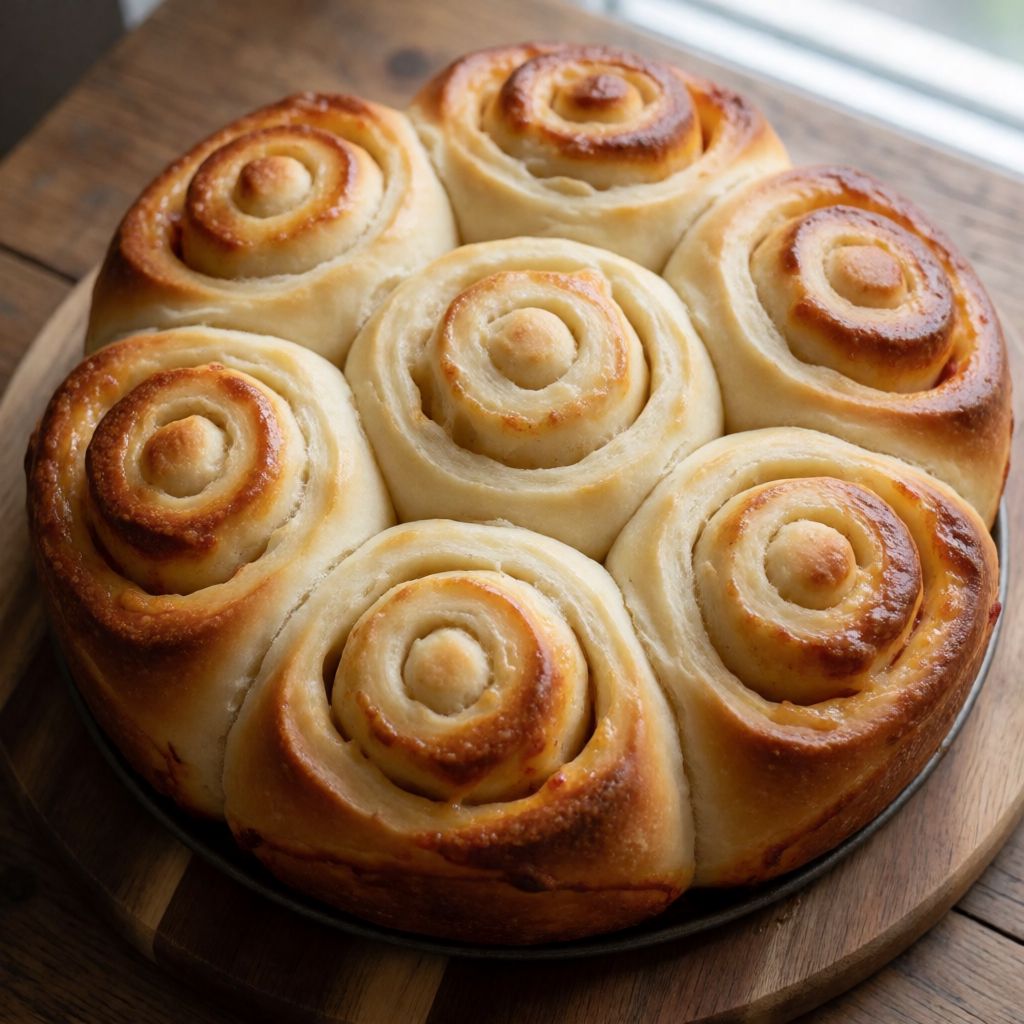
 AI photo
Pizza Swirl Rolls
Soft yeasted rolls spiralled with tomato sauce, mozzarella, chorizo and basil, like a pizza turned into a bun.
Labels are worked out automatically from the ingredients and can be wrong. Check the packaging if it matters to you.
Ingredients
- 25 g Yeast
- 100 ml Milk room temperature
- 200 ml Yogurt
- 1 pcs Egg
- 1 tbsp Honey
- 50 ml Olive oil
- 1 tsp Salt
- 150 g Wholemeal flour
- 350 g Plain flour
- 125 g Grated mozzarella
- 50 g Chorizo diced, can be left out for a vegetarian version
- 1 bunch Basil roughly chopped
- 1 pcs Egg for brushing












For the sauce
- 1 pcs Onion finely chopped
- 3 clove Garlic finely chopped
- 400 g Canned chopped tomatoes
- 1 tbsp Tomato paste
- 2 tsp Dried thyme
- 1 tbsp Olive oil for frying
- pinch Salt to taste
- pinch Black pepper freshly ground, to taste



Steps
Dissolve the yeast in the milk in a bowl.
Add the yogurt, egg, honey, olive oil, salt and wholemeal flour.
Mix the dough well, then add the plain flour.
Knead the dough until soft and elastic, preferably with a mixer on medium speed for 7–10 minutes.
Shape the dough into a ball and place in a bowl.
Cover the bowl with a clean tea towel and let the dough rise on the worktop for 1 hour.
Fry the onion and garlic in olive oil in a saucepan until the onion is soft.
Add the remaining sauce ingredients, mix well and simmer uncovered for 30 minutes to reduce slightly.
Season the sauce with salt and freshly ground pepper to taste.
Put the sauce in the fridge to cool completely before assembling the swirls.
Roll out the dough on a floured worktop into a rectangle about ½ cm thick.
Spread the cold tomato sauce over the dough, leaving the far 4 cm edge free, and sprinkle with mozzarella, basil and chorizo.
Roll the dough into a long log and cut with a sharp knife into swirls about 2 cm thick.
Place the swirls on a lined baking tray and shape them into neat rounds with your hands.
Let them rise for 30 minutes.
Brush with beaten egg and bake in a fan oven preheated to 180°C for 17–20 minutes, until golden.
Let cool slightly on a wire rack.
A pizza swirl roll is really two separate problems solved and then glued together: a yeast dough that has to hold its shape when sliced, and a sauce that has to be dry enough not to turn that dough to paste. Most things go wrong in the gap between those two, not in the baking.
Think of it as a cinnamon roll that went savoury and Italian. The dough is enriched — milk, yogurt, egg, honey, oil — so it's soft and a bit sweet on its own, closer to brioche than to a lean pizza base. That's not an accident: a lean dough (just flour, water, yeast, salt) would be chewier and could take wetter fillings, but it also dries out faster in a home oven and goes stale by the next morning. The enriched version stays tender for a day or two, which matters when you're making 14 and not eating them all today.
What actually decides whether these hold together or collapse into a puddle of orange grease: the sauce goes in cold and reduced. Skip the simmering-down step, or skip the chilling, and the sauce is still wet enough to soak straight into the dough while it proofs and seep out the bottom while it bakes — you'll get a flat, soggy spiral instead of a swirl with distinct rings. The tomatoes have to give up their water in the pan, not in the roll.
The second thing that decides it: how tight you roll, and whether you let the rolled-up log firm up (chilling it for ten minutes before slicing is not in your steps, but it's the difference between a clean knife cut and a smeared one — worth knowing even if you don't do it).
Go through the dough ingredients and each one is doing a specific job, not just padding out the ball. Yeast — 25 g, which is a lot if that's fresh yeast, more normal if it's a sachet of dried; either way it's there to eat sugars and produce the gas that gives you an open, pullable crumb rather than a dense knot. Milk at room temperature isn't fussiness — cold milk slows the yeast right down, and genuinely hot milk (above about 50°C, hotter than a bath) kills it outright, so "room temperature" is really just "don't be at either extreme." The yogurt adds acidity and moisture without thinning the dough the way more milk would; if you haven't got any, swap in more milk and accept a slightly less tender crumb. Honey feeds the yeast a little and browns the crust — golden syrup or sugar do the same job, just without the flavour note. Olive oil coats the gluten strands as they form, which is why this dough stays soft days later instead of going hard like a baguette; any neutral or mild oil works the same way, it's fat doing a physical job, not a flavour job, so you don't need good oil here — save that for the sauce.
The flour split — wholemeal plus plain — is a compromise, not tradition. All wholemeal and the bran cuts the gluten strands, so the dough struggles to stretch and the rolls turn dense. All plain and you lose the nuttiness and the slightly more honest "this isn't just a dessert roll" character. Knead it properly — by hand that's a good 10–12 minutes of push-fold-turn, by machine the 7–10 minutes your recipe gives — until a stretched bit of dough goes thin and translucent instead of tearing. That's the windowpane test, and it's the real marker, not the clock: under-kneaded dough tears when you roll it thin at step 11, and that's where fillings leak through.
On the sauce: canned chopped tomatoes plus paste, not fresh tomatoes — and that's economics as much as anything, since a British supermarket tomato in January has no sugar and no flavour, while a tin was picked and processed at peak ripeness months earlier. The onion and garlic go in raw into hot oil and come out the other side translucent and sweetened, not browned — if they catch colour and start smelling sharp or bitter, the heat was too high and you've started building bitterness into a sauce that's meant to be round and sweet-savoury. Thirty minutes of open simmering is doing the actual work here: water escapes as steam, the sauce thickens from "tinned tomatoes" to "something you could spread with a knife and it stays put" — that's your real doneness marker, more useful than the clock. "Simmer" here means lazy bubbles breaking the surface here and there, not a rolling boil that spits tomato across your hob and burns the bottom.
Mozzarella, chorizo, basil: mozzarella melts and binds, chorizo brings fat and smoke and salt the vegetarian version has to do without (a smoked paprika pinch in the sauce claws some of that back, though it's not the same thing), basil goes in raw for brightness since cooking it in the sauce would just turn it black and bitter. None of these are symmetrical substitutes-for-each-other — each is solving a different sensory problem — so if you're swapping, swap within category: another melting cheese for mozzarella, another cured spiced sausage for chorizo.
A word on your kitchen specifically: you're working in a flat with a normal fan oven and a normal worktop, not a pizzeria with a deck oven holding steady heat in the stone. 180°C fan for under 20 minutes is enough because these are small and thin, but your oven's actual temperature can drift 10–15 degrees either way from the dial, so trust the colour — a deep gold, not pale — over the timer. And the final proof, that 30 minutes after shaping: this is not optional resting, it's the yeast doing its last bit of work before the heat kills it. Rush it and the rolls bake flat and tight; some say you can skip the second rise if you're in a hurry — no, because that rise is where the open texture actually comes from, the oven only sets what the proof already built.