
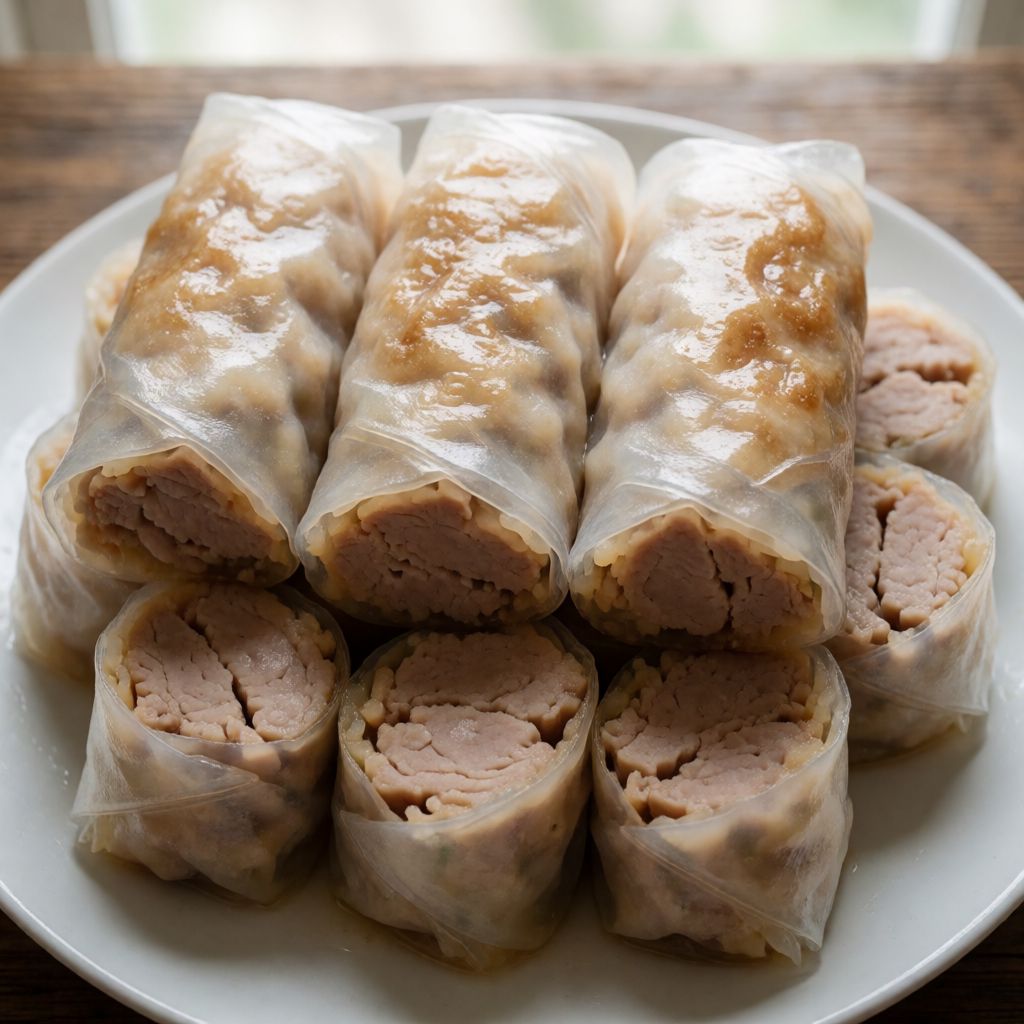
 AI photo
Fresh Spring Rolls with Pork Shoulder
Fresh spring rolls with marinated pork, crisp vegetables and herbs, served with hoisin dipping sauce.
Labels are worked out automatically from the ingredients and can be wrong. Check the packaging if it matters to you.
Ingredients
- 3 pcs Pork Shoulder Steaks cut into strips, pounded thin
- 1 pcs Lemongrass finely chopped stalk
- 2 tbsp Honey
- 2 tbsp Fish Sauce
- 2 clove Garlic crushed
- 1 tbsp Ginger finely grated
- 1 pcs Lime juice and zest
- 1 tbsp Sesame Oil for frying
- 12 pcs Rice Paper
- 2 pcs Nectarine
- 1 pcs Lettuce Heart washed and separated into leaves
- 1 pcs Coriander fresh, a handful
- 1 pcs Mint fresh, a handful
- 1 pcs Basil fresh, a handful, optional
- 1 pcs Red Chilli sliced into thin rings
- 50 ml Peanuts salted
- 50 ml Hoisin Sauce
- 50 ml Water
- 1 tsp Sugar
- 1 tbsp Peanuts finely chopped, salted
















Steps
Mix the marinade and coat the pork strips. Leave to marinate for at least 30 minutes.
30 minMake the hoisin sauce: put the hoisin, water and sugar into a pan and bring to the boil.
5 minQuickly fry the pork in a hot pan with the oil.
5 minSoak the rice paper in water, then lay the softened sheet on the worktop.
2 minPlace the filling (pork, lettuce, herbs, nectarine, peanuts and chilli) in a line along the centre. Fold the edges over the filling and roll up tightly.
2 minServe with the hoisin sauce, sprinkled with finely chopped peanuts.
What was changed
Pork cut swapped: Pork Shoulder Steaks, since neck is rarely sold under that name in UK supermarkets.
This isn't a cooked dish so much as an assembly job, and the pork is the only part of it that sees real heat. Everything else — the nectarine, the lettuce, the herbs — stays raw and cold, which is the whole point: you want contrast, a hot savoury strip of meat meeting cool fruit and crisp leaf inside a wrapper that's doing almost nothing except holding the thing together. If this goes wrong, it's not usually the pork. It's the rice paper — torn, sticking to itself, or turned to chewing gum because it sat in water too long.
What decides whether it works is restraint in two places: how thin you pound that pork, and how long you leave the rice paper in the water. Pound it thin and the marinade actually gets through the meat instead of sitting on the surface — a steak left at its natural thickness just shrugs off thirty minutes of lemongrass and fish sauce and tastes of itself underneath. The rice paper wants seconds in the water, not a soak. It keeps softening after you lift it out, from its own residual moisture, the same way pasta keeps cooking in its own heat off the stove. Go by feel: pliable like a wet contact lens, not slack like a dishcloth.
Some say rice paper needs hot water to work. No — hot water speeds up the softening past the point you can control it, and you end up with one half translucent and sticking to the worktop while the other half is still stiff. Cold or lukewarm water, a quick dip, and patience for the last bit of give to happen on the board — that's the whole trick.
Start with the pork. Shoulder steaks are a good, honest cut for this — enough fat running through them that a hot pan won't dry them out in the few minutes they need, unlike loin or fillet, which punish you for any delay. Cut into strips and pounded thin, they do two jobs: they cook through fast enough that you're not standing over a hot pan for ages, and they soak up the marinade properly, because flat meat has more surface relative to its thickness than a lump does. If you haven't got pork shoulder, chicken thigh treated the same way — sliced, flattened — behaves almost identically; it's the fat and the flattening that matter, not the species.
Lemongrass, garlic, ginger, lime, fish sauce, honey: this marinade is built the same way as most in that part of the world — sour, salty, sweet, aromatic, in that rough balance, so no one note dominates. Fish sauce is doing the salt and the savoury depth that plain salt can't; if the smell puts you off before you've tasted it, know that it disappears into the dish entirely once it's cooked and mixed — nothing in the finished roll tastes "fishy." No fish sauce in the cupboard, soy sauce with a pinch more salt gets you close enough. Lemongrass you want for its lemon-without-the-acid perfume; if you can't get the stalk, a strip of lime zest and a little extra ginger covers most of what it does.
Fry the pork hot and fast, in an oil that won't argue with the other flavours — sesame oil here is there for its own nutty smell as much as for frying, so don't swap it for a neutral oil unless you're happy to lose that note; if you do swap, use any oil with no flavour of its own, like a light vegetable or sunflower oil. The strips are thin, so this is a couple of minutes a side at most, judged not by a clock but by colour — the pale pink gone, the edges starting to catch and brown rather than just steam. A wide frying pan, your stand-in for a wok, actually suits this better than people think: the problem with a domestic hob is it struggles to get a wok properly hot in the middle, so a flatter pan with more surface touching the heat does the job just as well, maybe better.
The nectarine is the surprising part, and it's not decoration. Spring rolls like this live on temperature and texture contrast, and fruit gives you a sweetness and a juiciness that lettuce and herbs can't. If nectarines aren't in season or any good, mango does the same work — anything that's sweet, a bit acidic, and gives when you bite it rather than crunches.
The hoisin sauce here is thinned and loosened with water and a touch of sugar, which is really just correcting hoisin for what it is out of the jar — thick, sweet, built to coat, not to dip. Boiling it briefly with water doesn't cook it in any real sense; it just loosens the sugars so it pours instead of clings, and the heat helps the sugar you've added actually dissolve rather than sit gritty at the bottom.
Rolling itself rewards practice more than skill — don't expect your first three to look like the last three. Keep the filling in a line, not a heap, because a heap tears the paper when you try to roll over it; flat quantities along the centre let the wrapper fold evenly round both sides. This feeds four as a light meal or six as a starter — twelve rolls split three each is a reasonable lunch, two each a starter before something heavier.