
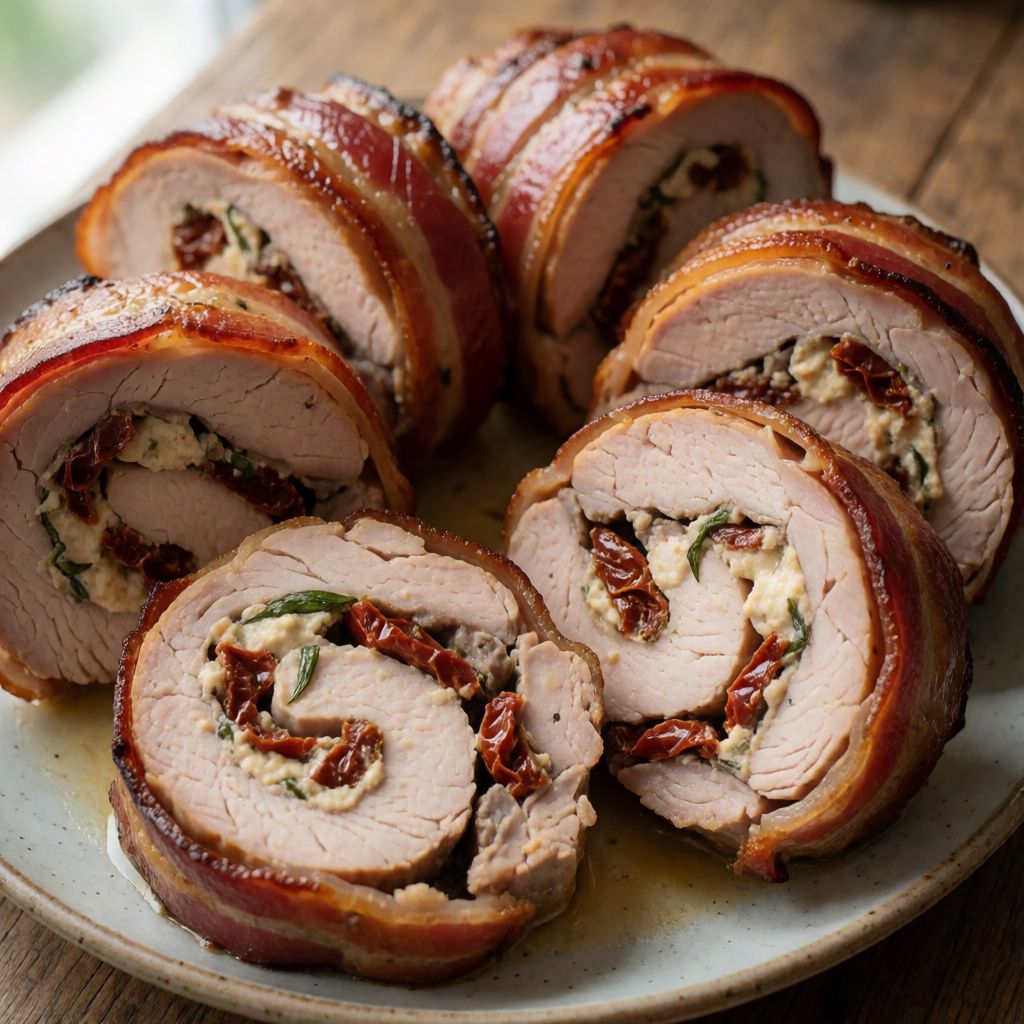
 AI photo
Turkey Breast Roulade, Roasted with Bacon, Garlic, Tomatoes and Basil
A turkey breast brined, stuffed with garlic cream cheese, sun-dried tomatoes, herbs and pine nuts, then rolled in bacon and roasted.
Labels are worked out automatically from the ingredients and can be wrong. Check the packaging if it matters to you.
Ingredients
- 1.4 kg Turkey breast
- 150 g Garlic cream cheese
- 50 g Sun-dried tomatoes finely chopped
- 2 clove Garlic finely grated
- 1 tsp Rosemary finely chopped, fresh
- 1 bunch Basil finely chopped, fresh
- 30 g Pine nuts roughly chopped
- 25 g Butter
- 150 g Bacon
- Salt
- Black pepper fresh
- 200 ml Stock for the tin
- 300 ml Water
- 3 tbsp Salt
- 2 tbsp Sugar
- 2 kg Potatoes
- 150 g Salad leaf mix
- 300 g Tomato cut into wedges
- 1 bunch Basil fresh
- 0.5 pcs Lemon zest and juice
- 3 tbsp Olive oil
- Salt
- Black pepper fresh
















Steps
For the brine, mix the water, salt and sugar, stirring until fully dissolved.
2 minPlace the turkey breast on a board, smooth side down. Make two cuts along the breast from the middle inwards so it can be opened out and butterflied.
60 minPlace the breast in the brine so the meat is covered, and chill in the fridge for 1 hour.
60 minMix the garlic cream cheese, sun-dried tomatoes, garlic, rosemary, basil and pine nuts in a bowl. Add a little oil from the sun-dried tomatoes so the filling becomes creamy and easy to spread.
3 minTake the breast out of the brine and pat it thoroughly dry with kitchen paper. Spread the filling over the meat and roll it tightly. Secure with cocktail sticks so the roll does not open, and turn it over.
5 minBrush the roll with a thin layer of butter and wrap it in bacon so the rashers overlap one another.
Place in a greased tin and pour in the stock. Roast in a preheated oven at 180°C (conventional) for 1 1/2 hours or until the breast reaches an internal temperature of 73°C, basting with the liquid from the tin roughly every 15 minutes.
Boil the potatoes in lightly salted water until just tender, drain, spread on a baking tray lined with parchment and crush with the bottom of a glass.
20 minTake the meat out of the oven and let it rest on a board or plate, covering with foil if you like. Coat the potatoes with the juices and fat from the turkey and roast at 220°C with fan for about 15 minutes while the meat rests.
15 minMake a dressing from the lemon juice, zest, oil, salt and pepper. Arrange the salad with the pine nuts, tomatoes and basil and drizzle with the dressing.
3 minSlice the turkey breast and serve with the salad and crushed potatoes.
2 min
What was changed
The second roasting temperature was rounded to to match the oven scale step.
This is a Sunday roast with its sleeves rolled up. Turkey breast, that driest of all the birds, gets butterflied, brined, stuffed with a garlic-and-tomato cream, rolled into a fat log and dressed in bacon like it's going out somewhere. It is, essentially, solving turkey's one real problem: breast meat has almost no fat of its own, so unless you do something clever it dries out long before the inside reaches a safe temperature. The brine and the bacon jacket are both answers to that same problem, not decoration.
What decides whether it works is the brine and the thermometer, not the oven. An hour in salt-and-sugar water lets the meat's proteins hold on to extra water through cooking — it's not seasoning, it's insurance against the moment you overshoot the oven by ten minutes because you got distracted doing the potatoes. Some say you can skip brining "if you watch it carefully" — no, because even careful cooks lose fifteen minutes to a phone call, and turkey breast forgives that badly. Pull it at 73°C in the core, not by the clock: ovens lie, thermometers don't.
The second thing that decides it is how tightly you roll. A loose roll means the filling runs out into the tin and the slices fall apart when you cut them; tight, tied with cocktail sticks, the cream cheese stays put and sets into a seam you can actually see on the plate. Bacon wrapped overlapping — not laid side by side — is what stops the fat rendering away before it's basted the meat underneath; gaps are just drains.
Turkey breast itself: buy it whole, skin removed or on as you like, butterflied yourself rather than bought pre-rolled — a shop roulade is already seasoned shut and you can't get a knife or a brine into it. 1.4 kg feeds eight thin-sliced, which tells you this is meant to be carved at the table, not portioned in the kitchen.
The brine is water, salt, sugar, nothing more — three tablespoons of salt and two of sugar in 300ml is strong, almost a cure strength, because you've only got an hour and need the salt to move fast. Longer brines use less salt for exactly this reason; don't leave it in overnight thinking "more is better" — past a few hours in a brine this strong the texture goes spongy, not juicy. Pat the meat properly dry afterwards, because a wet surface steams in the oven instead of browning, and a pale roulade under the bacon anyway is no great loss, but a wet surface also stops the filling sticking.
The filling is built on garlic cream cheese — any soft, mild, slightly garlicky cheese does the job; its whole function is to melt just enough to bind the sun-dried tomato, rosemary, basil and pine nuts into a paste that won't squeeze out when you slice. If you can't find garlic cream cheese, plain cream cheese with an extra clove of grated garlic worked through it behaves the same. The oil from the sun-dried tomato jar isn't an afterthought — it's what turns a stiff cheese into something spreadable without adding water, which would weep out during roasting. Pine nuts go in roughly chopped so they still give a bit of resistance against the soft filling; a smooth paste with nothing to bite into is the one way to make this feel heavier than it needs to.
Bacon: streaky, thin-cut, laid overlapping like roof tiles. Its fat is doing two jobs at once — basting the lean breast meat as it renders, and giving you something to baste back into the tin, which is why you keep spooning the tin juices over the roll every fifteen minutes rather than leaving it be. Smoked or unsmoked is just your preference; thick-cut streaky won't render fast enough in ninety minutes and you'll end up with chewy bacon and a dry patch of meat underneath where it never basted. The stock in the tin isn't for flavour so much as to stop those juices catching and burning onto the metal before you've had a chance to use them — in a domestic tin, which holds heat less evenly than you'd like, that's the difference between a basting liquid and a scraped black crust.
The potatoes, crushed rather than mashed, are there to catch everything the roulade drops — fat, stock, bacon juice — and they need the higher, fan-forced blast at the end because a crushed potato has more surface exposed than a whole one, and that surface is what you actually want crisp. Don't rush this stage by cranking the oven up earlier: it would catch the bacon before the turkey's done. Rest the meat properly before slicing — cut it straight from the oven and the juices you worked so hard to keep in run straight out onto the board instead of staying in the meat, and that defeats the brine, the bacon and the basting all at once. Patience here isn't optional, it's the step that cashes in everything before it.