
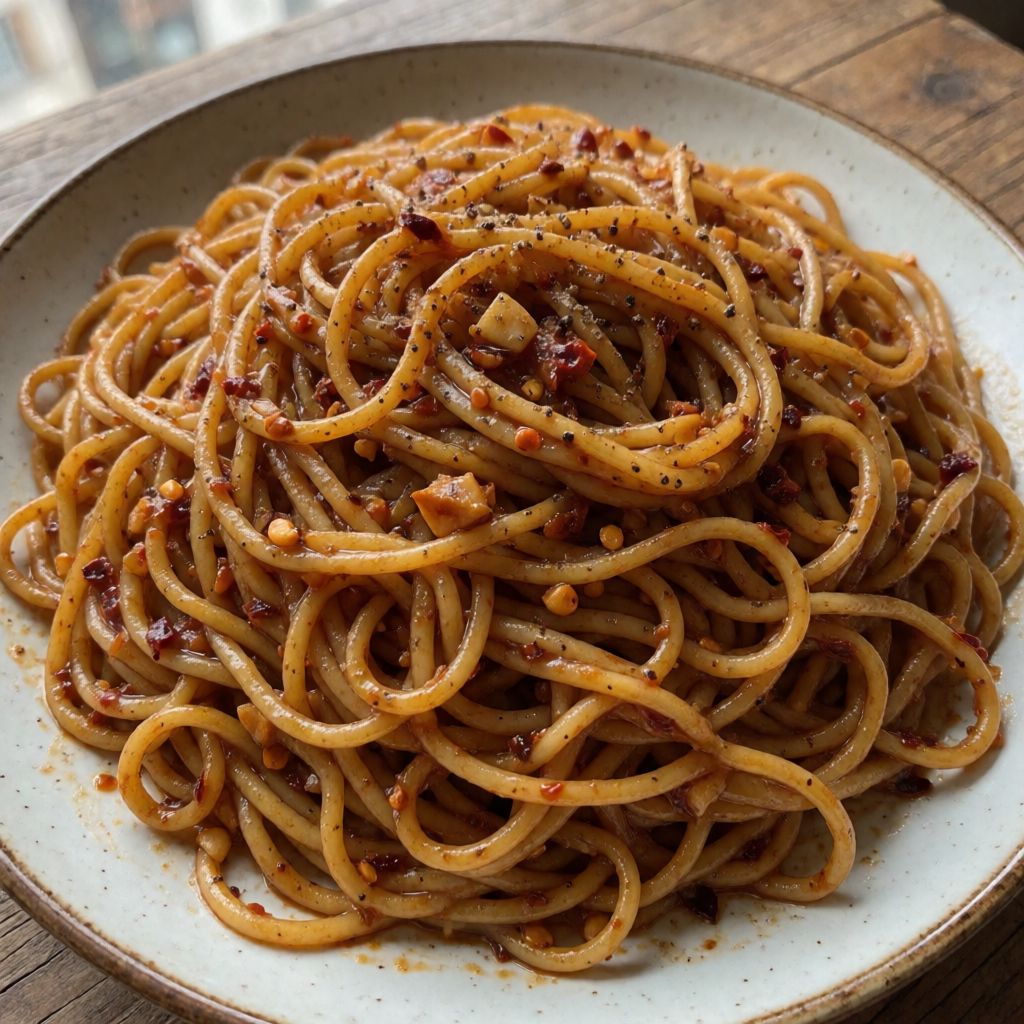
 AI photo
Spicy Chinese-Style Noodles
A spicy noodle dish with a rich sesame-peanut sauce, beef, and greens.
Labels are worked out automatically from the ingredients and can be wrong. Check the packaging if it matters to you.
Ingredients
- 100 ml Sesame oil
- 3 clove Garlic finely chopped
- 1 tsp Chilli flakes
- 1 tsp Sichuan pepper ground
- 3 tbsp Tahini
- 1 tbsp Peanut butter
- 1 tbsp Soy sauce
- 2 tbsp Hoisin sauce
- 2 tbsp Rice vinegar
- 2 tbsp Sugar
- 1 tbsp Sichuan pepper optional, less to taste and heat preference
- 400 g Beef mince
- 1 tsp Five spice
- 400 g Noodles egg noodles preferred
- 300 ml Stock
- 120 g Spinach
- 1 pcs Pak choi head, cut into long strips
- 30 g Peanuts finely chopped, salted
- 2 pcs Spring onion finely chopped















Steps
Put the sesame oil, garlic, chilli flakes and Sichuan pepper into a pan; heat slowly, taking care the garlic doesn't brown
4 minSimmer the mixture over medium heat for 3-4 minutes to release the aroma, then cool and pour into a bowl
Mix the tahini and peanut butter with soy sauce, hoisin sauce, sugar and rice vinegar until creamy
2 minAdd water or stock to the sauce as needed until creamy; season with sugar, Sichuan pepper and vinegar to taste
1 minCook the noodles according to the packet instructions, drain and rinse with iced water to stop cooking
8 minBring the chicken stock to a quick boil, add the spinach and pak choi, stir and remove from heat
3 minHeat a pan with oil on high heat, add the meat and fry well, stirring, until it starts to caramelise
5 minSprinkle the meat with the five spice mix, stir, add half of the Dan Dan sauce and bring to the boil, stirring constantly
2 minFry until the meat is caramelised and slightly crisp
3 minDivide the noodles among bowls, top with the meat, vegetables and Dan Dan sauce to taste
1 minPour the chicken stock with vegetables into the bowls, sprinkle with peanuts and spring onion, drizzle with chilli oil to taste
1 min
This is dan dan noodles, dragged out of Sichuan street-cart territory and made to behave in a British kitchen. The name means "carrying pole" — it was sold by men walking the alleys of Chengdu with two baskets slung on a bamboo pole, one holding noodles, the other the sauce and toppings. That's why the dish is built in separate pieces that only meet in the bowl at the end: chilli oil, nutty sauce, fried mince, stock with greens, noodles. You're not cooking one thing — you're running four small operations in parallel and converging them at the last minute.
What decides whether it works is restraint in two places. First, the chilli oil: garlic must infuse, never fry. The moment it goes from pale gold to actually browned, it turns bitter and that bitterness sits in the oil for the rest of the dish — there's no fixing it after. Second, the mince: it needs real contact with a hot pan, not a gentle simmer in its own juice, or you get grey crumbs in liquid instead of something crisp-edged and savoury. Everything else — the sauce ratios, the stock, the garnish — is forgiving. Those two aren't.
Some say dan dan noodles has to be fiery to be "authentic" — no, because the heat is adjustable by design: the Sichuan pepper and chilli flakes are a separate component (the oil) from the base sauce, specifically so you can dial each up or down without wrecking the other. A mild version is not a betrayal of the dish; it's the dish working as intended.
Sesame oil here is doing a job, not adding flavour on its own — it's the carrier for garlic, chilli and Sichuan pepper, infusing at a temperature low enough that you can still smell your own kitchen and not a frying pan. You want it warm enough to shimmer gently, cool enough that a piece of garlic dropped in sizzles quietly rather than spits. Any neutral-smelling oil will carry the infusion fine if you've no sesame oil to hand — sunflower, rapeseed — you just lose the faint toasted backdrop sesame gives for free. Toasted sesame oil specifically, by the way, not the pale cold-pressed kind sold as a cooking oil in some shops; the toasted one is what actually tastes of something.
Tahini and peanut butter are two different kinds of nutty fat doing the same structural job: giving the sauce body so it coats the noodle instead of pooling at the bottom of the bowl like a thin soy dressing would. If you've only got one of the two, use double of it — the dish doesn't collapse without variety, it just tastes slightly more "one-note nutty," which nobody at the table will flag. Hoisin brings sweetness with a fermented edge; soy brings salt and brown depth; rice vinegar cuts through all that richness so the sauce doesn't sit heavy on the tongue — leave it out and the whole bowl tastes muffled, like food eaten with a blocked nose.
Sichuan pepper is the one ingredient people get wrong by expecting heat from it. It isn't chilli-hot — it's the thing that makes your lips and tongue tingle and go slightly numb, a sensation the Chinese call má, which is why dan dan noodles is described as má là, numbing-and-spicy, not just spicy. Ground it loses that tingle fast sitting in a jar, so if yours has been open six months, use more than the recipe says and don't expect miracles — fresh whole peppercorns, toasted in a dry pan a minute until fragrant then ground, are a different ingredient entirely from stale pre-ground dust.
Beef mince is a British-kitchen adaptation — the Chengdu original uses pork, because pork was the everyday meat there the way beef is here. Use what your butcher sells well and cheap; lamb mince works too if you want something gamier, it just needs a touch more acid at the end to balance it. The point of frying it hard rather than gently is Maillard browning — that crust only forms above the temperature at which water boils off the meat's surface, so a crowded pan or one that's not properly hot just steams the mince in its own liquid and you never get past grey. Fry in batches if your pan's small; a domestic hob rarely throws enough heat to sear a full 400g at once without dropping the temperature.
Rinsing the noodles in iced water isn't fussiness, it's stopping carryover cooking — noodles pulled straight from boiling water keep cooking in their own residual heat and turn to paste by the time they hit the bowl. The ice bath is a hard stop. Egg noodles are specified because the egg gives them a bit of chew and structure that plain wheat noodles don't have; if you can't get them, a fresh linguine or even a dried spaghetti will carry the sauce adequately, you'll just lose some of that springy bite that's part of the point.
Patience shows up in exactly one place here: the garlic infusion. Everything else in this recipe moves fast — searing, boiling, assembling — but that first four minutes wants you to just watch the pan and do nothing else, because garlic burnt is garlic you can't un-burn, and it's the one mistake in the whole dish with no recovery. Get a kettle of tea on while you wait. That's what the four minutes are for.