
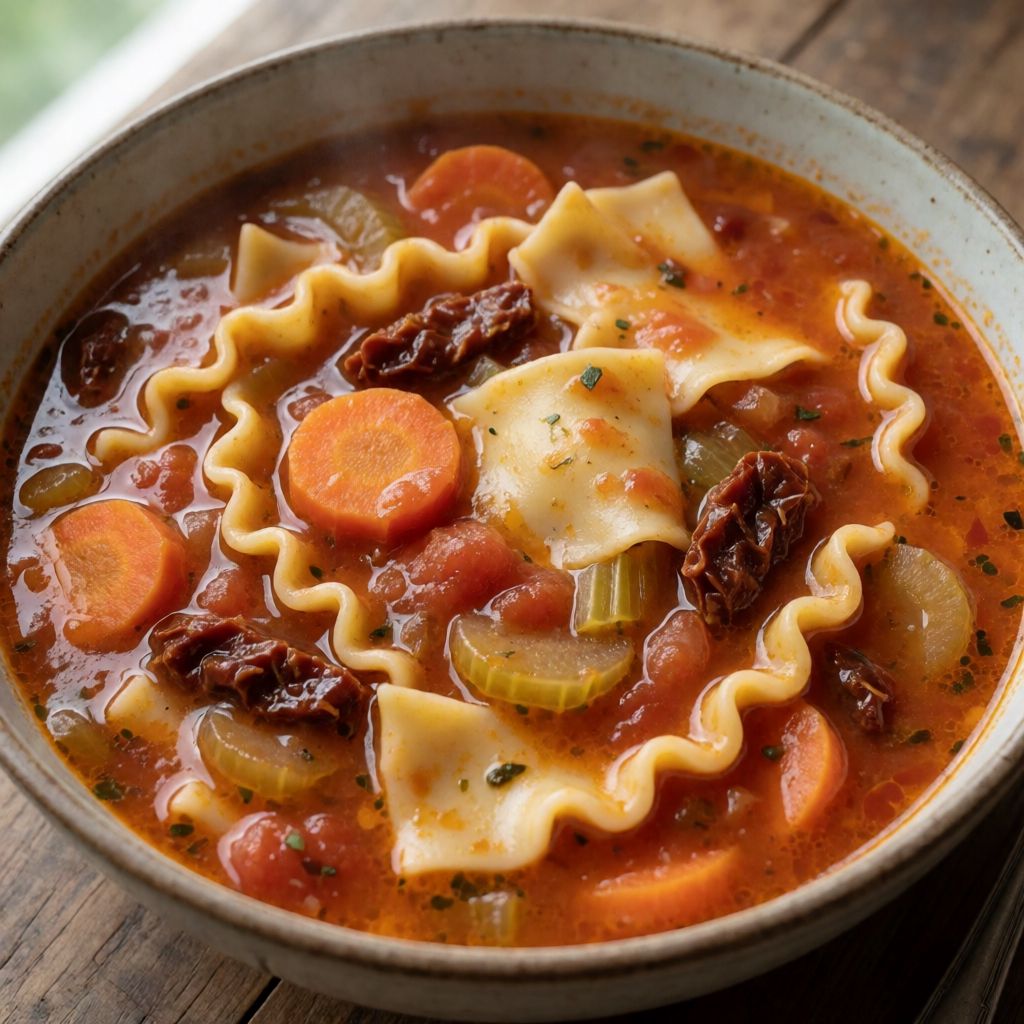
 AI photo
Vegetarian Lasagne Soup
A hearty vegetarian soup that combines all the comforting flavours of lasagne in a bowl.
Labels are worked out automatically from the ingredients and can be wrong. Check the packaging if it matters to you.
Ingredients
- 1 pcs Onion finely chopped
- 3 clove Garlic
- 2 pcs Carrot finely diced
- 2 pcs Celery stalks, finely diced
- 40 g Sun-dried tomatoes finely chopped
- 1 tsp Dried thyme
- 1 tsp Dried rosemary
- 75 g Red lentils
- 150 g Black beluga lentils
- 400 g Canned chopped tomatoes
- 1 l Vegetable stock
- 100 g Lasagne sheets fresh
- 1 bunch Basil fresh
- 2 tbsp Olive oil
- Salt
- Black pepper freshly ground
- 1 pcs Burrata
- 75 g Parmesan freshly grated
- 1 bunch Basil fresh

















Steps
Sauté the onion, garlic, carrot, celery and sun-dried tomatoes in a pot with the oil over medium heat.
Add the spices, red lentils, beluga lentils, chopped tomatoes and vegetable stock, and bring to the boil.
Cover and simmer for 30-40 minutes, or until the lentils are tender.
35 minCut the lasagne sheets into smaller pieces and add them to the soup.
Simmer the soup for a further 3-4 minutes, until the pasta is tender.
4 minSeason with salt and freshly ground pepper to taste.
Stir fresh basil into the soup and serve hot in bowls.
This is lasagne with its architecture knocked down — the same filling, the same starch, the same cheese finish, but nobody's layering sheets and nobody's waiting for a bake to set. You get the soup pot to do the work a lasagne dish does over an hour in the oven, in half the time, and the reward at the end is the same: a spoon that tastes of tomato, herb and melted cheese all at once. It's a weeknight answer to a Sunday-roast dish — same comfort, none of the scaffolding.
What decides whether it works is the two lentils, and most people only use one. Red lentils collapse — they have almost no seed coat left after milling, so they break down into a thickening puree, giving the broth its body. Beluga lentils (the small black ones, named for their resemblance to caviar, not because they taste of anything oceanic) keep their shape because their coat is intact; they give you something to actually chew. Use only red and you've made a lentil gravy with pasta in it. Use only beluga and the broth stays thin and separate. The pairing is the whole trick, and it's a cheap trick — lentils are among the least expensive proteins you can buy, which is half of why this dish exists at all. Peasant food dressed as a city soup.
Start with the vegetable base — onion, garlic, carrot, celery. This is soffritto, or mirepoix if you want the French name, and it's not there for flavour alone; it's there because raw alliums and raw carrot taste sharp and a little bitter, and heat with oil is what converts that sharpness into sweetness. You're not looking for colour here, you're looking for the onion losing its rawness — it goes translucent, loses its bite on the tongue, before anything else happens. Some say you need high heat to "seal in" flavour at this stage — no, because there's nothing to seal; what you're doing is slow enough heat that the sugars have time to develop before the vegetables scorch and turn bitter in the opposite direction. If your hob runs hot, pull it back a notch rather than rushing this — a burnt edge on a sun-dried tomato will sour the whole pot later, because there's no straining it back out.
Sun-dried tomatoes earlier in that sauté than the canned ones is deliberate — they're already concentrated, and a little time in the fat lets their oil-soaked sweetness spread through the base rather than sitting as separate chewy flecks later. If you can't get them, a tablespoon of tomato purée fried briefly in the same pan does a similar job — concentrated tomato cooked in fat before liquid goes in, which is the principle, not the brand.
The two lentils: red lentils are split and hulled, which is why they cook fast and fall apart — there's no coat to hold them together. Beluga (or use Puy/green lentils if beluga's not on the shelf — any lentil with its skin left on behaves the same way) takes the full simmer time to go from firm to yielding, and that's your real timer for the soup, not a clock. Taste one at the 30-minute mark: if it still squeaks a little between your teeth, it needs longer, whatever the number says.
Dried thyme and rosemary go in early, with the liquid, because dried herbs need time and moisture to rehydrate and release their oils — thrown in at the end they just sit on top, gritty and useless. This is the reverse of what you do with the fresh basil, which goes in last precisely because heat destroys its aromatics almost immediately; cook basil for ten minutes and you've made spinach.
Fresh lasagne sheets are a genuine convenience here over dried — if you only have dried, you can still use them, but you'll need to start them a few minutes earlier and check more often, since dried pasta carries almost no moisture and takes properly longer to soften. Either way, break them by hand into rough pieces rather than cutting neat squares — a lasagne soup doesn't need the discipline of a baked one, and uneven pieces actually catch more broth per bite.
On the stock: vegetable stock here is doing what lasagne's meat ragù would otherwise supply — savoury depth. A thin, salty cube-stock will leave the soup tasting flat under the richness of the cheese at the end, so if you're making your own, don't skimp it down to water with a cube dissolved in — simmer it properly, or buy a decent bought one.
Finally, parmesan and burrata are not interchangeable despite looking similar on a shelf — parmesan is the savoury, salty backbone you'd stir through at serving for seasoning depth; burrata is pure cream and fresh curd, added whole per bowl so it melts into pockets of richness rather than dissolving evenly like a grated cheese would. If burrata isn't to hand, a torn ball of fresh mozzarella with a spoon of double cream dropped alongside gets you close — the point is cream plus soft curd, not a specific Italian name on the label. This feeds four properly, more as a starter with bread alongside if you're six round the table after a roast the day before.