
 AI photo
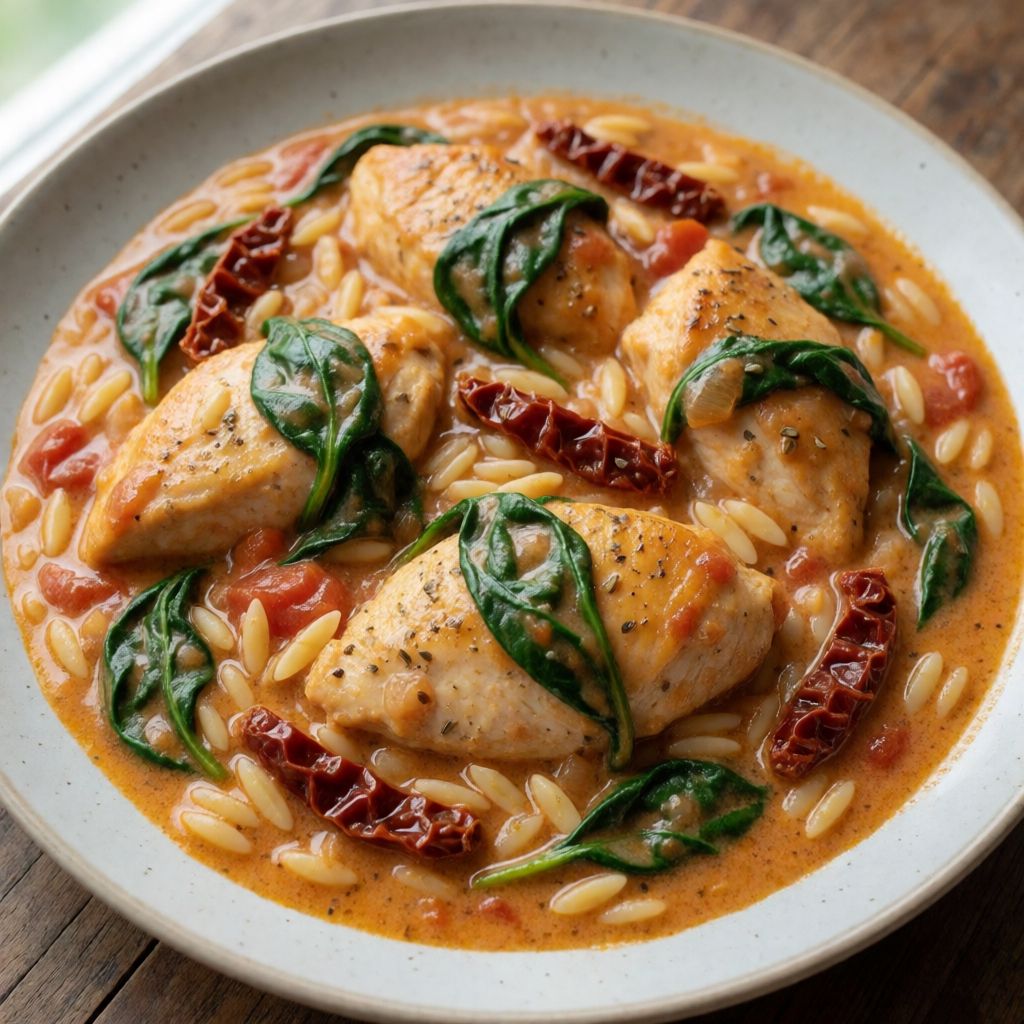
Chicken in Creamy Tomato Sauce with Orzo and Spinach
A cosy one-pot supper of chicken, orzo and spinach in a creamy tomato sauce.
Labels are worked out automatically from the ingredients and can be wrong. Check the packaging if it matters to you.
Ingredients
- 600 g Chicken breast cut into large cubes
- 1 tbsp Plain flour
- 2 pcs Onion finely chopped
- 4 clove Garlic finely grated
- 75 g Sun-dried tomatoes finely chopped
- 2 tsp Oregano dried
- 1 tsp Dried thyme
- 0.5 tsp Dried rosemary
- 100 ml Double cream
- 3 tbsp Tomato paste
- 800 ml Stock
- 400 g Orzo pasta
- 1 bunch Basil fresh
- 100 g Spinach
- 100 g Parmesan finely grated
- 2 tbsp Olive oil
- 10 g Butter for frying
- Salt
- Black pepper fresh



















Steps
Pat the chicken dry with paper towel and toss it in a mixture of flour, salt and pepper.
Heat a pan with olive oil, add the butter and let it melt.
Fry the chicken over medium heat until nicely coloured and golden.
Remove the chicken and let it rest briefly on a plate.
In the same pan add the sun-dried tomatoes, onion and garlic and sauté for a few minutes over medium heat.
Add the oregano, thyme, rosemary, cream, tomato paste and two-thirds of the stock, stir and bring to the boil.
Add the orzo and chicken to the sauce, stir and cover with a lid.
Simmer covered over medium heat, stirring occasionally, for 10-12 minutes until the pasta is tender.
11 minStir in the baby spinach, Parmesan and basil leaves, season with salt and pepper.
This is a one-pan pasta that borrows its whole logic from risotto, except the grain is orzo and you don't need to stand there stirring your life away. The chicken gets fried hard first — not to cook it through, just to colour it, because that colour is flavour that never comes back once liquid hits the pan. Then everything else — the sauce, the starch, the pasta — happens in the fond that frying left behind.
What decides whether this works is one thing: whether the orzo cooks in the sauce rather than floating in it. Orzo looks like rice and behaves like pasta — it needs to be mostly submerged, stirred now and then so it doesn't catch on the bottom in one spot and stay chalky two centimetres away, and it needs enough liquid that by the time it's tender, the sauce has thickened by absorption rather than by boiling dry. Some say add the pasta separately, boiled, and stir it through at the end — no, because then you've made two dishes and washed two pots, and you've lost the whole point, which is orzo cooking inside tomato and chicken stock until it tastes of both.
The cream and the Parmesan go in late for the same reason you don't boil a custard: heat and acid together will split dairy, and tomato paste is acid. Cream stirred in early, simmered hard for ten minutes next to tomato — you risk a sauce that looks slightly curdled, still tastes fine, but looks wrong on the plate. Stir it in with everything simmering gently, not rolling, and it stays glossy.
Chicken breast is the right cut here only because it's quick and forgiving if you don't overcook it — but it's also the cut most likely to go dry, because it has almost no fat to protect it. The flour coating before frying isn't decoration, it's a barrier: it browns before the meat underneath gets a chance to seize up, and it later helps thicken the sauce slightly as it dissolves in. If you want more margin for error, thigh meat does the same job and is harder to ruin — cheaper too, which is worth knowing since breast is the one upcharge supermarkets quietly bank on.
Sun-dried tomatoes aren't there to top up the tomato flavour — tomato paste already does that job hard. They're there for concentrated sweetness and a bit of chew, the kind fresh tomatoes can't give you out of season, which is most of the year in this country. If you haven't got them, a tablespoon more tomato paste and a pinch of sugar gets you close, though you lose the texture.
Onion and garlic go in after the chicken comes out, into the same fat, for the oldest reason there is: that fat is full of everything the chicken left behind, and the onion's job now is to pick it all up off the bottom of the pan as it softens. This is also where the flour-and-butter method earns its keep — butter alongside the oil isn't there for flavour alone, it browns faster and helps that fond form in the first place, which is the whole base of the sauce. Skip it and the sauce tastes thinner, less knit together.
Dried herbs — oregano, thyme, rosemary — make sense here precisely because they're dried. They need time in a liquid to open up, and a fifteen-minute simmer is exactly that time. Fresh herbs of the same kind would either scorch in the dry pan or barely register before the dish is done; save fresh for the basil at the end, which works in the opposite way — it wants heat for seconds, not minutes, or it just wilts into bitterness.
Stock is doing double duty: it's the cooking liquid for the orzo and the main body of the sauce, so use one with actual flavour — a proper chicken stock, homemade or a good bought one, not a stock cube dissolved in hot tap water and called the same thing. If stock's thin, the orzo cooks in flavourless water and the cream and tomato paste end up carrying a weight they're not built for.
Parmesan at the end is seasoning more than ingredient — salt, savoury depth, a bit of body from the starch it releases as it melts in. Any hard, aged grating cheese with real character does the same job; a bagged pre-grated "Italian hard cheese" from the cold shelf usually won't, because it's often bulked out and doesn't melt the same way, it just goes stringy and separates.
For the oil: anything with no smell of its own, so olive oil here isn't about flavour, it's about having a fat that can take the heat of frying without the butter alone burning. A mild rapeseed oil does exactly the same work if that's what's in the cupboard — sunflower too. Extra virgin olive oil, with its strong character, you'd save for finishing a dish, not frying chicken in it.
Last thing — patience with the simmer. Ten to twelve minutes is the lower bound, not a deadline; orzo in a thick, acidic sauce behaves differently pan to pan, pot to pot. You're watching for the grain going from chalky-white-centred to uniformly opaque and soft enough to bite without resistance, with the sauce clinging rather than pooling. Lift the lid, stir, taste a grain — don't just watch the clock on the cooker and hope.