
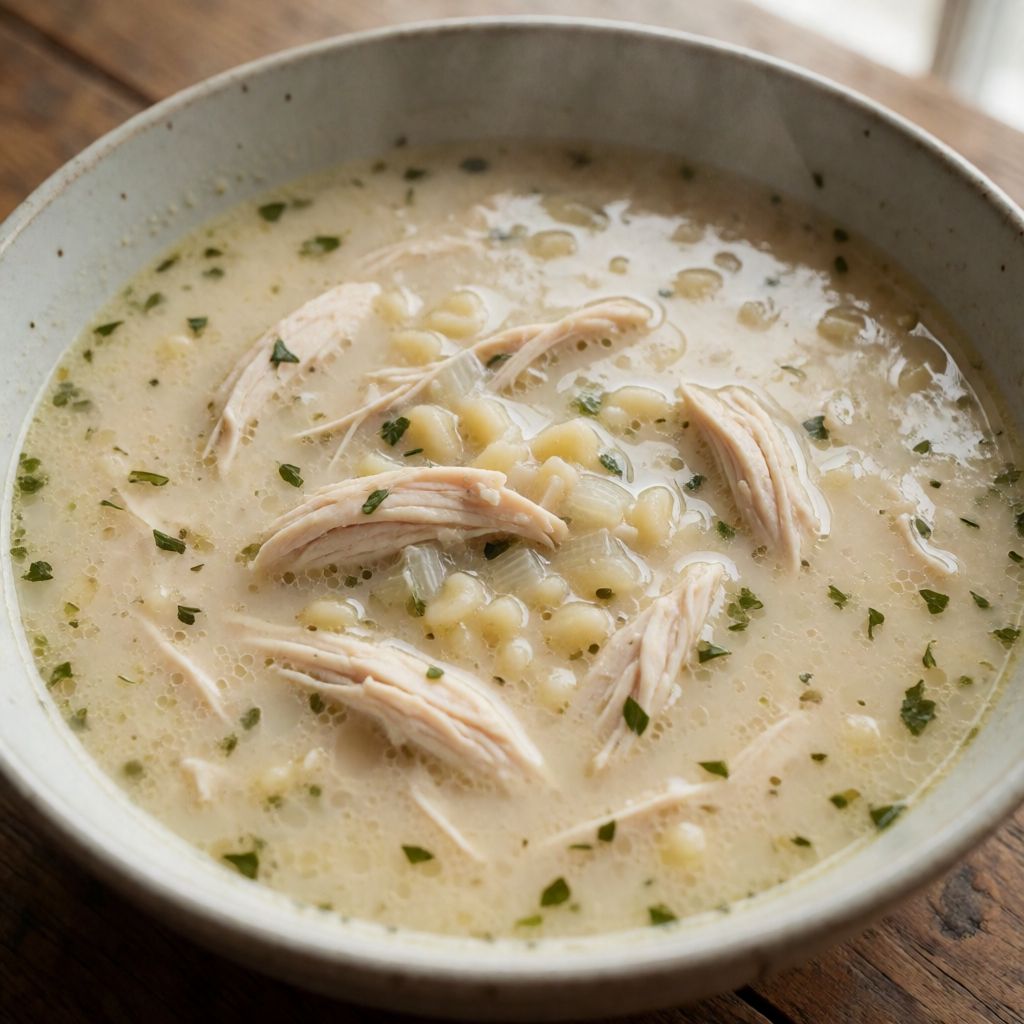
 AI photo
Creamy Chicken Pasta Soup
A comforting creamy soup with chicken, pasta, courgette and spinach, finished with crispy prosciutto and basil.
Labels are worked out automatically from the ingredients and can be wrong. Check the packaging if it matters to you.
Ingredients
- 1 pcs Onion finely chopped
- 4 clove Garlic finely chopped
- 2 tsp Dried thyme
- 1 tsp Dried rosemary
- 1 tsp Fennel seeds
- 500 ml Vegetable stock
- 1 l Chicken stock
- 300 g Courgette coarsely grated
- 2 pcs Celery coarsely grated
- 400 g Chicken breast
- 300 g Pasta
- 200 g Spinach
- 100 ml Double cream
- 100 g Parmesan freshly grated
- 2 tbsp Olive oil for frying
- Salt
- Black pepper freshly ground
- 90 g Prosciutto
- 1 bunch Basil fresh















Steps
Place the prosciutto on a baking tray lined with baking paper and bake for 10 minutes at 180°C, until crisp.
10 minFry the onion in a pot with the oil over medium heat until soft.
4 minAdd the garlic, thyme, rosemary, fennel seeds, courgette, celery, the vegetable and chicken stock, and the whole chicken breast fillet. Bring to the boil and simmer covered for 10 minutes.
3 minAdd the pasta shells and simmer covered for another 10 minutes, until the chicken is cooked through.
10 minRemove the chicken fillet from the soup and shred the meat with two forks once the pasta is perfectly tender, then return the meat to the soup and stir in the double cream.
2 minAdd the baby spinach and Parmesan just before serving and sprinkle with the crumbled crispy prosciutto and basil.
1 min
This isn't quite a soup and isn't quite a pasta dish — it's chicken noodle soup that got ambitious and borrowed cream and Parmesan from a risotto. The whole thing hinges on cooking the chicken breast whole, in the liquid, not pre-fried and diced. A whole fillet poached gently stays juicy because it loses moisture slowly through its own thickness; cut it into cubes first and you've multiplied the surface area that leaks juice into the stock, and you get dry, stringy bits by the time the pasta's done.
What decides whether it works is timing two things that have different textures of "done": the chicken (springs back, no pink, juices run clear if you nick it) and the pasta (bends without resistance, not a bullet in the middle). They go in together because they roughly take the same time in a simmering pot — that's not a coincidence, it's why the recipe is built this way. Pull the chicken too early and it's raw in the middle; leave it in too long after it's cooked and it turns to cotton wool, because muscle fibre keeps tightening and squeezing out water the longer it sits in hot liquid past doneness.
Onion first, in oil, over heat gentle enough that it softens rather than browns hard at the edges — you want it translucent and sweet, not caramelised, because this soup wants a mild background, not a deep roasted one. Garlic goes in after, briefly, because garlic burns in the time onion needs to soften, and burnt garlic is bitter in a way nothing afterwards fixes.
The dried herbs — thyme, rosemary, fennel seed — are there because this is a Sunday-roast-chicken flavour profile moved into a bowl of broth; it's the same herb logic that goes with a roast bird, just simmered instead of roasted. Fennel seed specifically gives a faint aniseed lift that stops the dish tasting like plain chicken soup and nudges it somewhere a bit more savoury-complex. If you haven't got fennel seed, leave it out rather than substitute something stronger — it's a background note, not a structural one.
Two stocks, vegetable and chicken, rather than all chicken: this isn't fussiness, it's dilution and layering. All chicken stock on its own can taste flat and one-note once you've also added a chicken breast to it; the vegetable stock brings a different, slightly sweeter base that keeps the whole liquid from tasting like concentrated chicken and nothing else. If you've only got chicken stock in the cupboard, use it for the whole 1.5 litres — the soup will be a shade richer and a shade less rounded, not ruined.
Courgette and celery are grated coarse rather than diced because grated vegetable cooks through and softens almost as fast as the broth comes to a simmer — no waiting for chunks to catch up, no biting into a hard lump of celery at the table. This is a kitchen shortcut as much as a texture choice: in a home pan without a kazan's steady heat, grating does the work that long, slow simmering would otherwise need to do.
Chicken breast, not thigh: breast is the lean cut, it poaches clean in a light broth without throwing off much fat, and because it's whole it's forgiving of the ten-minute window the recipe gives it. Thigh would work too and is harder to overcook, but it'll cloud the broth with more fat — fine if you don't mind a richer soup, wrong if you want this clean, brothy character.
Pasta shells catch sauce and hold a bit of the cream in their curve — any small shape that does the same job will do; what you don't want is a long strand shape like spaghetti, which fights the spoon. Double cream is the fat that carries flavour and gives the broth body without flour or a roux — some will tell you a soup needs a thickener to feel "proper," but that's for a different kind of soup; here the cream, the starch shed by the pasta, and the Parmesan at the end are doing that job between them. Parmesan freshly grated, not the dried tub kind, because pre-grated Parmesan is often cut with anti-caking starch and doesn't melt into a sauce the same way — it goes gritty instead of silky. Any firm, salty hard cheese that melts without turning oily will substitute, Grana Padano being the obvious stand-in.
Spinach in at the end, baby leaves if you can — they wilt in seconds; mature spinach takes longer and can leave tougher stems behind, so if that's what you've got, strip the thickest stalks first. Basil fresh, torn rather than chopped with a knife if you want to avoid the cut edges blackening on the plate. And the prosciutto — crisped dry in the oven, no oil needed because its own fat renders out and does the crisping — gives you the one bit of texture in the bowl that isn't soft, which is most of why it's there at all.