
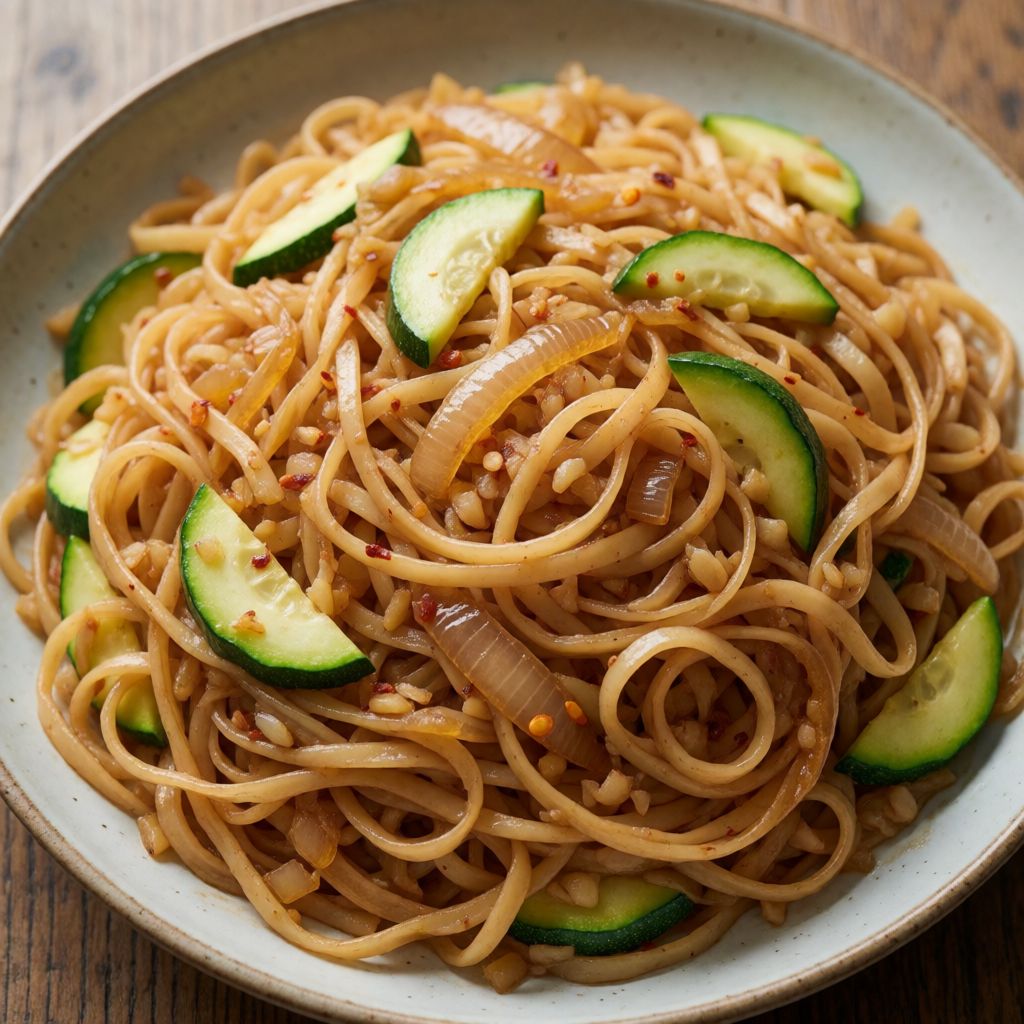
 AI photo
Vegetarian Pad Thai with Vegetables
A quick vegetarian pad Thai packed with crunchy vegetables, eggs and a tangy tamarind sauce.
Labels are worked out automatically from the ingredients and can be wrong. Check the packaging if it matters to you.
Ingredients
- 300 g Noodles
- 1 pcs Onion finely chopped
- 3 clove Garlic finely chopped
- 1 tbsp Ginger finely grated
- 1 tsp Chilli flakes
- 1 pcs Courgette diced
- 1 pcs Broccoli cut into florets
- 1 pcs Sweetheart cabbage shredded
- 4 pcs Eggs
- 200 g Bean sprouts
- 4 pcs Spring onion finely sliced
- 3 tbsp Sesame oil or another oil for frying
- Black pepper to taste
- 2 tbsp Rice vinegar
- 2 tbsp Soy sauce
- 2 tbsp Sugar
- 3 tbsp Tamarind or more to taste
- 1 bunch Coriander roughly chopped
- 2 pcs Lime cut into wedges
- 50 g Peanuts finely chopped
- 1 pcs Red chilli finely chopped












Steps
Mix the vinegar, soy sauce and sugar, gradually adding the tamarind paste and tasting as you go.
5 minCook the noodles according to the packet instructions and rinse in ice-cold water. Drain well.
10 minHeat the oil in a wok, add the onion, garlic, ginger and chilli flakes, and fry briefly.
2 minAdd the courgette, broccoli and cabbage. Put the noodles into the wok and stir-fry quickly.
5 minCrack the eggs into the wok and stir until they just begin to set.
3 minAdd the pad Thai sauce, bean sprouts and spring onion. Mix well.
2 minServe with fresh coriander, peanuts, lime and red chilli.
Pad Thai isn't a sauce poured over noodles — it's a balancing act performed in about ninety seconds of real heat, and everything before that is just getting your ingredients to the start line at the same moment. The dish was street food: cheap, fast, built around a wok that gets hotter than any domestic hob, by vendors who needed to turn a plate in under two minutes to keep the queue moving. That's the whole logic of it. Your wide pan at home will never roar the way a gas-ring wok burner does, and no amount of wishing changes that — so you compensate by doing almost everything else first, and using the heat only for the final assembly.
What decides whether it works is sequencing, not skill. The noodles get cooked and shocked in cold water well before they ever see the pan again — not for texture alone, but because wet, starchy noodles dumped straight from boiling water into a crowded pan will clump and steam instead of fry. The sauce — fish-sauce-sharp, sweet, sour from tamarind — gets mixed separately and tasted before it goes anywhere near heat, because once it's in the pan with everything else, you can't un-salt it or un-sour it. Tamarind's acidity is temperamental between brands, so "3 tbsp, or more to taste" is the only honest instruction anyone can give you.
Noodles: flat rice noodles are traditional because rice was the cheap, local starch in Thailand — wheat noodles would've been an imported luxury. At home any flat noodle that holds its shape after cooking works; thin rice vermicelli will just turn to paste in a hot pan, so avoid those if you can. The cold-water rinse after boiling isn't fussiness — it stops the noodles cooking further on residual heat and washes off surface starch, which is exactly what stops them welding together into one solid block when they hit the wok a second time.
Onion, garlic, ginger, chilli flakes: this quartet is your aromatic base, and it goes in on its own, briefly, before anything wet or bulky joins it. The real failure this guards against is garlic burning while you're still chopping the next vegetable — garlic turns bitter fast once it colours past pale gold, and bitterness doesn't cook out, it sits there all the way to the plate. Fry it only long enough to smell it change, not to see it brown.
Courgette, broccoli, cabbage: these are the vendor's improvisation — pad Thai traditionally used whatever vegetable was cheap that week, which is exactly why a vegetarian version with a mixed vegetable box isn't a betrayal of the dish, it's the dish doing what it's always done. Cut them roughly the same size so they finish at roughly the same time; broccoli florets that are twice the size of your courgette dice will leave you choosing between raw stalk and mush.
Eggs: four eggs for four people is not generous by accident — in a vegetable-and-noodle dish with no meat, egg is where the protein and the richness live. Push it in loosely and let curds form rather than scrambling it fine; fine curds disappear into the noodles and you lose the texture contrast that makes a forkful interesting.
Sauce — rice vinegar, soy sauce, sugar, tamarind: this is pad Thai's entire identity concentrated into four spoons. Soy sauce gives you the saltiness that fish sauce would traditionally provide — it's the honest vegetarian swap, not a compromise, because what you're actually after is savoury depth, not fish specifically. Rice vinegar is a clean, short acidity; if you haven't got it, any vinegar without a strong flavour of its own — white wine vinegar, for instance — will do the acid job, just taste and adjust because they're not equally sharp. Sugar balances both, and tamarind brings a fruitier, deeper sourness that vinegar alone can't fake — if you have no tamarind, lime juice stirred in at the end gets you closer than leaving it out entirely.
Bean sprouts and spring onion go in last, off or barely on the heat, because their whole appeal is crunch — cook them and you've made a different, worse dish. Peanuts, coriander, lime wedges and fresh chilli are not garnish in the decorative sense; they're the last chance to adjust the plate to your own taste — more acid, more heat, more crunch — after the pan has already made its decisions. Sesame oil gives a background nuttiness that's genuinely part of the flavour here, so if you swap it, pick something with no smell of its own — a neutral vegetable or groundnut oil — rather than another strongly flavoured oil that'll compete with it. Patience is the one ingredient not listed: have your sauce tasted, your noodles rinsed and your vegetables cut before the pan is hot, because once it is, you've got no time left to think.