
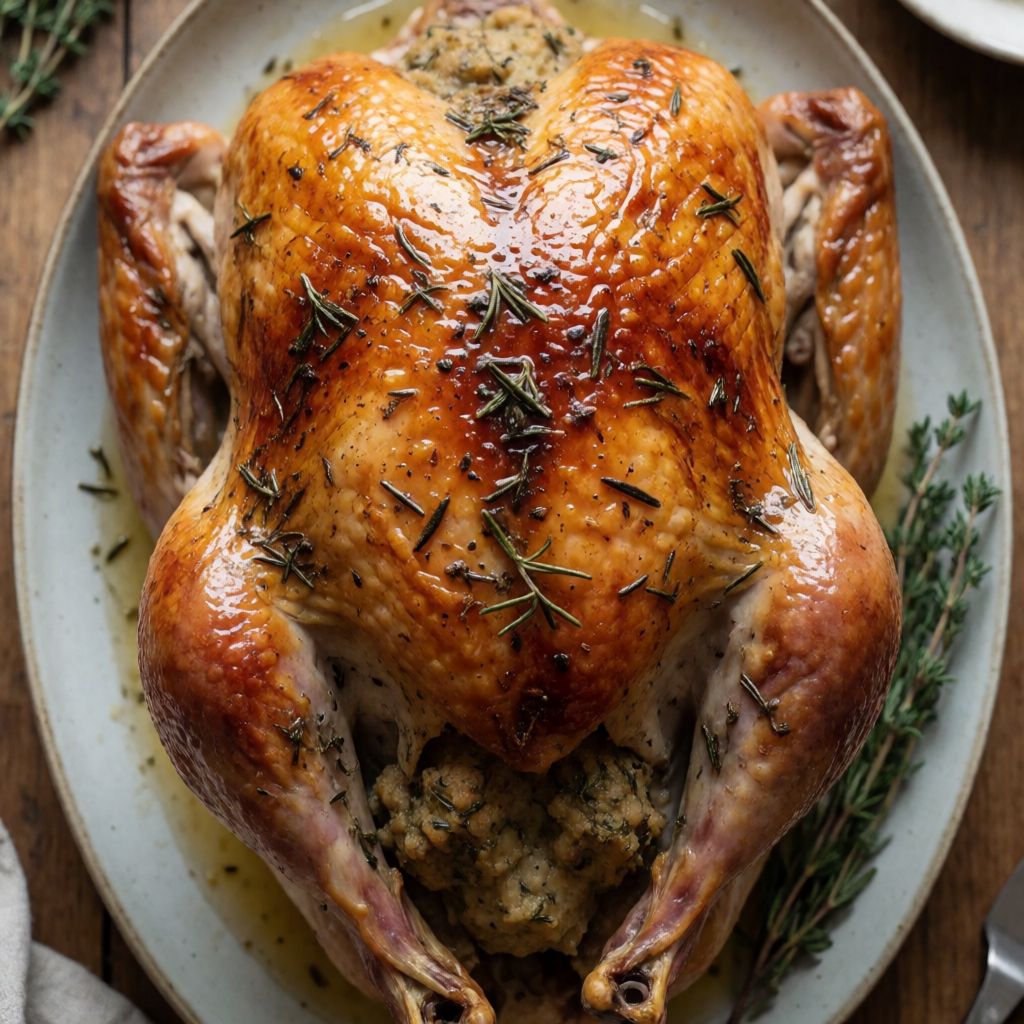
 AI photo
Stuffed Turkey
A whole turkey brined and filled with a rich pork, dried apricot and herb stuffing, roasted with a vegetable trivet for a classic festive centrepiece.
Labels are worked out automatically from the ingredients and can be wrong. Check the packaging if it matters to you.
Ingredients
- 1 pcs Turkey 6-7 kg
- 1 kg Salt
- 500 g Sugar
- 10 l Water
- 3 pcs Rosemary fresh sprigs
- 3 pcs Thyme fresh sprigs
- 3 pcs Sage fresh
- 3 pcs Bay leaf
- 100 g Dried apricots finely diced
- 150 ml Port wine
- 100 g Bread finely diced
- 250 ml Double cream
- 500 g Minced pork
- 1 Turkey liver finely chopped
- 1 Turkey heart finely chopped
- 2 tsp Thyme fresh
- 1 tsp Sage fresh
- 1 tsp Rosemary fresh
- 0.5 tsp Nutmeg finely grated
- 0.5 pcs Lemon zest only, finely grated
- 2 pcs Onion finely grated
- 50 g Walnut finely chopped
- 30 g Pine nut toasted and finely chopped
- Black pepper freshly ground
- 200 g Butter
- 125 g Bacon sliced
- 2 pcs Onion quartered
- 2 pcs Leek cut into large pieces
- 2 pcs Carrot cut into large pieces
- 4 pcs Celery cut into large pieces
- 4 pcs Bay leaf
- 2 pcs Rosemary fresh sprigs
- 2 pcs Thyme fresh sprigs
- 10 pcs Black pepper
- 1 Turkey gizzard
- 1.5 l Water
- 20 g Butter
- 20 g Plain flour
- 100 ml Double cream
- 1 tsp Caramel food colouring if needed





















Steps
Defrost the turkey in the fridge or in a closed box outdoors at around 5-7°C.
4320 minThe day before cooking, submerge the turkey in the brine, having first removed the giblets.
1440 minBring 1 litre of water to the boil with the salt, sugar and aromatics, cool, add the remaining water and pour over the turkey as brine.
Leave the turkey in the brine for a day in a cool place.
1440 minPut the diced apricots in a bowl and cover with the white port, leave to soak overnight.
1440 minPut the diced bread in a bowl with the double cream, add the soaked apricots and port, and mix.
Chop the turkey liver and heart, mix with the minced pork, bread, cream, apricots, herbs and nuts.
Make a small test patty and fry it in a pan to check the seasoning.
Remove the turkey from the brine and pat it thoroughly dry inside and out with kitchen paper.
Rub the turkey with salt and freshly ground pepper, both inside and out.
Make a deep pocket between the breast meat and the skin, and season the inside with salt and pepper.
Slide 100 g of butter in slices in a thin layer into the pockets between the skin and the breast meat.
Fill the turkey with the stuffing, without packing it too tightly.
A whole bird, brined for a day, boned enough to take a loose pocket of stuffing under the skin, and roasted — except this card stops at the stuffing, before the oven even gets a look-in. What decides whether the whole thing works is settled long before it's hot: the brine, and how much restraint you show when you fill it.
Brining isn't about flavour going in, it's about water staying in. A turkey breast is a lean, dense muscle with almost no fat running through it, which means it has nothing to baste itself with from the inside. Left raw and roasted, the proteins tighten as heat climbs and squeeze moisture out faster than the dark meat can cope with — that's why the breast is always dry before the legs are even cooked through. Salt dissolved in water forces its way into the muscle fibres and changes how tightly they can clench when heated, so the meat holds on to more of its own juice. The sugar in there isn't for sweetness you'll taste, it's to soften the edge of that much salt and help the surface brown later. Some say brining is just for flavour, like a marinade — no, a marinade sits on the surface, brine rearranges the structure of the meat itself.
Start with the turkey itself. Six to seven kilos feeds a proper Sunday-roast table — ten, maybe twelve, with leftovers for sandwiches the next day, which in most British kitchens is half the point of cooking a bird this size at all. Defrosting it slowly in the fridge, over days rather than hours, isn't fussiness — a bird this size thawed at room temperature will have its outer layers sitting in the danger zone for bacterial growth long before the centre has given up its ice. Patience here isn't optional, it's the ingredient that keeps everything after it safe.
The brine proportions matter more than they look like they should: a kilo of salt and half a kilo of sugar in ten litres of water is a working ratio, not a guess, strong enough to move through a six-kilo bird in a day without over-salting it. If you haven't got a container big enough for a whole turkey and ten litres — and most domestic kitchens haven't — a clean cool-box or a large catering bag inside a washing-up basin does the same job; the point is full submersion and a cold spot, not a specific vessel.
The stuffing ingredients split into three jobs. Bread soaked in cream is the binder and the moisture bank — it swells, holds liquid, and keeps the whole mix from turning tight and meatball-dense as it cooks. The pork mince brings fat the lean turkey liver and heart don't have; liver and heart themselves bring iron-rich depth that plain pork alone won't give you, and if you can't get them, more minced pork with a splash of chicken liver from the butcher does the job close enough. Dried apricots soaked in port are there to cut through all that richness with something sharp and a little sweet — dried prunes or figs in the same soak work on the same principle, anything dried and fruit-acid-forward that can take a few hours in alcohol. The walnuts and toasted pine nuts are texture against all that softness; leave them out if you're cooking for nut allergies and nobody will think the stuffing's failed, it'll just be smoother.
Grated onion rather than diced is worth noticing — grating breaks the cell walls right open, so the onion gives up its moisture and sweetness into the mix instead of staying as separate crunchy pieces fighting the texture of everything around it. Nutmeg and lemon zest are both there in small amounts for the same reason: to lift the richness of cream and pork fat without announcing themselves, so don't be heavy-handed just because the quantities look small on paper.
Testing the mix with a fried patty before it goes anywhere near the bird is not a chef's flourish, it's the only honest way to judge seasoning in raw meat — you cannot taste raw pork and liver safely, and under-salted stuffing inside a brined bird will taste flat by contrast, since everything around it is now well-seasoned. Any oil with no smell of its own works for frying the test patty — a flavourless vegetable or sunflower oil, nothing you'd notice if you weren't looking for it — because the point of the patty is to taste the mix, not the pan.