
 AI photo
Japanese-Style Bacon Waffles (Okonomiyaki)
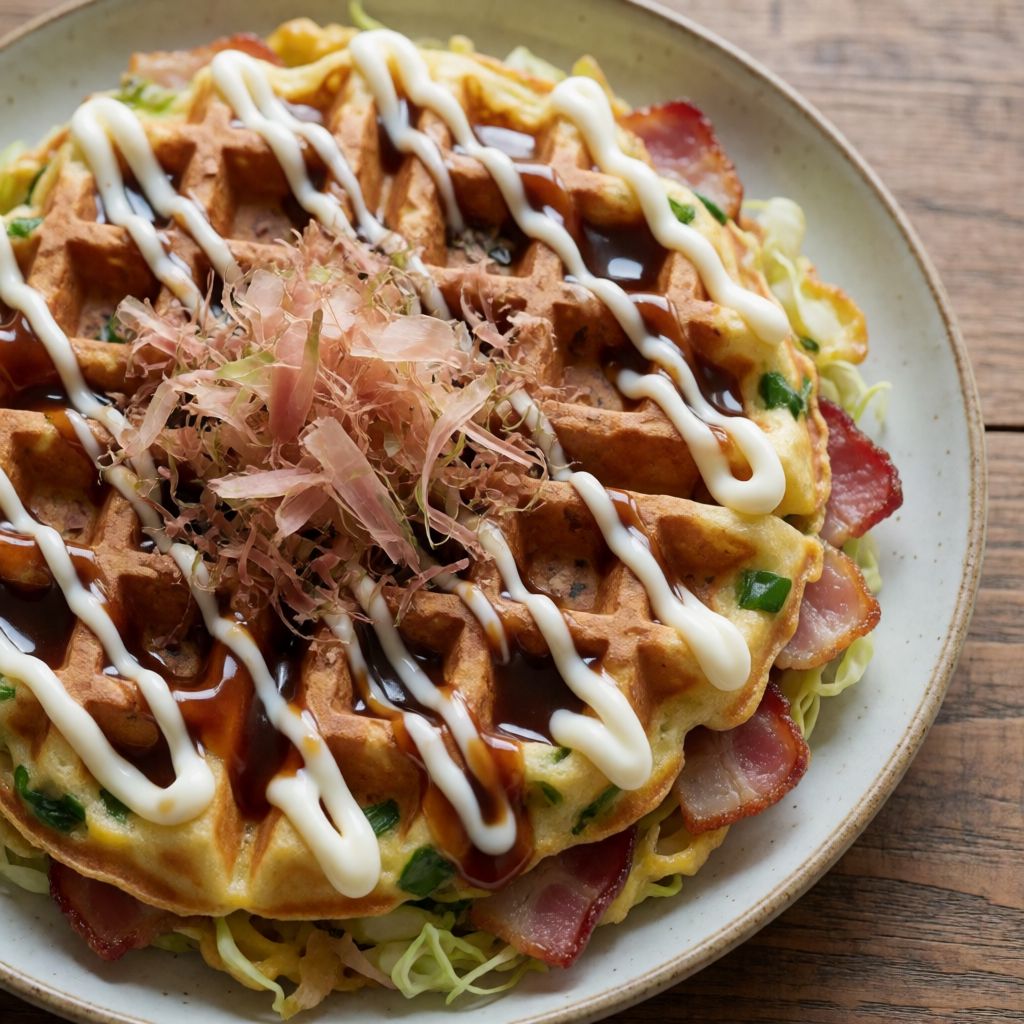
A savoury Japanese-style waffle batter folded with cabbage and topped with crispy bacon, spring onion and a sweet-savoury sauce.
Labels are worked out automatically from the ingredients and can be wrong. Check the packaging if it matters to you.
Ingredients
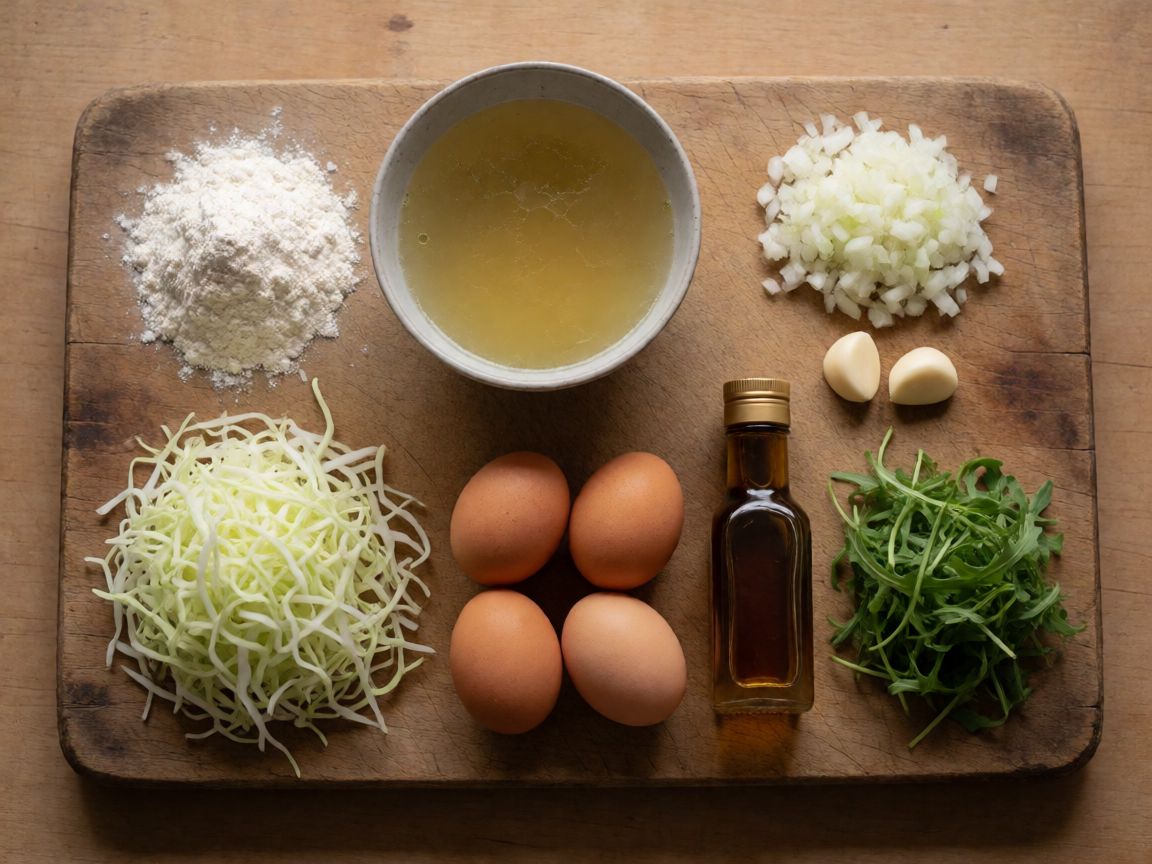
- 200 g Plain flour
- 400 ml Vegetable stock
- 1 pcs Onion finely chopped
- 2 clove Garlic finely chopped
- 4 pcs Eggs
- 400 g Pointed cabbage very finely chopped
- Salt
- Black pepper freshly ground
- 1 tbsp Sesame oil for frying
- 75 g Rocket
- ½ pcs Cucumber sliced
- 100 g Bacon fried crisp and finely chopped
- 2 pcs Spring onion sliced
- 2 tbsp Mayonnaise
- 1 bunch Watercress
- 25 g Sesame seeds
- 1 tsp Chilli flakes












For the dressing
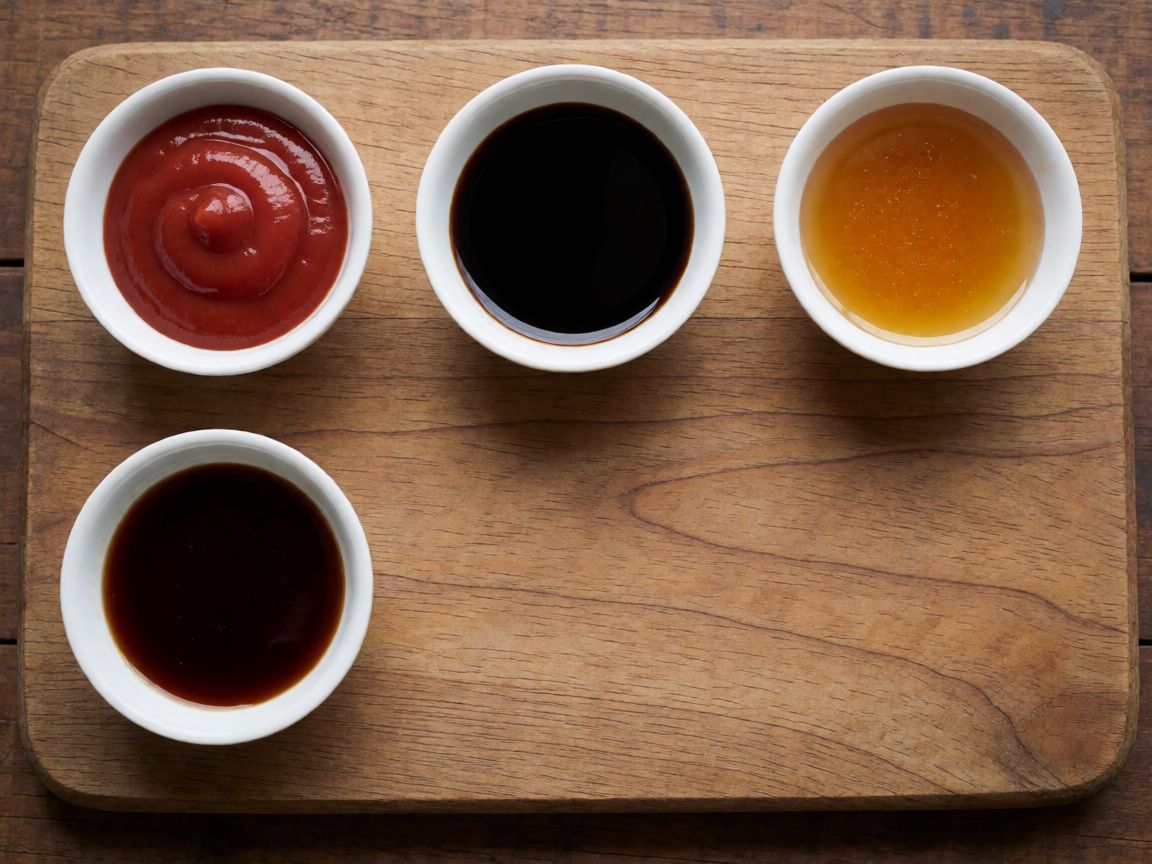
- 2 tbsp Ketchup
- 1 tbsp Soy sauce
- 1 tsp Honey
- 2 tbsp Worcestershire sauce



Steps
Mix the flour and vegetable stock in a bowl to a thick batter.
Leave the batter to rest on the kitchen counter for 10 minutes.
Meanwhile, fry the onion and garlic in a pan with a little oil until soft.
Add the fried onion, eggs and finely chopped pointed cabbage to the batter in the bowl, along with salt and freshly ground pepper, and mix well.
Cook the okonomiyaki waffles in a waffle iron brushed with oil until golden and cooked through.
For the okonomiyaki dressing: mix the ketchup, soy sauce, honey and Worcestershire sauce until smooth and adjust to taste.
To serve: stack two waffles on a plate and spread a little okonomiyaki dressing between them.
Scatter the finely chopped bacon, spring onion, and strips of okonomiyaki dressing and mayonnaise over the top.
Sprinkle with watercress, sesame seeds and spring onion before serving.
Forget what you think okonomiyaki is supposed to be. The real thing is cooked on a flat iron griddle in Osaka, a thick batter-and-cabbage pancake turned once with two spatulas, built up in layers. This version swaps the griddle for a waffle iron. That sounds like a gimmick, and it is one — but it's a smart one, because what a waffle iron actually gives you is two hot plates pressing from both sides at once, which is the one thing a domestic hob struggles to do with a pancake. No flipping, no half-raw middle, no collapsed edge. The iron does the job the Japanese cook does with two metal spatulas and a lot of practice.
What decides whether this works is the batter-to-cabbage ratio, and specifically how wet that cabbage is. Pointed cabbage, chopped fine, is mostly water held inside rigid cell walls. Salt it too early or let it sit too long once mixed, and it weeps, and your "thick batter" turns into soup that floods out the sides of the waffle iron and burns onto the plates instead of cooking into the waffle. That's why you mix at the last moment and get it into the iron — patience earlier, speed here.
The second thing that decides it is the stock-to-flour ratio producing a batter thick enough to hold cabbage suspended, not thin enough to run. Thick, not pourable — closer to a scone dough loosened with liquid than to a crepe batter. If yours runs off a spoon in a thin stream, add a spoonful more flour before it ever meets the cabbage.
Start with the batter rest — ten minutes on the counter, not in the fridge. That's not laziness, it's physics: flour needs time for the liquid to actually penetrate the starch granules and the gluten strands to relax after mixing, otherwise your waffle fights you, comes out tight and a bit rubbery at the edge instead of tender. Ten minutes is the floor, not a stopwatch deadline — if your kitchen's cold, give it a few more. You'll know it's ready because the batter sits heavier in the bowl, less grainy-looking, more like it's settled.
The onion and garlic get fried first and go in cooked, not raw — this matters more than it looks. Raw onion in a short-cook batter stays sharp and a little bitter; what you want is the sweetness that only comes from heat breaking down the onion's sulphur compounds, which needs real contact with a hot pan, not the brief heat of the waffle iron itself. Fry it until it turns from white to translucent and smells sweet rather than sharp — that's the cue, not a timer. Any neutral oil works here; you don't need the sesame oil yet, save that flavour for the iron itself where it actually touches the batter and gets tasted.
Pointed cabbage (sometimes called sweetheart cabbage here) is specified because it's tender and slightly sweet with thin leaves that cook through fast — standard round white cabbage is tougher, needs longer, and will still have crunch when your waffle's done, which throws the texture off. If you can only get round cabbage, slice it thinner than you think you need to and accept it'll have a bit more bite. Savoy works too, and has the advantage of being what a lot of British greengrocers actually stock.
The eggs are structural, not just enrichment — they're what sets around the starch and cabbage under heat and stops the whole thing falling apart when you lift it out of the iron. Four eggs for 200g flour is a generous ratio; don't be tempted to cut it back, a loose waffle that can't hold its own weight is the single most common okonomiyaki failure, and it's always an egg or liquid problem, not a cooking-time problem.
Sesame oil for brushing the iron: use it for the nutty flavour, not as your only option. Any oil with a high enough smoke point and no smell of its own that would fight the sesame — a flavourless vegetable or sunflower oil — will do the actual job of stopping the waffle sticking. If you want the aroma without the cost, brush with a neutral oil and drizzle literally a few drops of sesame oil over the batter in the iron itself; you get the smell for a fraction of the oil.
The dressing split — Worcestershire, soy, ketchup and honey on one side, mayonnaise on the other — mimics Japan's own okonomiyaki sauce and Kewpie mayo, both of which are themselves adaptations: Japanese okonomiyaki sauce descends from Worcestershire sauce, brought in by British trading ships in the 1800s and sweetened and thickened for the Japanese palate. So building your own version from British pantry Worcestershire sauce isn't a compromise, it's closing the loop — you're using the ancestor to recreate the descendant. Taste the mix before you use it; honey varies, ketchups vary, adjust by spoonfuls until it's thick enough to sit in a line without running, sharp-sweet enough to cut the egg and bacon fat.
Bacon has to be fried properly crisp, not just cooked — this isn't about the bacon itself but about what it does once scattered over the stack. Limp bacon goes soggy under the mayonnaise lines within a minute; crisp bacon holds its crunch a while longer and gives you a contrast against the soft waffle that's most of the point of adding it at all. Chop it only once it's cold and crisp — hot bacon crumbles unevenly and you lose the little crisp shards that are the whole reason it's there.
No waffle iron at hand? A wide, heavy frying pan works, but accept its limits honestly: you'll only get heat from below, so you need a lid — or failing that, a plate pressed loosely over the pan — to trap enough heat above the batter to set the top without burning the base solid. Lower heat than you'd think, patient enough that the edges firm up before you attempt to turn it, because this is where home cooks lose okonomiyaki — flipping too soon, into a wet centre, and the whole thing folding on itself. Watch the edge: when it looks matte and holds together rather than glistening and wet, it's ready to turn.