
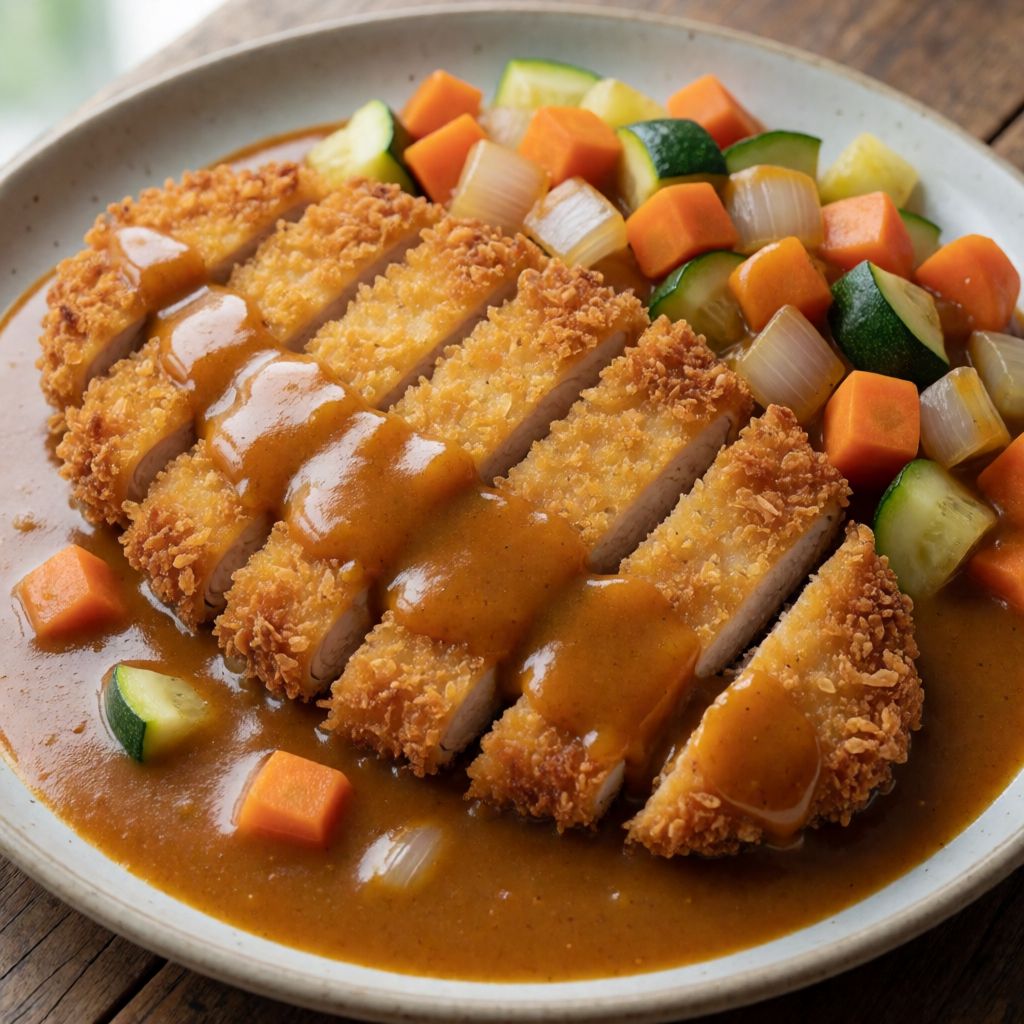
 AI photo
Chicken Katsu with Curry Sauce
Crispy breaded chicken breast served with a mild curry sauce, rice and crunchy pointed cabbage.
Labels are worked out automatically from the ingredients and can be wrong. Check the packaging if it matters to you.
Ingredients
- 2 tbsp Curry powder medium heat
- 300 g Courgette diced
- 3 pcs Carrot diced
- 2 pcs Onion finely chopped
- 4 clove Garlic finely chopped
- 1 pcs Apple diced
- 1 tsp Turmeric ground
- 400 ml Coconut milk
- 100 ml Stock a little more if needed
- 1 tsp Soy sauce
- 1 tsp Sesame oil
- Black pepper freshly ground
- 600 g Chicken breast
- 1 tsp Plain flour
- 2 pcs Eggs
- 75 g Panko breadcrumbs dried
- 50 ml Sesame oil for frying
- Salt
- 300 ml Basmati rice cooked according to packet instructions
- 2 pcs Spring onion stalks, finely chopped
- ½ pcs Pointed cabbage a half head, thinly shredded
- 1 tsp Sesame seeds
- 1 tsp Chilli flakes



















Steps
Toast the curry powder in a dry pan over medium heat until fragrant.
Add oil, courgette, carrot, onion, garlic, apple and turmeric, and stir well for a few minutes.
Add the coconut milk, cover and simmer for about 15 minutes or until the carrot is tender.
Blend the sauce with a blender until completely smooth.
Adjust the consistency with chicken stock to the desired thickness and season to taste with soy sauce and pepper.
Lightly flatten the chicken breasts to even out the thickness — this ensures a shorter frying time, keeping the meat juicy and the crumb from burning.
Beat the eggs in a deep bowl, and tip the panko into another deep bowl.
Coat the chicken breasts in plain flour seasoned with salt and pepper, then dip in the beaten egg and coat in panko.
Fry in a pan over medium heat in oil for about 6 minutes on each side, until crisp and golden.
Check that the chicken is cooked through.
Put the thinly shredded pointed cabbage in a bowl, add a pinch of salt and massage with your hands for about a minute to soften it.
Serve the chicken katsu hot with rice, pointed cabbage and finely chopped spring onion, sprinkled with sesame seeds and chilli flakes.
This is two separate dishes meeting on one plate, and the whole thing hinges on keeping them separate until the last second. A curry sauce — British curry-house style, not anyone's grandmother's, blended smooth as a soup — and a piece of fried chicken with a crust that has to stay a crust. Pour the sauce over the crumb too early and you've made soggy toast with a drumstick inside it. That's the one rule that actually matters here.
The sauce is curry powder's whole job description. It's a dry mix of spices that have already been roasted once at the factory, then ground — which means the aromatic oils in them are sitting dormant, and a few seconds in a hot dry pan wakes them back up before anything wet goes near them. Skip this and you get a sauce that tastes of raw powder — flat, a bit chalky, not unpleasant exactly, just thin where it should be deep. You'll smell the difference: one moment it's just spice dust, the next it smells like a kitchen you want to stay in.
Everything that follows the spices — courgette, carrot, onion, garlic, apple, turmeric — isn't there to be tasted as itself. It dissolves. The carrot's sweetness, the apple's sweetness and acid, the onion's body: all of it gets blended into the coconut milk until there's no texture left, only flavour. So don't treat the carrot pieces as a vegetable side-dish-in-waiting — cut them small, because the test for "done" is simply whether the blender can turn them to silk, and a big chunk left too firm will leave a fibrous fleck in an otherwise smooth sauce.
Curry powder: "medium heat" on the jar means nothing without a brand attached — one maker's medium is another's mild. Taste yours before you commit two tablespoons of it to a pan; if you're not sure, start with less and toast more in at the end, because toasted-but-under-seasoned is fixable and toasted-and-scorched isn't. Any curry powder blend works here — the dish doesn't demand a specific one, it demands that it be fresh. Powder that's been in the cupboard since the last coronation will toast but won't bloom; buy it in a size you'll use within a few months.
Coconut milk is the body of the sauce, and the tin matters more than the recipe suggests. A cheap tin, mostly water with a thin cap of cream, will never thicken past "watery curry" no matter how long you simmer — you're better off using less stock and letting that tin's own fat do the work. A full-fat tin with a solid cream layer gives you a sauce that coats a spoon rather than running off it. If you only have light coconut milk, cut the added stock right back and compensate later; don't expect the simmer alone to fix a thin base.
Turmeric here is doing colour and a faint bitterness, not flavour you'll clock on its own — it's the thing that keeps the whole sauce from looking like beige soup. The apple is the quiet trick: a touch of sweetness and acid so the sauce doesn't read as flat coconut-and-spice. Any firm, not-too-sweet apple works; a soft, mealy one will just collapse into mush rather than contribute brightness, so reach for something crisp.
For the chicken: flattening the breast isn't about tenderising, despite what people say about tenderising mallets breaking down muscle fibre — no, because a thin mallet-bash mostly just bruises and tears the surface. What it actually does is even out the thickness, so the thick end and the thin end finish cooking at the same moment instead of one being raw and the other dry by the time you've waited for the first to catch up. That's the whole point, and it's why step six comes before step nine, not after.
The three-stage coat — flour, egg, panko — each layer has one job. Flour gives the egg something rough to grip, because egg alone slides off smooth wet chicken. Egg is the glue holding the panko on. Panko itself is dried into large, airy shards rather than fine crumbs, which is why it fries into a crust with actual crunch and air pockets instead of a dense, oily shell — a finer breadcrumb will work in a pinch, but it packs tighter and drinks more oil, so the crust turns heavier and greasier rather than light.
Frying oil: anything with a high smoke point and no smell of its own, so the crust tastes of itself, not of the fat — sunflower, groundnut, a light vegetable oil, all fine; a 50ml shallow fry in an ordinary flat-dwelling pan rather than a deep-fryer, so turn the heat down a touch from what you'd use for a thinner cutlet, because at the same heat a thicker piece colours on the outside before the centre's done, and you end up cutting into something pink near the bone. Check doneness by cutting into the thickest point, not by the clock — six minutes a side is a floor, not a ceiling, especially on a domestic hob where the heat under the pan is never quite as even as it looks.
The cabbage salted and massaged for a minute isn't decorative effort — raw shredded cabbage is stiff and a bit bitter; a pinch of salt pulls water out of the cells and softens the leaf within a minute, no cooking required, so what lands on the plate is tender rather than squeaky. It's a bowl, a minute of hand work, nothing more.
This feeds four at a normal appetite, and it's a weeknight dish built from a Sunday-roast instinct — braise a sauce low and slow while you do something else, then a short sharp fry right before serving. The sauce can sit, even improve, made an hour or a day ahead; the chicken cannot wait around once it's crisp. So time your rice and your frying to the sauce, not the other way round, and keep the sauce in its own jug at the table — let people pour it themselves, onto the rice and cabbage, around the chicken rather than over it. Patience here isn't about long cooking; it's about not rushing the pour.