
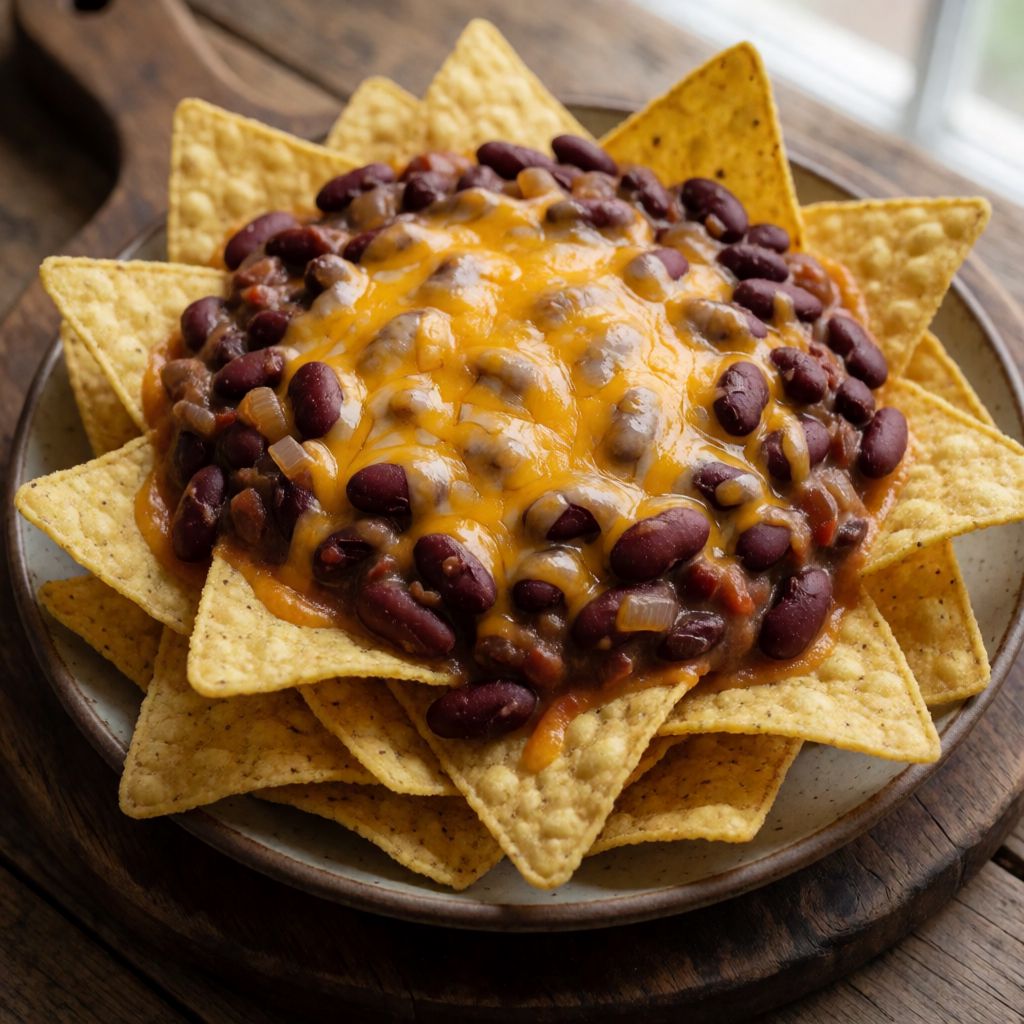
 AI photo
Nachos with Braised Kidney Beans and Cheddar
Loaded nachos with slow-braised kidney beans, melted cheddar, avocado, tomato and crème fraîche.
Labels are worked out automatically from the ingredients and can be wrong. Check the packaging if it matters to you.
Ingredients
- 1 pcs Onion finely chopped
- 2 clove Garlic finely grated
- ½ tsp Chilli flakes
- 1 tsp Cumin ground
- ½ tsp Oregano dried
- 1 can Kidney beans
- 100 ml Stock
- 3 tbsp Olive oil
- Salt
- Black pepper freshly ground
- 150 g Tortilla chips
- 150 g Mature cheddar freshly grated
- 1 pcs Avocado
- 100 ml Crème fraîche
- 1 bunch Coriander fresh
- 300 g Tomato cut into quarters
- 1 pcs Lime cut into wedges
















Steps
Fry the onion in a saucepan with oil until softened.
5 minAdd the garlic and spices along with the kidney beans and mix well for a few minutes.
3 minDip a hand blender into the mixture and pulse briefly so the beans become roughly mashed.
1 minHeat the mixture through well and adjust the consistency with a little stock if needed.
5 minSeason with salt and freshly ground black pepper to taste.
1 minSpread half the tortilla chips in a greased ovenproof dish, scatter over half the braised beans and half the cheddar.
2 minRepeat with another layer and bake the nachos in a preheated fan oven at 200°C for 13-15 minutes, until the cheese has melted.
14 minMash the avocado with half the crème fraîche and season with salt, pepper and a little lime juice.
3 minSpoon the avocado mash over the nacho dish, add dollops of crème fraîche, fresh coriander and tomato.
2 minServe with lime wedges for squeezing over.
1 min
What was changed
Kidney beans was added to the ingredient list because the steps braise kidney beans that were missing from the original list.
Nachos look like a snack you assemble. Really they're two separate cooking jobs stacked on top of each other: a proper bean braise underneath, and a quick melt-and-dress on top. Get the braise wrong — thin, underseasoned, raw-tasting cumin — and no amount of cheddar fixes it, because cheese is a finisher, not a rescue.
The whole dish stands or falls on texture contrast: crisp chip, soft hot bean, molten cheese, cold cream and avocado on top. That's the actual engineering. If the beans go on wet, the chips go soft before the oven even gets to them, and you've made bean soup with crisps floating in it. If the cheese goes on too thin or too late, it sets into a skin instead of a sauce. Everything in the method is there to protect that contrast.
Some say nachos are a dump-everything-on-a-tray dish, no technique required. No — because the one ingredient doing real work, the kidney bean mix, needs the same care you'd give a dal or a ragù: fat first, aromatics bloomed in it, liquid reduced to the right thickness before it ever touches a chip. Skip that and you've got tinned beans with cheese on, which is a different, sadder dish.
Four people, one tray, thirty minutes of actual cooking — most of it unattended in the oven. This is weeknight food dressed as a treat, not a Sunday roast understudy, and it doesn't pretend otherwise.
Start with the onion in oil, not butter — oil tolerates the higher heat of a sauté without the milk solids in butter catching and turning bitter before the onion's even translucent. You want it soft and sweet-smelling, not browned; browning here means caramelisation flavours that fight the clean heat of the chilli and cumin rather than supporting it. That's the "softened" cue to look for: the onion goes from sharp and raw-smelling to mild, and loses its bite when you taste a shred.
Garlic and dried spices go in after, briefly, because raw garlic burns fast and bitter if it hits hot oil alone, and ground spices need a few seconds of fat-contact to open up — that's the whole reason "bloom the spices" is a real instruction and not a flourish. Any neutral oil works for the base — sunflower, groundnut — but olive oil is specified because its own flavour is mild enough not to clash with cumin and oregano, and robust enough to survive the heat. If all you have is a strongly flavoured extra virgin, save it for drizzling, not frying.
The tinned kidney bean is doing a job dried beans would do more slowly and less reliably at home: it's already cooked soft, so your only task is to season it and thicken its liquid into a sauce, not to cook the bean itself. The hand-blender pulse is there to break some beans down for body — a sauce that clings to a chip instead of rolling off it — while leaving others whole for texture. Over-blend and you get bean paste, which slides off a chip instead of sitting on it. The stock is adjustable by eye, not by the tablespoon: you're chasing "thick enough to hold its shape in a spoon," because anything looser soaks straight through a tortilla chip and turns crunch into mush within minutes.
Mature cheddar, not mild, because the oven time here is short and the cheese needs to carry flavour on its own — mild cheddar under heat goes greasy and bland before it's had time to brown. Freshly grated matters for a mechanical reason, not a snobbish one: pre-grated cheese is coated in anti-caking starch that stops it melting smoothly, so it sits in little dry clumps instead of flowing between the chips. If cheddar isn't to hand, any firm, well-aged melting cheese with real character — a strong Lancashire, an aged Gouda — does the same job; a fresh, wet cheese like mozzarella will melt but won't bring flavour.
The avocado-crème fraîche mix and the plain crème fraîche on top aren't decoration, they're temperature control for your mouth: straight off a 200°C bake, molten cheese and hot beans need something cold and fatty to interrupt them, or every bite is just heat. Lime juice in the avocado does double duty — it seasons, and it slows the browning that turns mashed avocado grey and sad within the half hour you'll spend eating. Buy an avocado that gives gently under thumb pressure at the stalk end; rock-hard won't mash, and one that's gone brown inside won't improve no matter how much lime you add.
A domestic fan oven at 200°C is hot enough to melt cheese and crisp edges in under fifteen minutes — but it's a smaller, more even box than a commercial oven, so check at thirteen minutes rather than waiting the full window; cheese that's gone from melted to leathery can't be undone. Build the layers in the dish you're actually going to serve from — nachos moved after baking shed their chips and their nerve. And eat it close to when it comes out: patience earlier in the braise is rewarded, but patience at the table just gets you cold cheese and soft chips, which is the one place in this recipe where waiting is the enemy rather than the method.