
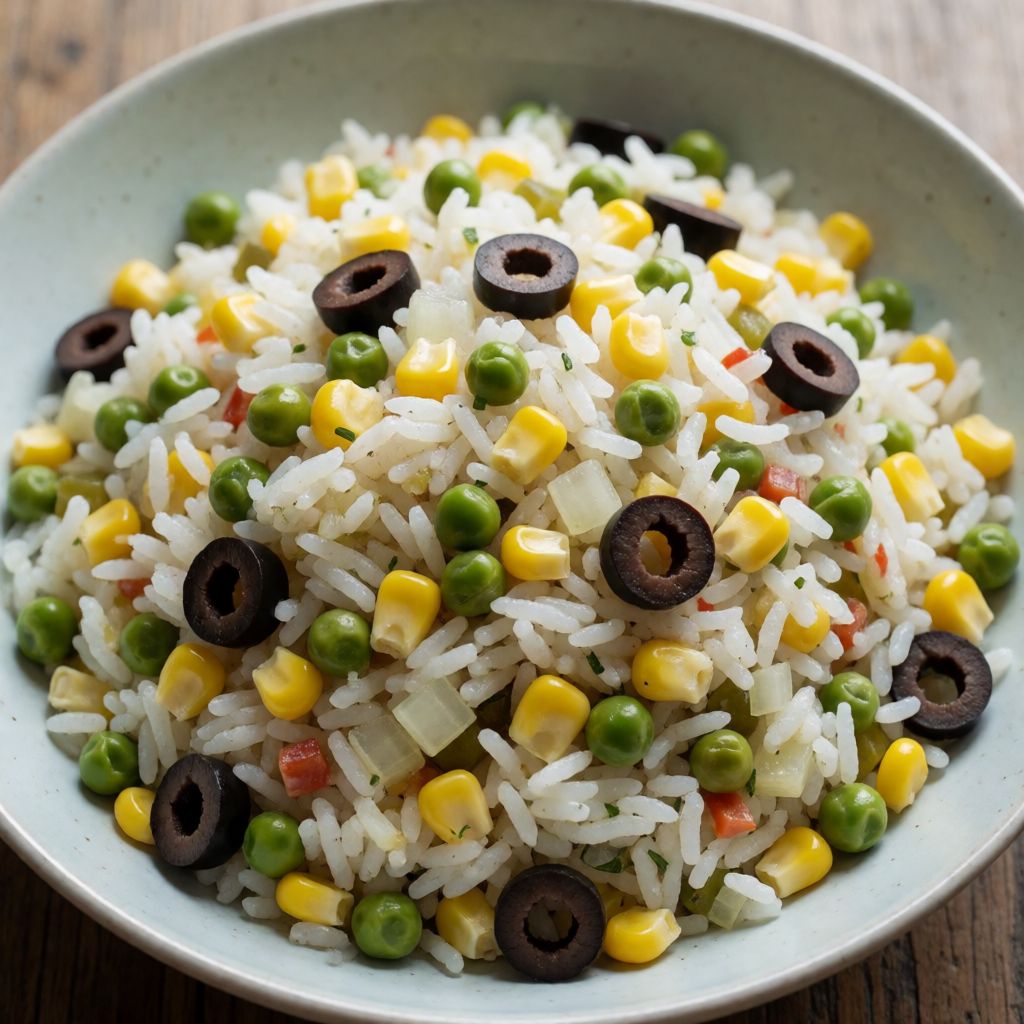
 AI photo
Rice Salad with Pickled Vegetables
A fresh rice salad tossed with pickled vegetables, olives and tomatoes — a cool, colourful dish.
Labels are worked out automatically from the ingredients and can be wrong. Check the packaging if it matters to you.
Ingredients
- 400 g Rice
- 2 tbsp Olive Oil to taste
- 50 g Sweetcorn
- 50 g Peas
- 10 pcs Small Pickling Onions
- 10 pcs Pitted Green Olives
- 10 pcs Tomato
- 10 pcs Pickled Artichoke
- 10 pcs Pickled Gherkins
- 1 pcs Carrot
- Salt for the water







Steps
Boil the rice in plenty of salted water.
20 minDrain the rice into a colander and rinse under cold running water until the water runs clear.
Let the rice cool to room temperature, add a little olive oil and mix.
5 minCut the carrot into thin strips, add all the other ingredients and cut them into small pieces.
5 minMix thoroughly and place in the fridge for half an hour before serving.
30 min
This is a cold rice dish, and that one word — cold — is the whole mechanism. You're not making a warm pilaf and letting it sit; you're deliberately killing the heat so the starch behaves differently and the vegetables stay crisp instead of wilting in residual warmth. Rice salad lives or dies on texture: grains that are separate, not glued, against a scatter of things that crunch, pop, or give a little acid bite. Get that contrast right and it's a dish that feeds four without anyone noticing there's no meat on the plate.
The real decision point is the rinsing. Rice cooked in plenty of salted water releases starch into that water as it swells — fine, that's what makes risotto creamy. But for a salad, creamy is the enemy: it means clumps, and clumps mean a spoonful of mush instead of grains you can taste individually. So you drain, then rinse under cold running water until it runs clear — that's not a rinse for cleanliness, it's a rinse to strip the surface starch off each grain before it has a chance to set into glue as the rice cools. Skip it and you'll get a rice brick by the time it hits the fridge.
Cooling to room temperature before oiling is the second lock. Oil on hot rice soaks into the grain and you lose the separation you just rinsed for; oil on cool rice coats the outside, keeps grains sliding past each other instead of sticking. Some say you can shortcut this by oiling the rice while it's still warm "so the oil absorbs better" — no, because that absorption is exactly what makes the salad clump by the time it's fridge-cold.
Start with the rice itself. You want a variety that holds its shape when boiled hard and rinsed hard afterwards — a mid-length grain rather than anything that goes gluey on its own (skip risotto rice here, it's built for the opposite job). "Plenty of salted water" matters for a mundane reason: rice cooked in a tight, barely-covered pan steams as much as it boils, and steamed rice in a small volume of water re-absorbs its own starchy liquid, which is the clumping problem again, just earlier. A wide pan with real room for the water to move is doing you a favour here — this is one of the rare cases where a British hob's wide, shallow pans are actually the right shape for the job, no kazan needed.
Olive oil "to taste" is really a coating agent, not a flavour you're meant to notice loudly. Any oil with no smell of its own and a clean, slightly round mouthfeel will do the same mechanical job — a light sunflower or rapeseed oil works fine if that's what's in the cupboard; save a more peppery extra-virgin for drizzling at the end if you want its taste to actually register, because cooked rice won't carry a shy oil's flavour far.
Sweetcorn and peas are here for colour and a different kind of bite — sweet, slightly mealy, breaking up the rice's uniformity. Frozen, defrosted versions of either work exactly as well as tinned; there's no mechanism here that demands fresh, since both are blanched before packing anyway.
The pickled onions, gherkins, and artichoke are doing the real flavour work — they're why this isn't just "rice with vegetables." Pickling brine is acid, and acid is what stops a cold starch-and-oil dish from tasting flat; without it you'd need to lean hard on salt instead, and salt alone doesn't cut through oil the way vinegar does. If you're short on pickled artichoke specifically, pickled cauliflower or even a chopped gherkin extra will cover the same job — the criterion is "something vinegary and firm," not the artichoke by name.
Raw carrot cut into thin strips is there precisely because it's raw — it's the one ingredient giving you a genuine snap against everything else's softness. Cut it thin enough that it bends easily in your fingers rather than snapping; that's your doneness cue even though nothing here is cooked — too thick and it reads as a vegetable stick, not a salad component. Tomato, cut small, brings juice and acidity that the pickled items don't quite cover on their own, since pickling brine is sharp but tomato is fresh-sour, a different register entirely.
One honest limit of an ordinary flat kitchen: you won't have a proper salad spinner or a big colander with enough surface area to rinse four hundred grams of rice fast. Don't fight it — rinse in batches if your colander's small, because rice sitting wet and warm in a crowded colander keeps cooking itself from residual heat and you lose the texture you just fought for.