
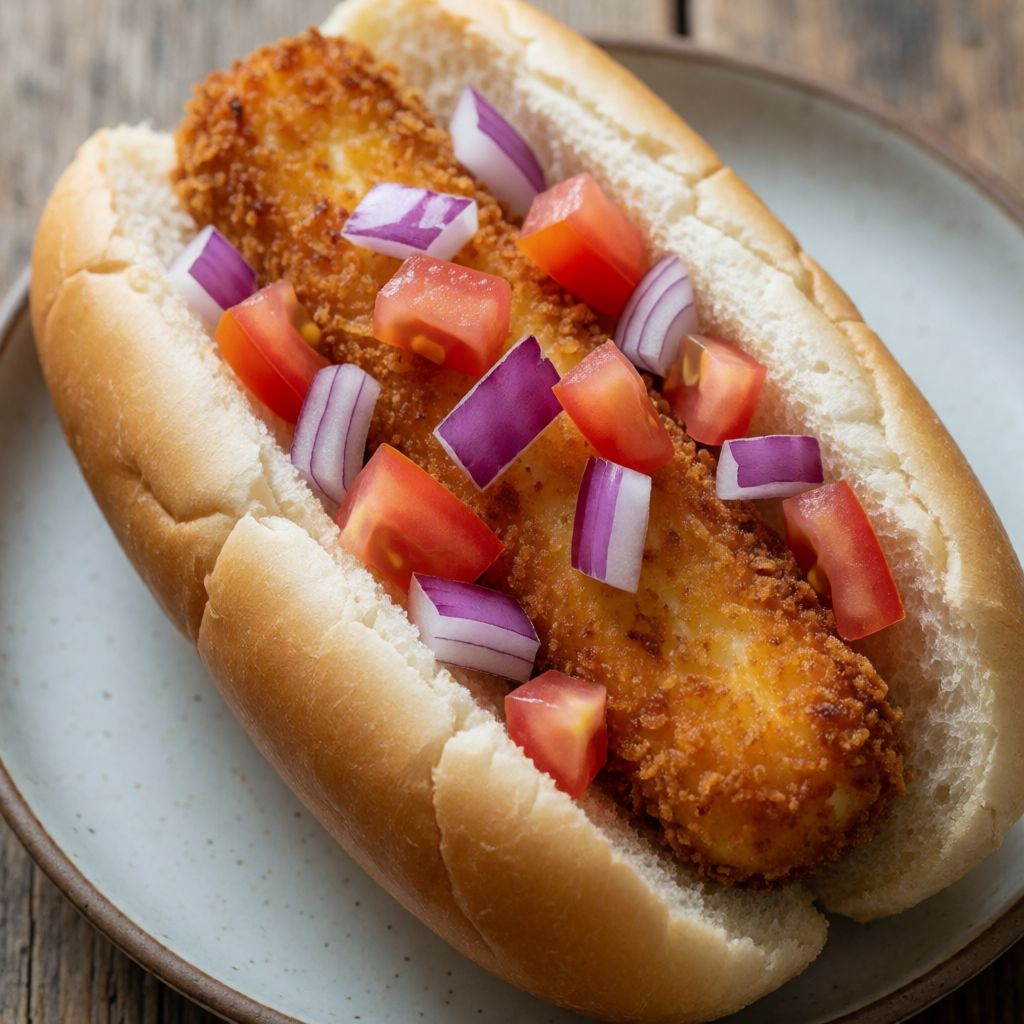
 AI photo
Halloumi Hot Dog
A crispy fried halloumi hot dog topped with pico de gallo, jalapeños, coriander and lime-avocado cream.
Labels are worked out automatically from the ingredients and can be wrong. Check the packaging if it matters to you.
Ingredients
- 200 g Halloumi
- 20 g Plain flour
- 1 pcs Eggs
- 50 g Panko breadcrumbs
- 300 g Tomato finely chopped
- 1 pcs red onion finely chopped
- ½ pcs red chilli finely chopped
- 1 clove Garlic finely chopped
- 1 bunch Coriander finely chopped
- 2 pcs Lime zest and juice
- 2 tbsp Olive oil for frying
- Salt
- Black pepper
- 1 pcs Avocado
- 1 pcs Lime
- 8 pcs hot dog roll
- 50 g Jalapeño
- 1 bunch Coriander finely chopped







Steps
For the pico de gallo, place all the ingredients in a large bowl and mix well.
Adjust to taste, adding more chilli, lime juice and zest, salt and pepper as needed.
Coat the halloumi in plain flour, then in beaten egg and finally in panko breadcrumbs.
Place on a plate and let it rest briefly on the kitchen counter.
5 minHeat a pan with oil and fry the halloumi on all sides until golden and crisp.
8 minWarm the rolls in the oven.
5 minMash the avocado with lime juice and zest, salt and pepper.
Spread the avocado cream onto the rolls.
Place the fried halloumi fingers into each hot dog, then top with pico de gallo, jalapeños and coriander.
This isn't really a hot dog — it's a halloumi finger pretending to be a sausage, dressed in pico de gallo and mashed avocado, stuffed in a bread roll because that's the easiest thing to eat it out of. The whole dish is a crumbing exercise with a salsa and a guacamole either side of it, and what decides whether it works is almost entirely the frying: get that crust crisp and dry, and the squeak-cheese underneath goes soft and salty and holds the whole thing together.
Halloumi is a strange cheese to cook with because it barely melts — it's made to be fried or grilled, which is exactly why it's the only cheese that survives being breaded without turning into a puddle. The crumb coat isn't decoration. It's there to stop the halloumi drying out and going rubbery on the outside before the inside has had a chance to soften, and to give you something that shatters when you bite it, which bare fried halloumi never does.
Everything else — the pico de gallo, the avocado, the jalapeños — is there to do what sauce always does for a sausage in a bun: cut the richness and the salt, add acid, add heat, add something wet so the whole thing doesn't eat like a dry sandwich. Lime juice is doing the job vinegar does in a proper salsa. There's no mystery ingredient here, just balance.
Flour, egg, panko — that's a standard three-stage crumb, and the order matters more than people think. The flour isn't for taste, it's a dry key coat that gives the egg something to grip; skip it and the egg slides off wet cheese and you get bald patches that burn before the rest colours. The egg is the glue. The panko is the texture — coarser and drier than ordinary breadcrumbs, so it stays crunchy rather than going soft and greasy, because the shards are bigger and hold more air. If you've no panko, crush up dry white bread into rough crumbs, or use cornflakes — same principle, texture over taste, something with structure.
That five-minute rest on the counter after crumbing isn't fussy ritual. It lets the egg start to set and the crumb bind properly to the surface, so it doesn't slough off the moment it hits hot oil. Skip it and you'll lose half your coating in the pan — that's the actual mechanism behind "let it rest," not some vague kitchen superstition.
For the frying itself: you want the oil hot enough that the crumb starts fizzing and colouring within a few seconds of the halloumi going in — if it sits there pale and oil just soaks in quietly, the pan's not hot enough, and you'll end up with soggy, oily crumb instead of crisp. Too hot, and the crumb scorches before the halloumi's warmed through. Judge it by the crumb: pale gold going to a deeper amber, turned on each side as it gets there, not by a clock. Eight minutes is roughly what it takes, not a target to hit blindly. Some say halloumi needs to be fried in loads of oil, deep enough to float it — no, because it's a dense, low-moisture cheese; a shallow film in a normal pan, turned a few times, crisps it just as well and you're not left with a pan of oil to deal with after.
The pico de gallo is the fresh component, and "finely chopped" is doing real work there — it's meant to be a texture you get a spoonful of, not big wet chunks that slide off the halloumi. Tomato for juice and acid, red onion for sharp bite (soak it in the lime juice a few minutes if raw onion is too much — that mellows it without cooking it), chilli and garlic for heat and punch, coriander and lime to lift the whole thing. If you can't get good tomatoes — which in a UK kitchen most of the year means pale, watery ones — a handful of halved cherry tomatoes gives you more flavour concentrated into less water.
Avocado mash is just guacamole without the ceremony: lime juice stops it browning and seasons it at the same time, which is the actual reason every avocado recipe insists on citrus — it's not tradition, it's oxidation control. Mash it rough rather than smooth; it needs to hold its shape on the roll, not run off the sides.
For the rolls — warming them isn't about temperature for its own sake, it's about getting a slightly crisp outside and a roll that won't collapse the second it's loaded with avocado and salsa. A cold roll goes soggy and tears; a warmed one holds. This feeds four as a proper lunch, two rolls each, which is generous — halloumi's rich and salty enough that most people don't manage three.
Patience here isn't really about time, it's about not rushing the crumb to rest and not rushing the pan before it's properly hot — those are the two places this falls apart if you hurry it.