
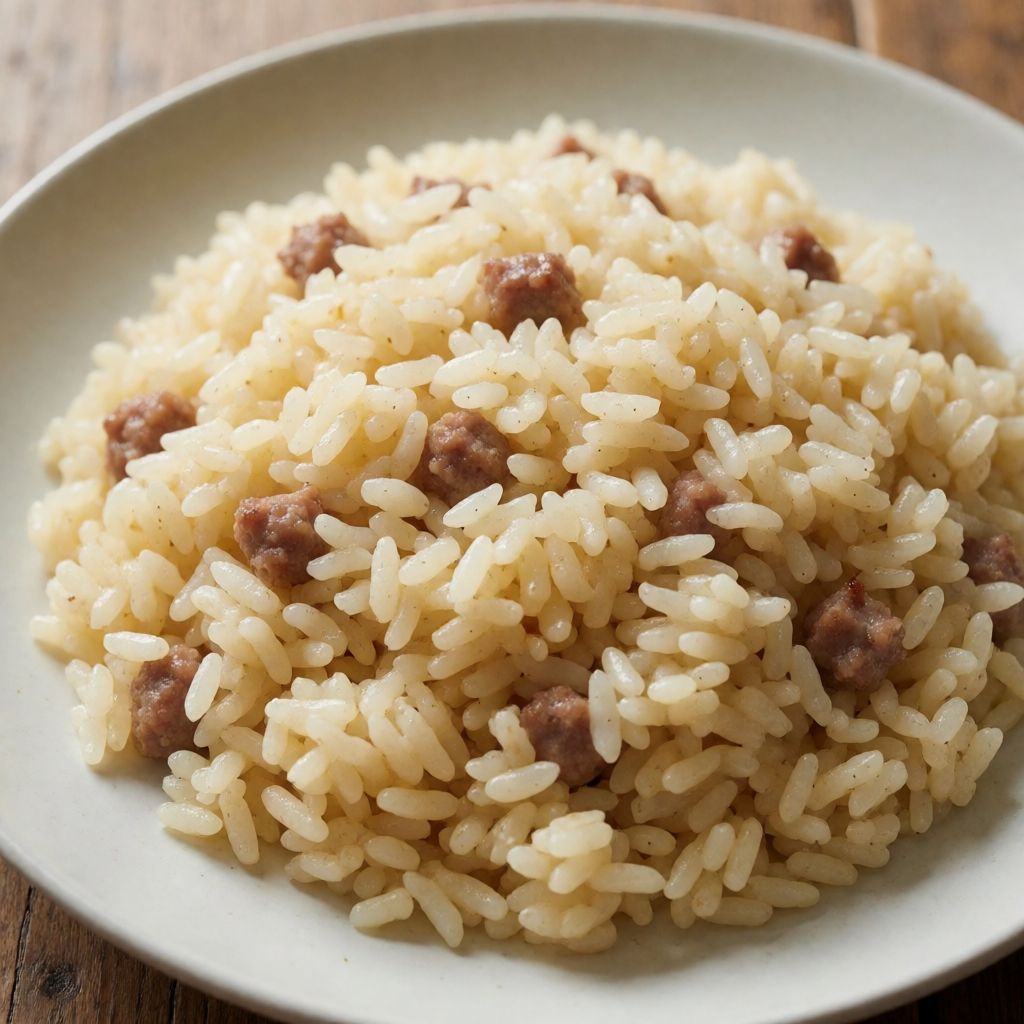
 AI photo
Mantuan-Style Rice with Pork Sausage
A creamy Mantuan rice dish finished with crumbled pork sausage, butter and Parmesan.
Labels are worked out automatically from the ingredients and can be wrong. Check the packaging if it matters to you.
Ingredients
- 350 g Rice Vialone Nano or similar semi-round rice
- 300 g Fresh Italian-style pork sausage skinned and chopped
- 80 g Butter
- 100 g Parmesan
- Salt to taste





Steps
Pour 600 ml of water into a pot and bring to the boil, add salt, then pour in the rice, shaping it into a mound.
Cook the rice for about 10 minutes, levelling it with gentle movements of the pot.
10 minRemove the pot from the heat, cover the rice with a towel and a lid, and leave to finish cooking for 10 minutes.
10 minMelt the butter in another pot, add the skinned and chopped sausage, and fry until golden and cooked through to an internal temperature of 70°C.
Remove the towel from the rice, add the fried sausage and most of the Parmesan, and mix well.
Divide the rice among plates and sprinkle with the remaining Parmesan.
What was changed
The salamella has been swapped for Fresh Italian-style pork sausage, which is easier to find in local shops.
This is Mantuan rice the way it's cooked when a kazan or wide pan isn't the point — the point is starch, not broth. No stock, no stirring every thirty seconds like a risotto, no slow addition of liquid cup by cup. You boil rice in salted water, almost as if for pasta, then you stop and let steam finish the job. That stopping is the whole trick. Some say rice this way turns to glue if you don't babysit it — no, because the glue comes from stirring and from too much water, not from rice sitting quietly under a towel.
What decides whether it works is the ratio of water to rice and what you do the moment the water's gone. Vialone Nano is a semi-round grain, short and starchy enough to hold its shape but still release enough starch to bind with butter and Parmesan into something creamy without a drop of stock. Mantua, inland from the rice paddies of the Po valley, never had seafood stock traditions to lean on — what it had was pork, butter from its dairy herds, and good rice from the valley itself. So the sauce is the fat, not a reduction.
The sausage is fried separately and that separation matters: cook it in the same pot as the rice and you get grease in the water, cloudy starch, a mess. Cook it apart in butter until it's properly browned — not just pale and steaming, but gone the colour of a roast potato skin, cooked through — and you get flavour you can fold in at the end without diluting it.
Rice first. Vialone Nano is what Mantua reaches for because it's grown a short drive away in the paddies around Verona and the lower Po — short-grain economics, not romance. It carries more surface starch than long grain but holds a bit more bite than Arborio, so it survives being boiled rather than coaxed with broth additions. If you can't find it, any semi-round, starch-heavy rice will do — Arborio works, Carnaroli works, even risotto rice from the supermarket shelf works, because what you need is a grain built to release starch, not a long-grain rice bred to stay separate and fluffy. Basmati or jasmine rice will not behave here; they're the wrong tool, like trying to make gravy with vinegar.
The water-to-rice ratio (600 ml to 350 g) is tighter than you'd use for plain boiled rice, because you're not draining it afterwards — every drop gets absorbed, so too much water and you've made soup; too little and the bottom scorches before the top's done. The ten minutes at a boil is a lower bound, not a stopwatch deadline — you're watching for the water to vanish into the grain, the surface going from wet and glassy to just-damp. Then comes the part that looks like doing nothing: off the heat, towel under the lid, ten more minutes. The towel absorbs the steam that would otherwise condense back down as water and turn your rice soft and waterlogged — this is the mechanism, not a ritual. Skip it and the rice finishes cooking in its own sweat, unevenly, mushy on top and undercooked underneath.
The sausage should be a plain fresh pork sausage with no strong spicing of its own — Italian-style sausage is usually just pork, salt, maybe a little fennel or pepper, nothing that fights the butter and Parmesan. A British good butcher's pork sausage, skinned, works fine as a substitute; what you're after is pork fat that renders and meat that browns, not a sausage built around sage and onion stuffing flavours that would turn this into something else entirely. Frying it until it's gone from pink and wet to browned and firm, cooked through, isn't optional — raw pork fat folded into warm rice is a food safety problem, not a texture one. An internal temperature around 70°C is your actual marker here, not colour alone, though colour gets you most of the way: pale sausage means it's not ready, however good it smells.
Butter is doing the job broth does in a risotto — carrying fat and gloss into the starch. Use a butter with a clean taste; UK salted butter works, just go easier on the extra salt in the rice water if you do, because doubling up on salt is the easiest way to ruin this. There's no substitute that keeps the dish the same — oil would thin it out, and oil "with no smell of its own" like a flavourless vegetable oil would make the dish taste of nothing where butter gives richness.
Parmesan at the end, most of it stirred in while the rice is still hot enough to melt it into the butter, the rest kept back to sprinkle on top for a bit of texture and salt that hasn't dissolved away. Buy a block, not the pre-grated dust in a tub — pre-grated Parmesan is often cut with anti-caking starch and doesn't melt the same way, leaving gritty bits instead of binding. Grana Padano is the honest substitute if Parmesan's not to hand or budget; it's milder, less aged, but does the same structural job.
Patience here isn't poetic — it's literally an ingredient you can't buy more of. The ten minutes under the towel is doing real work you can't speed up by turning the heat back on; rushing it just means you've paid for good rice and sausage and then undercooked the whole point of the method.