
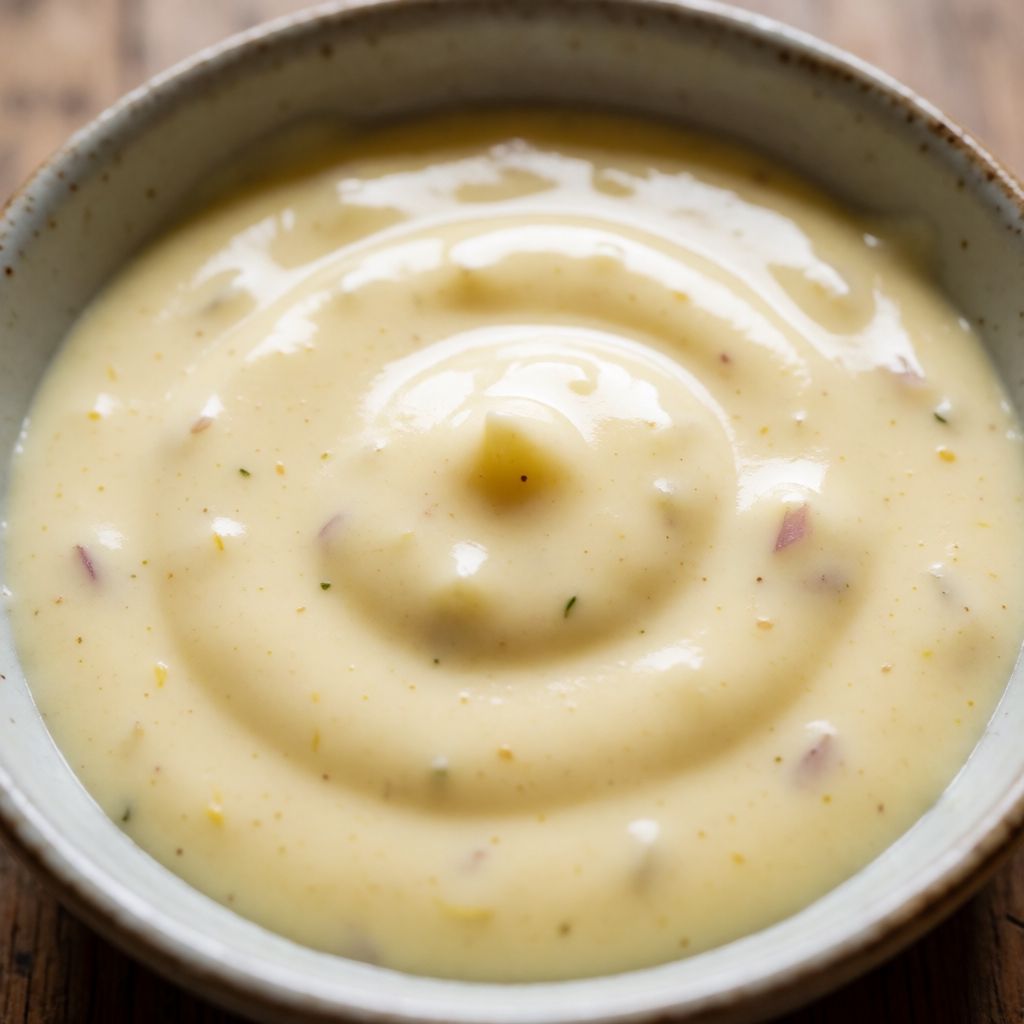
 AI photo
Béarnaise Sauce
A classic butter and egg yolk sauce, flavoured with shallot, tarragon and white wine vinegar.
Labels are worked out automatically from the ingredients and can be wrong. Check the packaging if it matters to you.
Ingredients
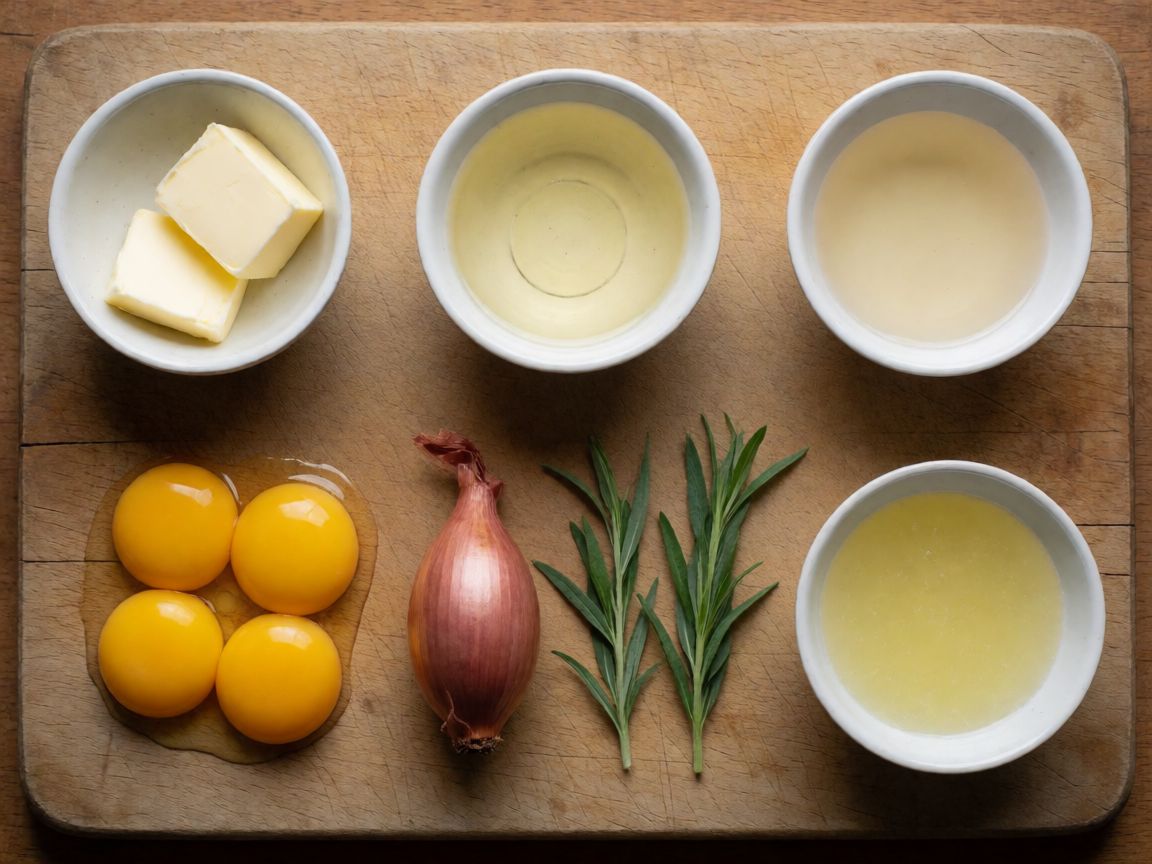
- 4 pcs egg yolks
- 300 g butter
- 70 ml white wine
- 20 ml white wine vinegar
- 80 ml water
- 1 pcs shallot
- 2 pcs tarragon sprigs
- salt to taste
- black pepper to taste
- lemon juice a few drops






Steps
Rinse the tarragon under running water, pick the leaves and chop finely.
Peel the shallot and cut it into wedges.
Pour the water, white wine and white wine vinegar into a saucepan, and add salt and pepper.
Add the shallot and half the tarragon, then bring to the boil.
Lower the heat and simmer until the liquid has reduced by about a third.
Take off the heat, leave to cool, then strain through a sieve.
In a bowl, whisk the egg yolks, gradually pouring in the strained liquid in a thin stream.
Set the bowl over a pan of simmering water and cook over the double boiler, whisking constantly.
Whisk in the hot melted butter in a thin stream until the sauce is smooth.
Take the sauce off the heat, check the seasoning, then stir in the lemon juice and remaining tarragon.
Give it a final stir and serve at once.
Béarnaise is hollandaise that remembered it had a flavour. Same mechanism underneath — egg yolk holding fat in suspension — but instead of lemon juice doing the acid work, you've got a reduction of wine, vinegar, shallot and tarragon doing it, which is the whole reason this sauce tastes of something rather than just tasting of butter. What decides whether it works isn't the ingredients, it's the heat, and specifically whether you respect that an egg yolk scrambles at a temperature your hand can still bear.
The reduction at the start isn't decoration, it's concentration — you're boiling off water so what's left is sharp, shallot-sweet, aniseed-green from the tarragon, strong enough to carry through a few hundred grams of butter without vanishing. Some say you can skip straining it and just lift out the shallot with a spoon. No — the shallot wedges are soft wedges by then, they'll shred into the sauce and you'll be chewing texture where you want silk. Strain it.
The double boiler is the actual engine of the dish. Egg yolk firms and sets somewhere around 70°C; butter you're about to add in is hot, molten, nowhere near gentle. Put raw yolk straight over real heat or into hot butter cold, and you get sweet eggy scraps floating in grease, not sauce. Over simmering water — not boiling, simmering, so the steam underneath never gets aggressive — the yolk warms gradually enough that it thickens into an emulsion instead of curdling into omelette.
It feeds six as a sauce — a few spoonfuls over steak or asparagus each, not a bowl to drink.
Butter first, because it's the volume ingredient and the one most people get wrong by overthinking. "Melted" here doesn't mean browned, doesn't mean foaming and separating — just liquid, warm, with the milk solids still part of it. If you let it split into clear fat and white solids and only pour in the clear top layer, you'll get a glossier sauce some chefs prefer, but it isn't necessary for a home version. Melt it gently, in a small pan or even the microwave in bursts, and keep it warm but not hot enough to hiss when it hits the whisk.
The eggs: four yolks for 300g of butter is roughly the ratio you need, because each yolk can only hold so much fat in emulsion before it gives up and separates. Don't go hunting for a use for the whites in the same dish — freeze them or use them in something else. Size matters a little; UK medium-to-large eggs are what this is built around, and if your eggs are unusually small you're thinner on emulsifying power, so four becomes a touch marginal.
Shallot rather than onion because it's milder and sweeter when reduced down fast — onion in that short a reduction time stays more raw-edged and can turn the sauce bitter rather than rounded. If you've only got onion, use less of it and reduce a touch longer so the sharp edge cooks off. White wine and white wine vinegar together give you two different kinds of acid brightness — wine for fruit and body, vinegar for the clean sharp lift that lemon alone gives hollandaise. If you're out of white wine vinegar, a dry white wine vinegar substitute like cider vinegar works, but go gentler, it's got a rounder character that can dull the sharpness you're after.
Tarragon is not negotiable in spirit, even if it is in practice — it's the ingredient that makes this béarnaise rather than hollandaise with wine in it. Fresh, if you can get it; dried tarragon loses the faint aniseed lift fast and you'll taste mostly hay. Splitting it — half into the reduction, half stirred in at the end — means you get both the cooked, mellowed flavour and the fresh, grassy bite in the finished sauce, rather than one flat note throughout.
The pan of simmering water under your bowl: in a UK kitchen without a proper double-boiler insert, any pan with a bowl set over it that doesn't touch the water does the job. Keep the water at a gentle shiver, not a rolling boil — a domestic hob held on a low-medium setting manages this fine, but check it, because an electric ring holds heat and can creep the water up past where you want it while your back is turned. Whisk the whole time you're over the heat; stopping even briefly is how patches of yolk near the bottom of the bowl get ahead of the rest and set solid.
Patience is the real ingredient list item nobody prints. Pour the reduction and then the butter in slowly, in a thin stream, whisking without pause — rush either addition and the yolk can't incorporate the fat fast enough, and it splits, grainy and oily rather than smooth. If it does split, a splash of cold water whisked in hard, off the heat, can sometimes bring it back; worth trying before you give up and start again with a fresh yolk. Serve it the moment it's made — it doesn't reheat, doesn't wait, doesn't sit happily on the side of a Sunday roast plate for twenty minutes while you carve. It's a last-minute sauce, make your peace with that.