
 AI photo
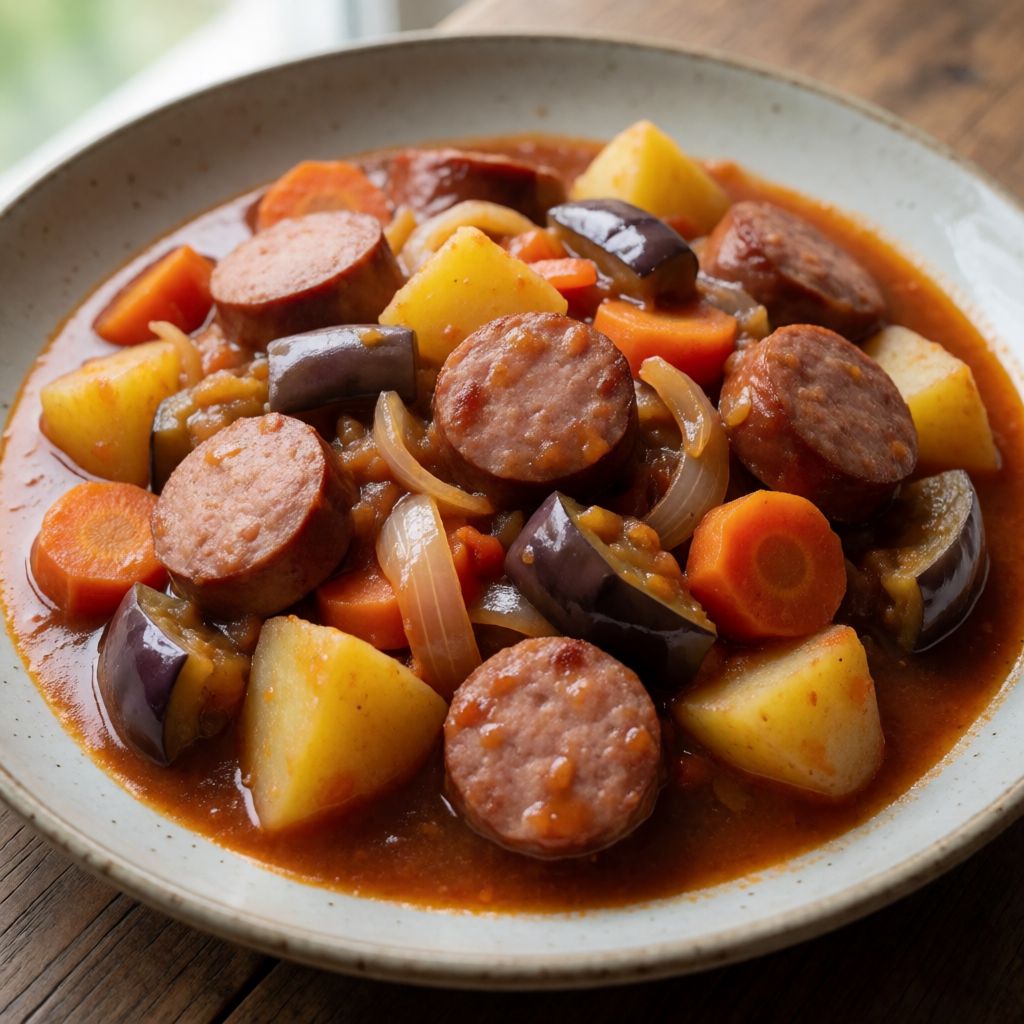
French-Style Sausage and Vegetable Ragout
A hearty ragout of sausage and vegetables, simmered with tomatoes and a splash of cream.
Labels are worked out automatically from the ingredients and can be wrong. Check the packaging if it matters to you.
Ingredients
- 400 g Sausage sliced
- 1 kg Potato diced, boiled and cooled
- 1 pcs Onion finely chopped
- 1 clove Garlic finely chopped
- 1 pcs Aubergine diced
- 2 pcs Carrot thinly sliced
- 2 pcs Bell Pepper diced
- 1 pcs Courgette diced
- 1 tsp Dried Thyme
- 0.5 tsp Dried Rosemary
- 1 tsp Smoked Paprika
- 400 g Canned Chopped Tomatoes
- 100 ml Stock
- 50 ml Double Cream
- 1 tbsp Olive Oil for frying
- Salt to taste
- Black Pepper freshly ground, to taste
- 1 bunch Parsley leaves











Steps
Fry the sausage in olive oil in a large sauté pan until browned and lightly crisp.
Add the onion, garlic, aubergine, carrot, bell pepper, courgette, thyme, dried rosemary and smoked paprika, and cook until the vegetables start to brown.
Add the potato, canned chopped tomatoes, stock and a little double cream.
Cover and simmer for 10 minutes, then season with salt and freshly ground black pepper to taste.
10 minServe in deep bowls, sprinkled with fresh parsley.
What was changed
The simmering time (10 minutes) from the original step text was recorded explicitly.
This is not French, whatever the name tells you — it is the thing every household in Europe makes when there is a bit of sausage, a drawer of tired vegetables and no appetite for a proper sauce. "Ragout" here just means: cut it small, cook it together, let the liquid do the matchmaking. Nothing wrong with that. The name is a flag of convenience, not a contract.
What decides whether it works is the order you add things in, not the list of things. Sausage first, alone, in a dry hot pan — that's non-negotiable, because sausage releases fat and if vegetables go in with it they steam in that fat instead of browning, and you get grey mush instead of colour. Browning is not decoration. It's the Maillard reaction, the same chemistry that makes a Sunday roast crust worth fighting over, and it only happens on a dry, hot surface, not in a wet crowded one.
Then the vegetable order matters because they don't all want the same thing from the heat: onion and garlic want gentle colour, aubergine and courgette want their water driven off before they're asked to brown, carrot wants time because it's the densest thing in the pan. Throw them all in together with no sequence and you get some vegetables raw-tasting and others collapsed, in the same spoonful.
Sausage: any sausage with a decent amount of fat and seasoning already in it — that's the whole point of using sausage instead of raw mince, you're buying flavour and self-basting fat in one shape. A smoky Toulouse-style or a coarse pork sausage with herbs works; a thin, lean breakfast sausage will just dry out and give you nothing to fry the vegetables in afterwards, so you'd need extra oil regardless.
Potato: diced, boiled, cooled on purpose — not an oversight, not "I had leftovers." Waxy potato (Charlotte, Maris Peter, new potatoes) holds its dice through a second cooking; a floury baking potato (Maris Piper, King Edward) will start breaking down and thicken the sauce by dissolving, which isn't wrong exactly, but it's a different dish — more stew, less ragout, less distinct chunks in the bowl.
Aubergine and courgette: both are mostly water held in a spongy structure, and both will shed that water the moment they hit heat. That's why they go in with the vegetables that need colour, not with the liquid stage — give them the chance to lose moisture and pick up some brown at the edges before you drown them in tomato and stock. Skip this and they just turn into pale wet lumps.
Smoked paprika: this is doing the job a kazan or a wood fire would do for you elsewhere — a whiff of smoke without needing actual smoke, which you are not getting on a domestic hob. Don't confuse it with sweet paprika; sweet paprika is colour with no smell behind it, and the smoked one is the only paprika in this dish that's pulling its weight rather than just tinting the sauce orange. No smoked paprika in the cupboard — a very small pinch of smoked salt or a drop of liquid smoke gets you closer than plain paprika ever will.
Double cream, just 50 ml: not there to make a creamy sauce — there's nowhere near enough for that — it's there to round off the acidity of 400g of canned tomato, the way a splash of milk softens a too-strong cup of tea. Some say cream and tomato don't belong together — no, because a small amount of fat doesn't curdle on top of a simmering, well-seasoned sauce, it just mellows it; what curdles cream is a cold splash into a near-boiling, thin, low-fat liquid with nothing to buffer it, and this sauce — with potato starch and tomato body in it — isn't that.
Stock: here mainly for thinning, so use whatever you'd put in a gravy boat on a Sunday — chicken or vegetable, not beef, which would fight the sausage for the dominant flavour in the pan. No stock made up — a stock cube dissolved in the 100ml of hot water is an honest substitute, nobody's checking.
Herbs — thyme and rosemary, dried: dried is correct here, not a compromise, because they're going into a pan that simmers for a while and dried herbs need that time to soften and release what they've got; fresh thyme and rosemary, with their woody little stems, would want longer still, or a tying-up and fishing-out you don't need for a weeknight pan. Parsley, by contrast, goes on raw at the very end — fresh, because parsley's whole value is a clean green smell that dies the second it sees real heat.
Doneness here isn't a clock. Watch the vegetables start to brown at the edges, not blacken — that's step two's actual instruction, whatever the minutes say. Watch the carrot: it should give a little resistance to a fork, not the snap of raw carrot and not the collapse of overcooked carrot. The ten minutes under the lid is a floor, not a ceiling — if your carrot's still stubborn at ten minutes, give it more, the dish won't mind waiting, and that waiting is as much an ingredient as the paprika.
On the pan itself: a kazan would let you do all this in one wide, shallow vessel with heat from underneath and around, so the vegetables brown rather than stew even while the liquid's building up. A UK hob with a saucepan does the opposite — heat only from below, so a narrow deep pan traps steam over the vegetables and stops them browning at all. Use the widest pan or sauté dish you own, and don't crowd it; if the vegetables are piled two deep, do the browning stage in two batches rather than one damp one.