
 AI photo
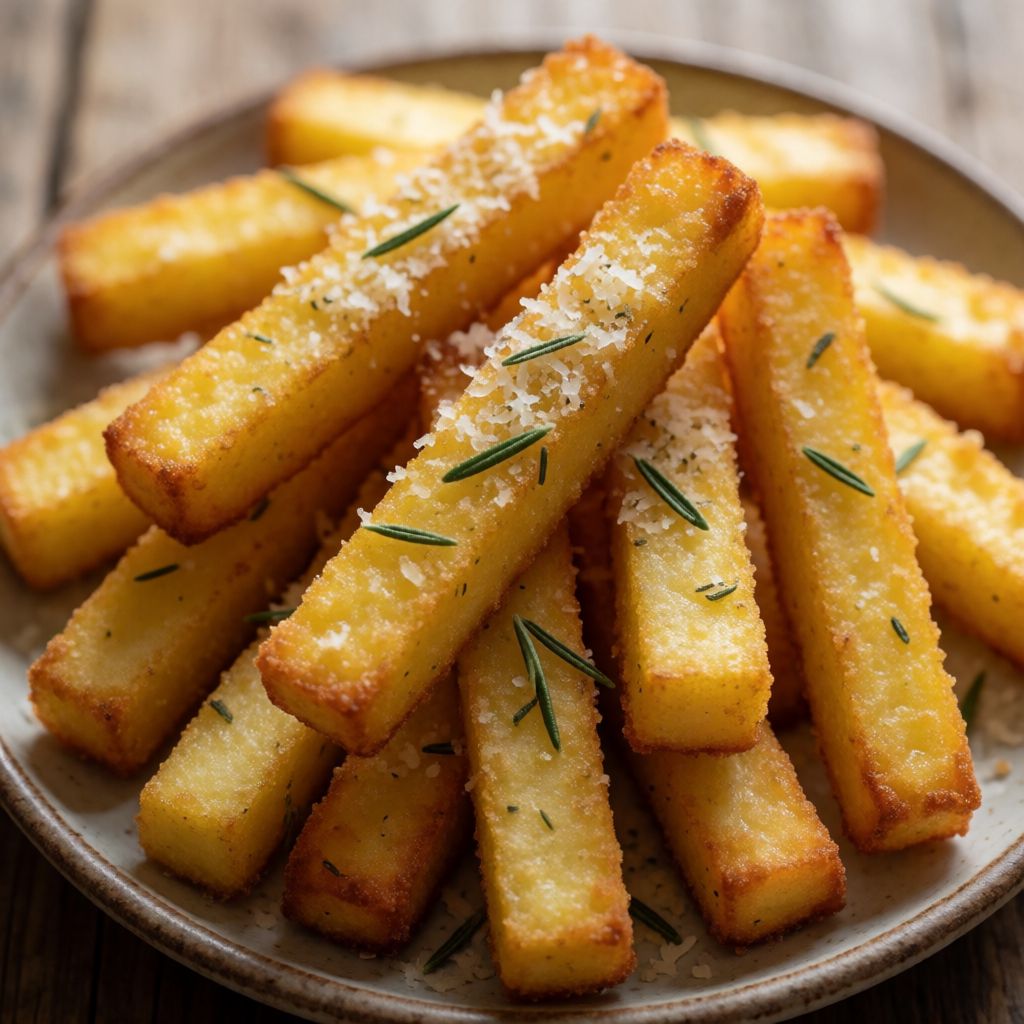
Crispy Fried Polenta Chips
Firm-set polenta, sliced into chips and oven-baked until crisp, served with a herby dip.
Labels are worked out automatically from the ingredients and can be wrong. Check the packaging if it matters to you.
Ingredients
- 250 g Polenta (cornmeal)
- 1 l Water
- 1 pinch Salt
- 4 tbsp Olive oil about 1 tbsp for greasing the tin
- 3 pcs Rosemary fresh sprigs
- 3 tbsp Parmesan finely grated
- 1 pinch Salt to taste
- 1 pinch Black pepper freshly ground







Herby dip
- 100 ml Crème fraîche 18%
- 2 tbsp Mayonnaise
- 1 tbsp Parmesan finely grated
- 1 tbsp Rosemary finely chopped, fresh
- 1 tsp Apple cider vinegar
- 1 pinch Salt to taste
- 1 pinch Black pepper freshly ground



Steps
Bring the water to the boil, reduce the heat and pour in the polenta, stirring constantly. Stir thoroughly so no lumps form.
Let the polenta simmer, covered, for 30–45 minutes, stirring regularly and adding a little more water if needed.
Grease a tin with a little olive oil and spread the polenta in it. Press down firmly to form an even layer, then cover with baking paper.
Chill in the fridge for at least a few hours, or ideally overnight.
Turn the polenta out of the tin and cut into thin chips. The polenta will be firm and slightly rubbery, which makes it easy to work with.
Toss the chips with oil, salt and pepper and bake the polenta chips in the oven at 225°C fan for 30 minutes, turning them roughly halfway through baking.
Before serving, sprinkle with finely grated fresh Parmesan and finely chopped rosemary, and season with salt to taste.
For the dip, mix the crème fraîche and mayonnaise with the Parmesan and rosemary, and season to taste with salt, pepper and apple cider vinegar.
Polenta is boiled cornmeal, and boiled cornmeal is just wet sand until you do two things to it: cook out the raw starch taste, and let it go cold and solid. This recipe is really two separate jobs wearing one name — a porridge you make today, and a chip you fry (well, bake) tomorrow. Skip the waiting and you don't get a chip, you get mash with ambitions.
What decides whether this works is not the baking, it's the setting. Polenta thickens as it cooks, but it only becomes sliceable, hold-its-edges firm once it's cold — the starch granules that swelled in the hot water tighten up and link together as they lose heat, the same mechanism that makes a cooled rice pudding or a set custard behave. Rush that chill and the chips smear instead of snap.
Some say polenta needs a copper pot and an hour of arm-ache by the fire. No — because what's actually happening is starch granules absorbing water and swelling, and a wide pan on your hob does that exactly as well as a kazan-shaped pot over an open flame. What you can't skip is the stirring, and here's the real reason for it: unstirred polenta scorches on the bottom in patches, and one scorched patch tastes bitter enough to ruin the whole pot — stirring isn't tradition, it's quality control.
The water-to-polenta ratio (four to one here) is doing the same job every porridge ratio does: enough liquid that the starch can fully swell before it runs out, not so much that you're still cooking off water an hour later. If your polenta tastes gritty or chalky in the centre, that's not a seasoning problem, that's undercooked starch — it needed more time, or a touch more water, not more salt.
The oil for greasing the tin earns its keep at the edges: polenta sets stiff enough to grab at any dry patch of metal and tear when you try to turn it out. A thin film of any neutral-tasting oil — one with no flavour of its own, so sunflower or a mild olive oil, not the peppery first-press stuff you'd want on a salad — breaks that bond without adding its own taste to a dish that's meant to taste of corn and parmesan.
Parmesan here is doing salt and savoury depth both, and it's one of the few cheeses that survives high dry heat without just turning to oil-slick — it's hard, low-moisture, and built to be grated over hot food precisely because it melts without weeping. A pecorino would do the same job with more bite; a soft cheese would just puddle and burn.
Rosemary, fresh, matters more than usual here because it's doing two different things in two different states: whole sprigs (implied, or simply chopped and scattered) survive the oven's dry heat and perfume the chips as they crisp, while in the dip it's raw and chopped fine, so you get its sharper, more resinous side raw against the cream. Dried rosemary will get you through in the cooking stage, barely — in the raw dip it tastes of dust, so don't.
The dip itself is built on an old trick: crème fraîche alone is thick but flat, mayonnaise alone is rich but one-note, and together with a splash of vinegar you get something that tastes like it's been thought about rather than squeezed from a jar. The vinegar's job is specific — it cuts the fat so the dip doesn't just coat your tongue and sit there; a squeeze of lemon does the same acid job if that's what's in your fridge.
On your hob, forget a kazan or a proper lidded cast-iron pot if you don't have one — a wide, heavy-based saucepan with a splatter guard or even just a loose-fitting lid works, because what polenta needs is low steady heat and room for the odd bubble to escape, not a specific pot. What it does need is that you don't walk away for ten minutes — the stuff thickens quickly near the end and catches fast once it does.
Four portions here means four people sharing one tin's worth of chips and one bowl of dip as a side — scale the tin size with the headcount, not the ingredient list, because what you're really managing is surface area: a too-thin layer gives you crackers, a too-thick one gives you chips with a soft, unset core no amount of oven time will fix.