
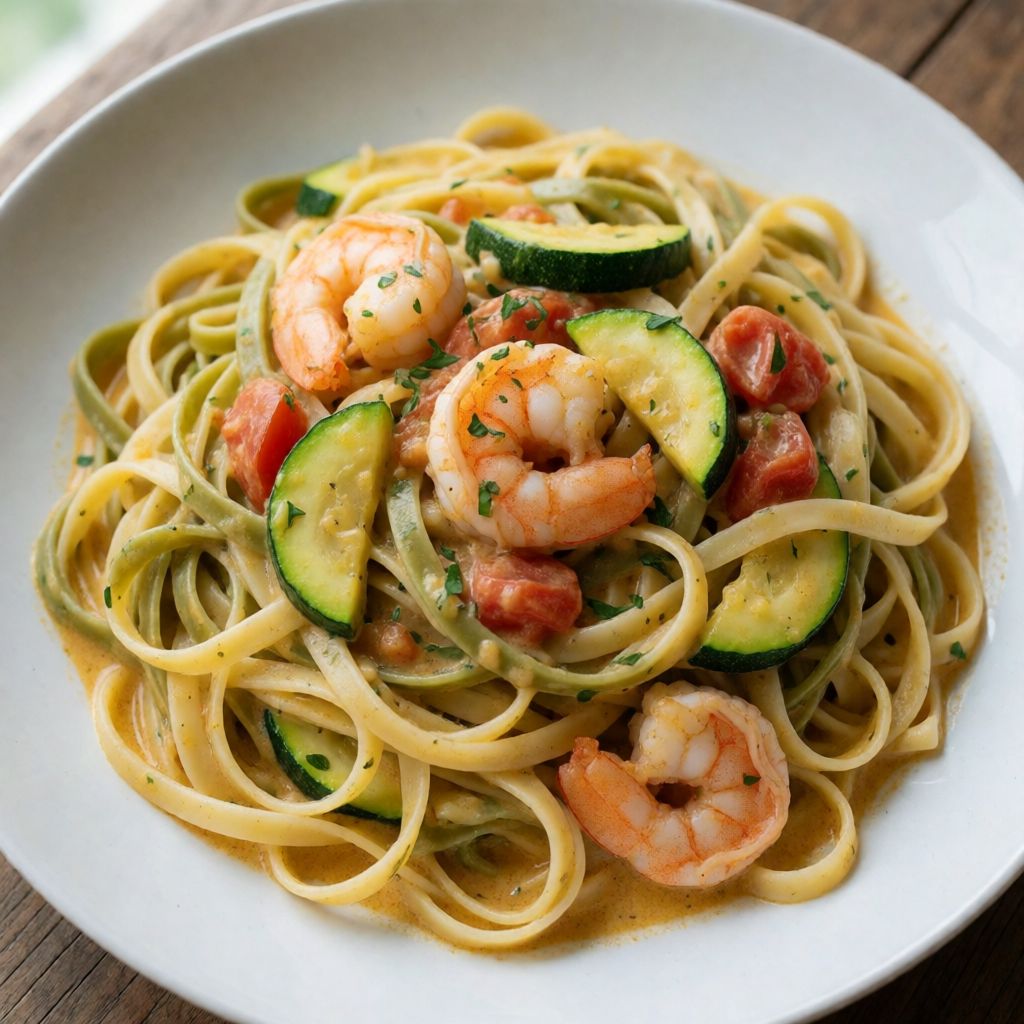
 AI photo
Pasta with Prawns, Courgette and Curry
A creamy curried prawn pasta with courgette and cherry tomatoes, with white wine reduced into the sauce.
Labels are worked out automatically from the ingredients and can be wrong. Check the packaging if it matters to you.
Ingredients
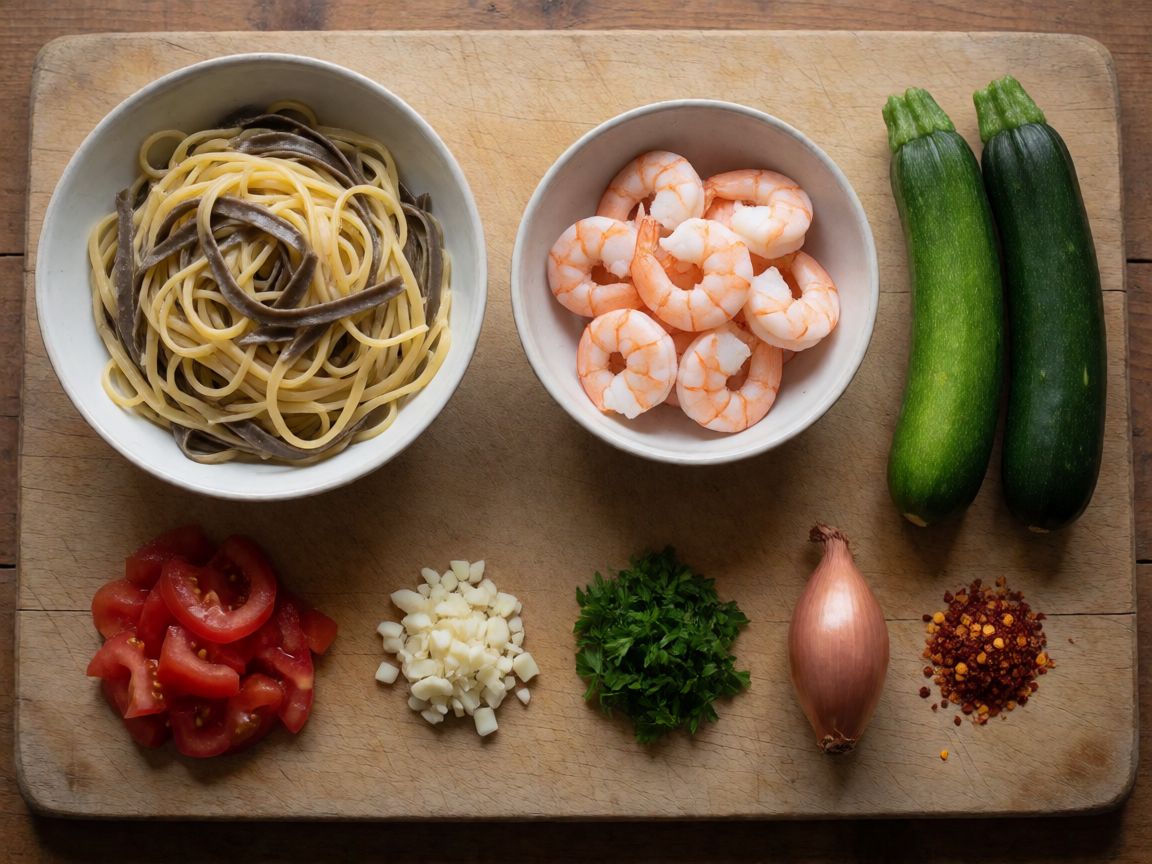
- 400 g Paglia e fieno pasta
- 400 g Prawns
- 150 g Cherry tomatoes
- 2 pcs Courgette
- Garlic to taste
- Parsley to taste
- 1 pcs Shallot
- Olive oil to taste
- 200 ml Plant-based (dairy-free) cream
- Salt to taste
- 1 pinch Chilli flakes
- 2 tbsp Curry powder
- 120 ml White wine










Steps
Heat olive oil in a pan and fry the finely chopped shallot, garlic and parsley.
Add the courgette and cherry tomatoes, and cook for a few minutes.
Pour in a splash of warm water and cook for a few more minutes.
Add the prawns, fry briefly, pour in the wine, let it reduce, and continue cooking. Doneness: 63°C at the thickest point.
Season with salt, add a pinch of chilli flakes, the plant-based cream and curry powder, and stir.
Cook the pasta, drain, and fry briefly in the pan with the finished sauce.
Serve immediately.
Paglia e fieno — "straw and hay" — is just egg tagliatelle and spinach tagliatelle twisted together so the plate looks like a field in two colours. Nobody invented a flavour here; they invented a visual trick to sell two pastas as one dish. You can use any ribbon pasta of the same width and lose nothing but the stripes.
What decides whether this works isn't the curry, it's the prawns. Everything else — shallot, courgette, tomatoes, cream — is scaffolding built to hold a few minutes of prawn in suspension without wrecking it. Prawns go from translucent to rubber in the time it takes to answer the phone. The recipe gives you a real marker instead of a guess: 63°C at the thickest point, where the flesh turns from grey-pink and glassy to opaque and firm. Some say prawns are done "when they curl up" — no, because a tight curl means they've already seized and gone past the point of return; a gentle C-shape is what you want, a tight O is overcooked.
The curry powder is doing something specific, not decoration. It's a mix of toasted spices, and toasted spices need a few seconds of fat and heat to wake up their oils — that's why it goes in near the end, into warm cream, not dry into a cold pan. Dump it straight into boiling liquid or raw oil and you get dusty bitterness instead of warmth; stir it into the cream and it blooms gently and coats instead of scorching.
Start with the shallot, garlic and parsley together in oil — this is the base every onion-family sauce in every cuisine runs on, under a dozen different names. The point of frying them gently first, before anything wet goes in, is to cook off the raw sulphur bite of the alliums before it has a chance to dominate the dish. Skip this and you taste harsh onion for the next twenty minutes; do it properly and you taste sweetness. Use a plain oil with no smell of its own here — a light olive oil, not your good finishing extra virgin, which you'd only burn off and waste.
Courgette and cherry tomatoes go in next because they need the longest run at a direct, dry heat before any liquid arrives. Courgette is mostly water held in a weak structure; if you drown it in wine and cream from the start, it steams rather than fries, and you get grey mush instead of pieces that hold shape and pick up a little colour at the edges. The splash of warm water that follows isn't about adding liquid for its own sake — it's a shortcut to finish softening the vegetables without more oil or more time, and warm water doesn't shock the pan's temperature down the way cold water would.
The wine goes in with the prawns and needs to reduce — meaning you let it bubble down to a syrupy half or less, not just warm through. Raw wine tastes of raw wine: sharp, a bit sour, with alcohol still sitting on top. Reducing drives the alcohol and rough edges off and leaves behind acidity and a little sweetness that belongs in the sauce rather than fighting it. If you don't have white wine, a dry vermouth does the same acidic, aromatic job; stock with a spoon of lemon juice is the non-alcoholic stand-in, though it's a different, flatter animal.
Prawns themselves: raw, shell-off is simplest for a home pan, since peeling cooked prawns after frying is a faff nobody needs on a weeknight. If you're using frozen, thaw them fully and pat them properly dry first — wet prawns hit hot oil and you get a pan full of spitting steam instead of a sear, and steam is what turns prawns rubbery before they're even through.
Chilli flakes are there for background heat, not to announce themselves — a pinch, not a show of bravado. If you don't have flakes, a pinch of cayenne or a few twists of a dried chilli works the same way; what you're after is warmth that sits under the curry, not a separate flavour competing with it.
Last, frying the drained pasta briefly in the finished sauce is the step people skip because it feels redundant — the pasta's cooked, why fry it again? Because pasta tossed straight from colander to plate sits on top of a sauce; pasta that gets thirty seconds in the pan with the sauce actually takes some of it up, especially through the starch left on the surface from cooking. That's also why you don't rinse it. Serve this the moment it's off the heat — it's not a dish that improves with waiting, and the prawns will keep cooking in their own residual heat even once the pan's off the hob, so get it to the plate fast.