
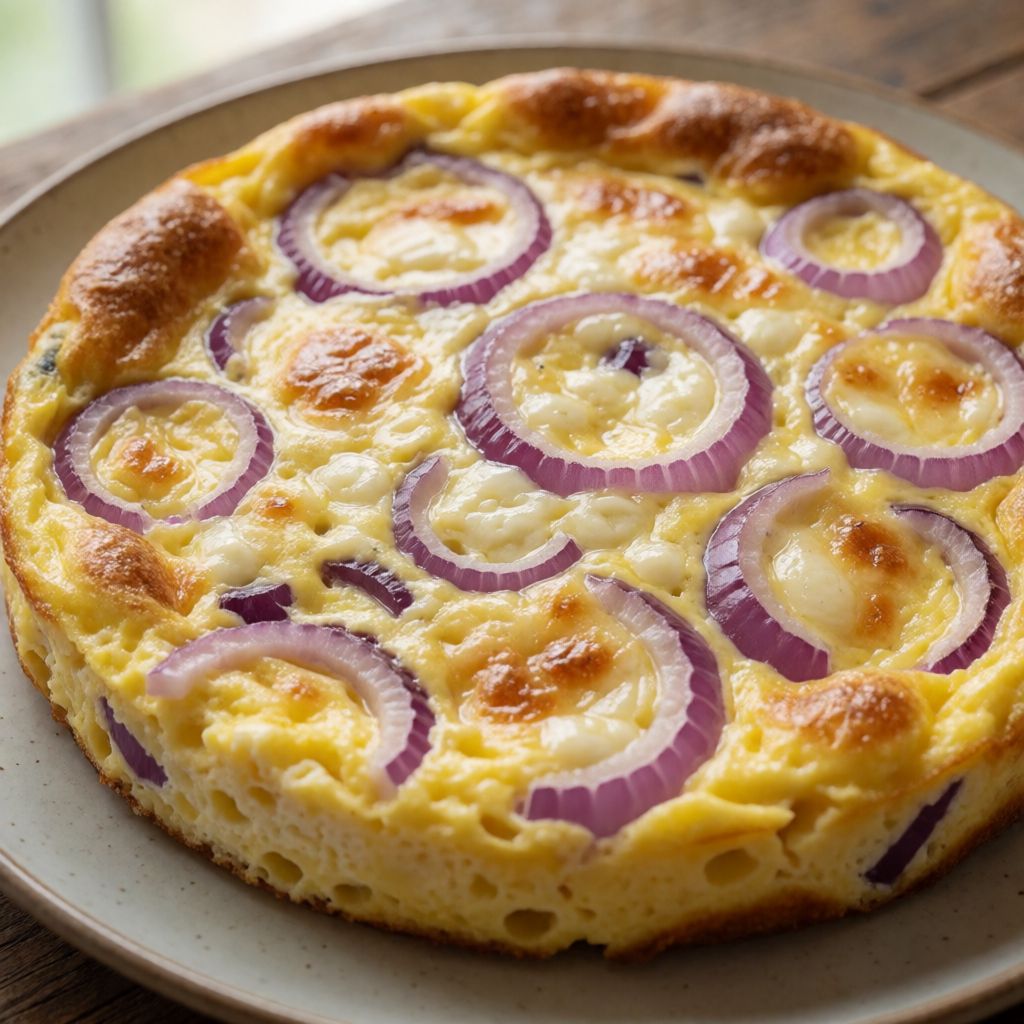
 AI photo
Red Onion Frittata
A simple frittata made with sweet red onion, mozzarella and parmesan, pan-fried until golden on both sides.
Labels are worked out automatically from the ingredients and can be wrong. Check the packaging if it matters to you.
Ingredients
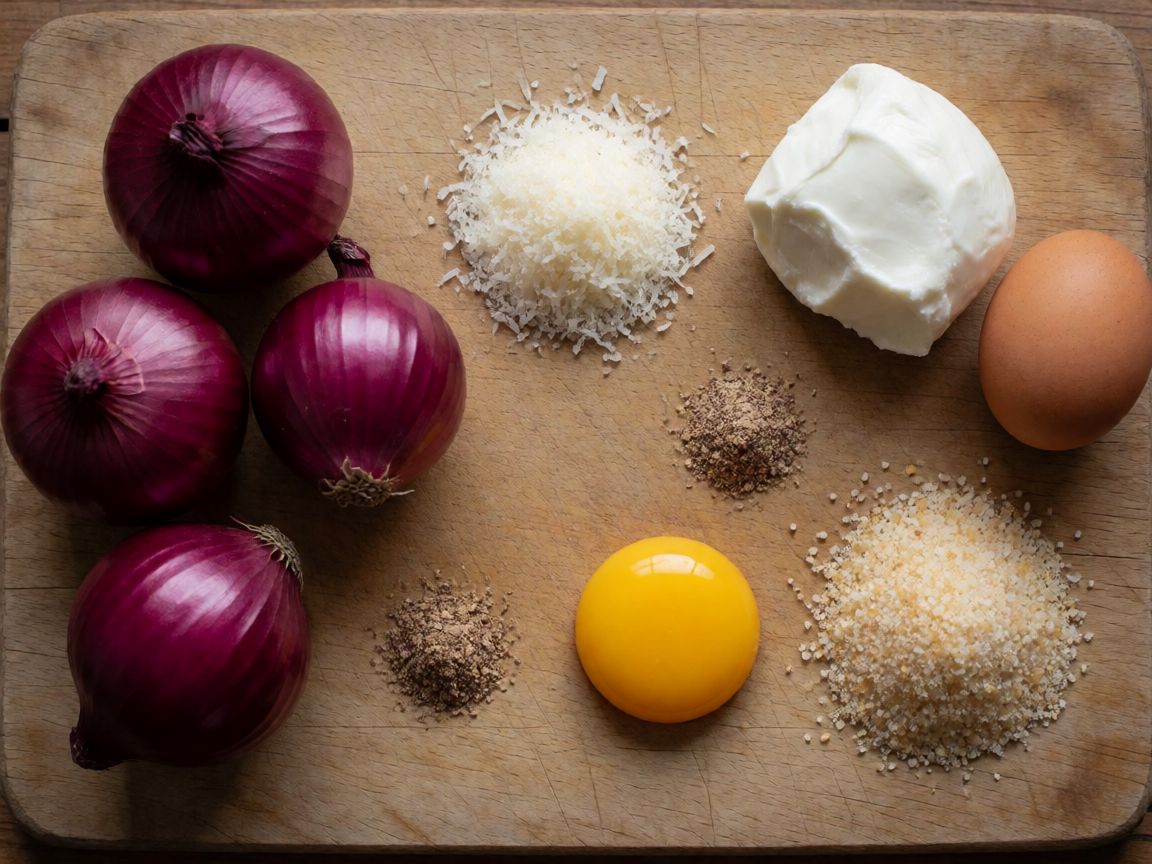
- 5 pcs Red Onion
- 100 g Parmesan
- 1 pcs Mozzarella
- 1 pcs Eggs
- 1 pcs Egg Yolk
- Vegetable Oil to taste
- Salt to taste
- Black Pepper to taste
- Nutmeg to taste
- Breadcrumbs to taste, dried



Steps
Cut the red onion into large chunks. Pour the oil into a frying pan.
Fry the onion until soft and golden.
Let the onion cool, then transfer to a bowl and mix with the egg, egg yolk, mozzarella, parmesan, nutmeg, salt and black pepper.
Grease the pan with oil, sprinkle with breadcrumbs and pour in the egg and onion mixture.
Cook for a few minutes, then flip to the other side.
A frittata is not an omelette that got ambitious — it's an omelette that stopped being about eggs. Here the eggs are glue, barely more. Five onions carry the dish; one egg plus one yolk just holds them together once they've already done the work of turning sweet.
What decides whether this works is what happens to the onion before it ever meets the egg. Raw red onion is sharp — that bite comes from sulphur compounds that want to escape as gas the moment you cut it, which is also why it makes you cry. Heat breaks those compounds down and lets the onion's sugar show through instead. So you're not "frying onion", you're dismantling its sharpness on purpose. Some say red onion is "for salads, not for cooking" — no, because its colour and faint sweetness are exactly what a plain yellow onion can't give this dish; it just needs longer, gentler heat to get there without catching at the edges.
The second thing that decides it is the flip. This is a two-sided cake, not a folded omelette, and the two sides are cooked by two completely different methods — one in fat on a hob, one by ambient heat from above or below with no direct flame under it. Get that part wrong and you either have a raw top or a leathery bottom. That's the whole engineering problem of a frittata in a normal kitchen, and it's worth being honest about before you start.
Start with the onion and the heat it sees. Cut it in big chunks, not thin half-moons — thin pieces lose their shape entirely once they soften, and you want chunks you can still feel in the finished cake, not a paste. Put it in the pan in enough oil that it's touching fat all round, not steaming in its own puddle, and let it sit over heat gentle enough that it goes from purple-red to a soft, translucent rose, then slowly towards amber at the edges — never a hard brown crust, because that's bitterness from the sugar burning, not deeper flavour. You're watching colour, not a clock: purple to pink to gold-at-the-tips is the whole story, and if it takes longer on your hob than you expected, that's fine, that's just your hob.
Letting it cool before mixing with the egg isn't fussiness — hot onion straight into raw egg starts cooking the egg on contact, and you get little solid threads through the mix instead of one even batter. A few minutes on a plate solves it; nobody needs a thermometer for "no longer steaming."
The eggs: one whole egg, one extra yolk. The yolk is there for richness and for binding fat (cheese, oil) into the mixture without thinning it with more white, which would make the whole thing wetter and slower to set. If you only have whole eggs to hand, two whole eggs instead of one-plus-yolk will still work — you lose a little silkiness, not the dish.
Parmesan and mozzarella do two different jobs, and it matters which is which. Parmesan is dry, salty, and melts into the batter rather than staying as lumps — it seasons from the inside. Mozzarella is wet and stringy and gives you pull and pockets of melt. If you swap parmesan for "any hard cheese", look for one that's aged and crumbly rather than young and rubbery — a firm pecorino or a mature cheddar will do the same job of seasoning-by-dissolving. Mozzarella has fewer honest substitutes because its whole point is the stretch; a soft, young, low-salt cheese that holds a bit of water is the criterion — a torn-up ball of a mild white cheese gets you close enough.
The breadcrumbs under the batter aren't decoration. A raw pan plus wet egg batter means the bottom sticks the instant it meets metal, because egg protein bonds to hot metal faster than it sets into a crust you can slide a spatula under. A thin layer of dried crumbs between oiled pan and batter gives the egg something porous to grip instead of the pan itself — it's a release layer, the same logic as flouring a tin for cake.
On the flip: in a proper kitchen this goes under a grill or into an oven to finish the top without ever touching the second side to direct flame. In an ordinary British kitchen, where the oven is doing the Sunday roast and you don't want to fight it for space, the honest move is a plate. Cook the first side until the edges have pulled in from the rim and the centre has gone from glossy liquid to matte and just-set — not dry, just no longer wobbling in the middle. Slide it onto a plate, invert the pan over the plate, flip the whole thing in one confident motion, then slide it back into the pan uncooked-side down. Nerve-wracking the first time, genuinely fine the second. Nutmeg goes in with a light hand — its job is to round off the dairy, not to announce itself; too much and it tastes like custard, not cheese.
This feeds four as a light lunch with bread and something green, or as part of a bigger spread — it sits well at room temperature, which is the other reason it earns its keep: cook it before guests arrive, not while they're standing in your kitchen.