
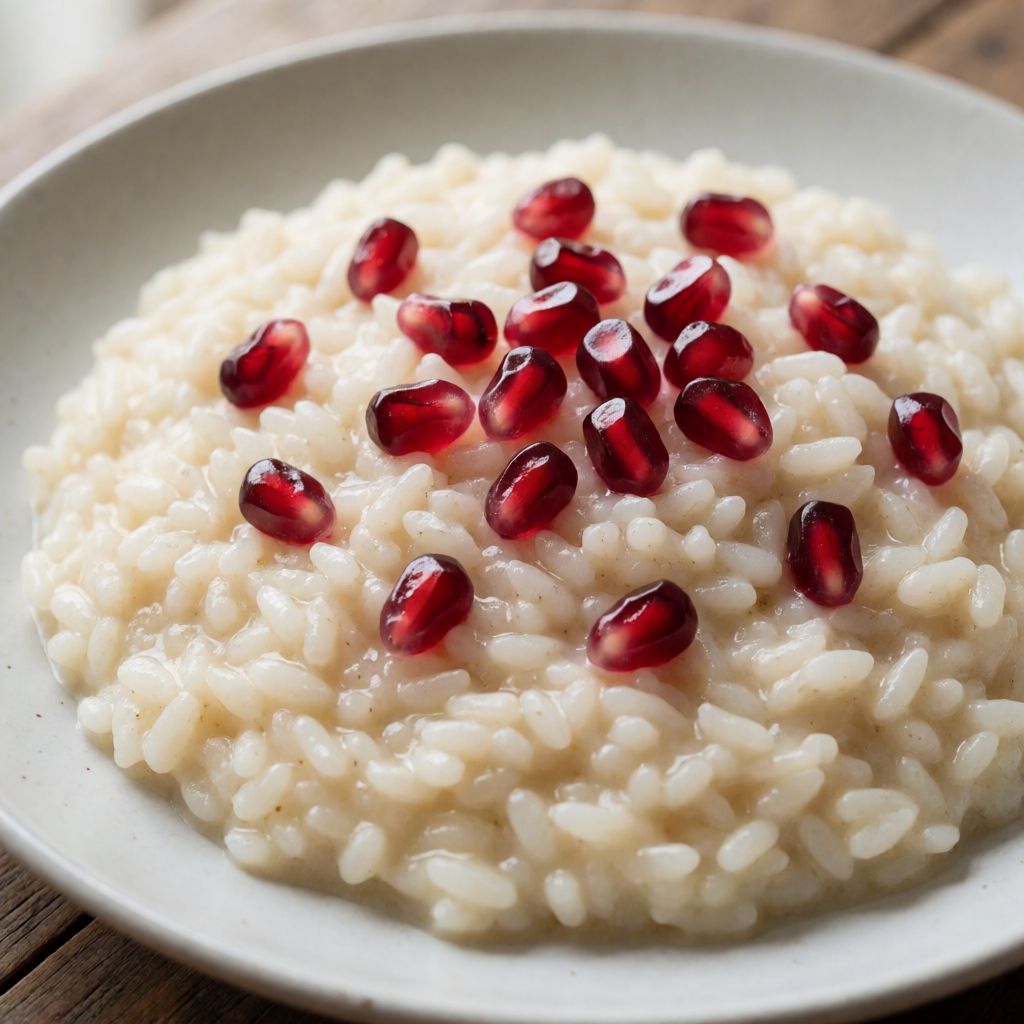
 AI photo
Pomegranate Risotto
A creamy risotto brightened with pomegranate juice and seeds.
Labels are worked out automatically from the ingredients and can be wrong. Check the packaging if it matters to you.
Ingredients
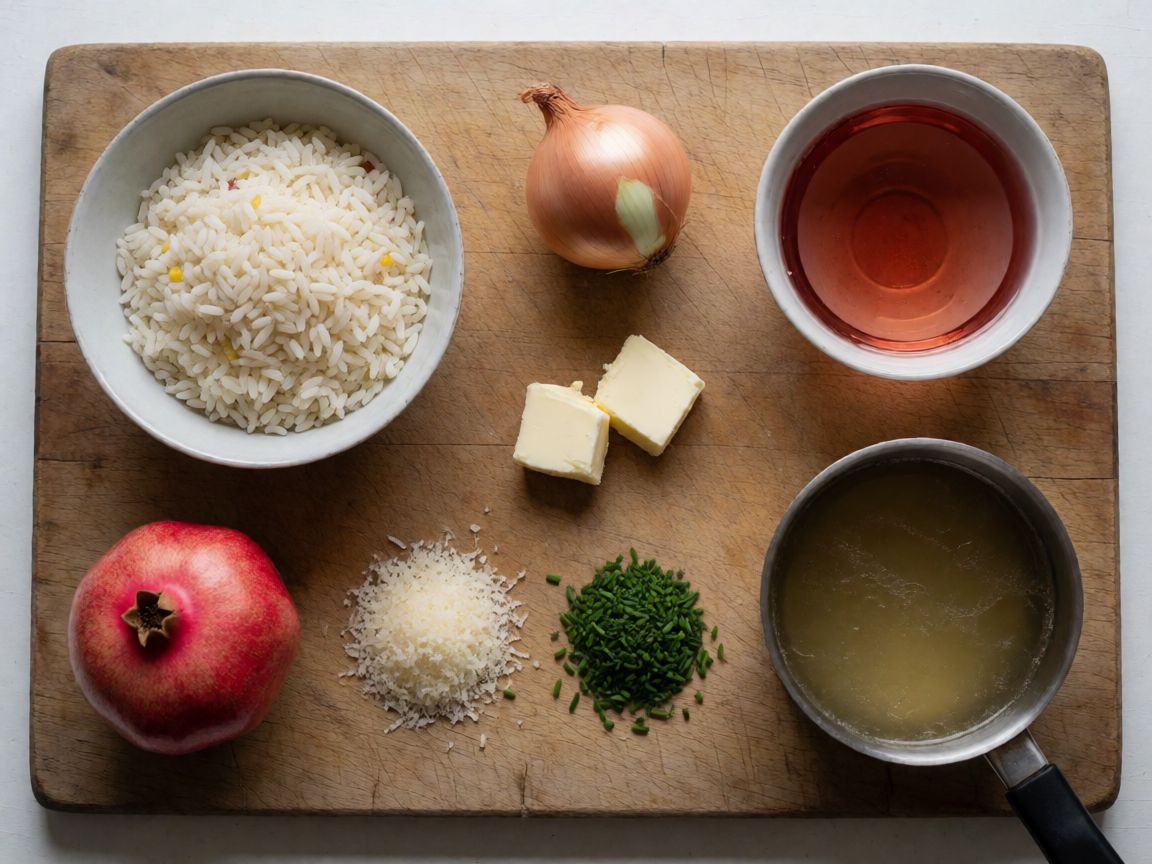
- 350 g Carnaroli rice
- 1 pcs Onion
- 20 g Butter
- 2 tbsp Olive oil
- 1 pcs Pomegranate
- 125 ml Red wine or rosé wine
- Salt
- Black pepper
- Vegetable stock
- 1 tbsp Parmesan
- Dried chives











Steps
Squeeze the seeds from the pomegranate and set the juice aside, keeping a few whole seeds for garnishing the finished dish.
In a pan, fry the finely chopped onion in olive oil.
Add the rice and toast it.
Pour in the wine and let it evaporate completely.
Add the pomegranate juice and crushed seeds, and finish cooking the risotto, gradually adding the vegetable stock.
Season with salt and pepper and sprinkle lightly with dried chives.
Remove from the heat and stir in the butter and Parmesan until creamy.
Add the remaining pomegranate seeds and serve immediately.
Risotto is not a rice dish. It's a starch-management exercise where rice is the medium. Carnaroli has a hard, high-amylose shell around a soft core — that's the whole trick. The shell holds its shape so the grain never turns to mush, while the core leaks starch slowly into the liquid around it, and that leaked starch is what makes the sauce creamy without a drop of cream. Pomegranate risotto takes that mechanism and runs it on fruit instead of stock alone — the juice brings sharp sourness and a stain of colour, the seeds crack between your teeth for texture, and the whole thing reads as both familiar and a bit mischievous, the kind of dish that looks like a mistake until you taste it and realise the acidity is doing exactly what a squeeze of lemon does to a rich sauce: cutting through the butter so it doesn't sit heavy.
What decides whether it works is attention, not skill. You're not performing difficult moves — you're standing at the pan for twenty-five minutes adding liquid a little at a time, and the two things that ruin it are rushing the wine-off and rushing the stock additions. Both come from the same impatience: wanting to move to the next step before the current one has finished its job.
Some say risotto needs a kazan-wide pan and constant violent stirring or it won't release starch. No — it needs contact between grain and liquid and occasional stirring so nothing sticks to one spot. A regular saucepan, wide enough that the rice isn't piled three layers deep, does the job fine in a British kitchen. You don't need special equipment; you need to not wander off.
Carnaroli is the ingredient the whole method is built around, so don't swap it for just any rice. You want a variety bred for exactly this: a tough outer layer that resists breaking down under heat and stirring, and a starchy centre that does break down, slowly, into the cooking liquid. Arborio works at a pinch — it's more common on UK supermarket shelves and cheaper — but it's softer and more forgiving of overcooking, which sounds like an advantage until you realise "forgiving" here means "less textured, more prone to going gluey." If Carnaroli isn't on the shelf, Arborio is the honest substitute, not basmati, not pudding rice — anything bred for absorption rather than fluffing apart.
The onion goes in first and slow, because its job is to dissolve into sweetness, not to brown. If it catches colour early you've lost the base note the whole dish sits on — bitter edges where there should be a mellow backdrop. Fry it gently in the olive oil until it goes translucent and soft, not golden. Olive oil here isn't for flavour so much as for a higher smoke point than butter alone, so the onion doesn't burn while you're not looking.
Toasting the rice — tostatura, if you want the word for it — coats each grain in fat and seals that outer shell slightly, which is what lets it survive the next twenty minutes of simmering without collapsing. Skip this and the rice absorbs liquid too fast and too unevenly; some grains blow out before others cook through. You'll feel it change under the spoon: it goes from a wet clack to a drier, slightly resistant rattle.
Wine goes in to deglaze and to add acidity before the sweeter pomegranate juice takes over — and it must evaporate fully, not just reduce. Raw alcohol smell sitting in a finished risotto is the single most common fault in home versions, because people are afraid of letting the pan run a little dry and add stock too soon. Let it go until you can't smell the wine anymore, only then start with the stock. Rosé or a light red both work — anything without heavy tannin, which would fight the pomegranate rather than sit alongside it.
Pomegranate itself splits into two jobs that shouldn't be confused: juice for acidity and colour running through the whole dish, seeds — some crushed in with the juice, some kept whole for the top — for a pop of actual fruit against all that creaminess. If pomegranates are out of season or just expensive (they usually are in a British winter), bottled pure pomegranate juice without added sugar covers the liquid half of the job, though you lose the seeds for garnish and with them some of the point of the dish, so it's a genuine compromise, not a free swap.
Stock gets added gradually — a ladle at a time, waiting until the pan looks nearly dry before the next — because that's how you control the rate at which starch comes off the rice. Dump it all in at once and you get rice simmering in a pool, cooking unevenly, with no concentrated starch-and-liquid contact to build the sauce. This bit takes patience more than skill: nobody is born knowing how to wait by a stove, you just do it until it's not annoying anymore.
The finish — off the heat, butter and Parmesan beaten in — is called mantecatura, and the reason it happens away from the flame is that direct heat would split the fat out of the dairy instead of marrying it into the starchy liquid. You want the pan hot from residual heat, not actively cooking, when you stir those in. That's the difference between a risotto that looks glossy and coats the spoon, and one with a slick of melted butter floating separately on top.
Doneness in the rice itself isn't a clock reading, it's a bite: the centre should still have the faintest resistance, not crunch, not mush — the Italians call it al dente for a reason that applies here exactly as it does to pasta. Taste a grain near the end rather than trusting any stated time, because your hob, your pan, your onion's moisture content all shift how fast liquid cooks off.
·