
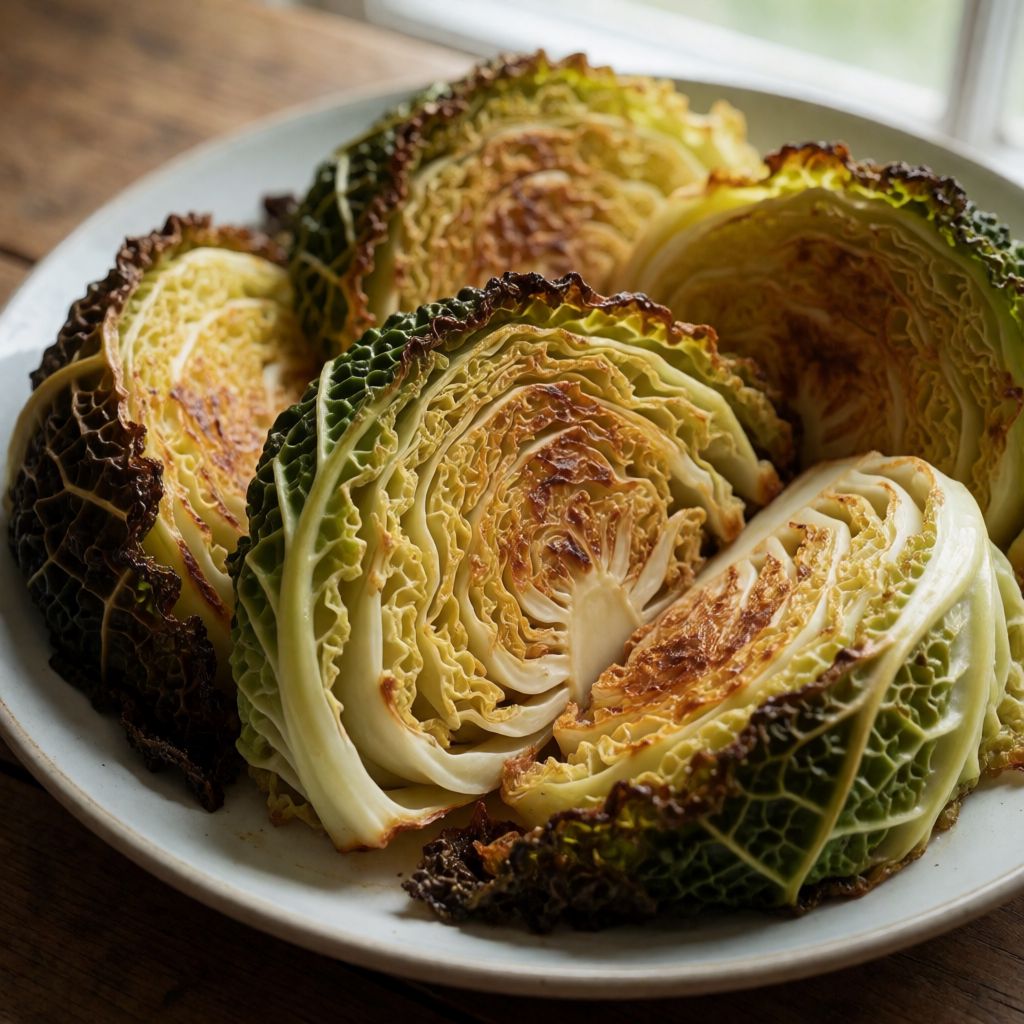
 AI photo
Oven-Roasted Savoy Cabbage
A simple side of savoy cabbage roasted with olive oil and finished with Parmesan.
Labels are worked out automatically from the ingredients and can be wrong. Check the packaging if it matters to you.
Ingredients



Steps
Remove the tough outer leaves of the cabbage, cut away the hard core, and slice the leaves into strips about half a centimetre wide.
Blanch the cabbage for 4-5 minutes, then drain and pat dry with a towel.
5 minPlace the cabbage in a baking dish, drizzle with olive oil and add a pinch of salt.
Preheat the oven to 180°C, using the fan setting if available.
Roast the cabbage for about 20 minutes, stirring halfway through cooking.
20 minSprinkle with Parmesan and serve.
Savoy cabbage roasted is a different vegetable from Savoy cabbage boiled to death on a Sunday, and the whole dish turns on one decision: you blanch it first, for a few minutes only, and then you dry it before it ever sees oil. Skip the drying and you don't roast — you steam, because wet cabbage in a dish just makes its own puddle, and anything sitting in liquid at 180°C goes soft and grey instead of catching colour at the edges.
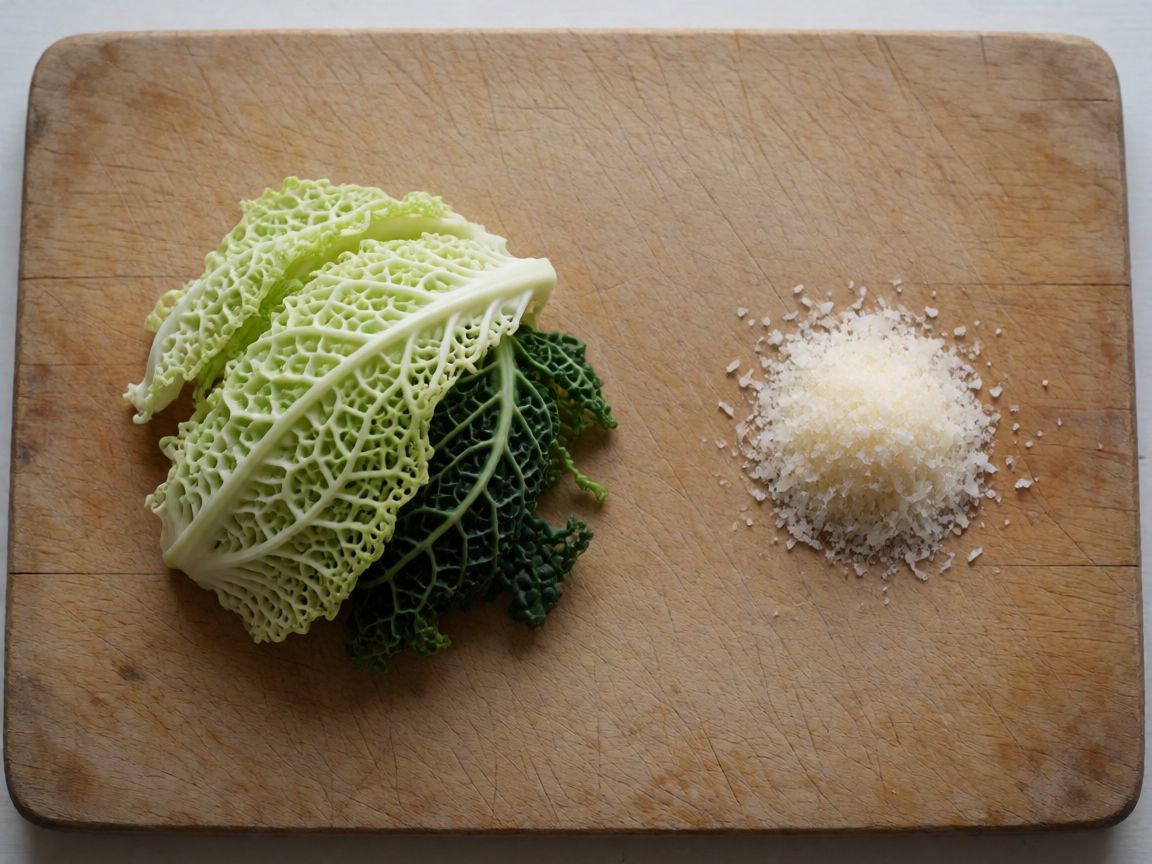
Savoy is the right cabbage for this because its leaves are crinkled, not flat and tight like a white cabbage's. That crinkle is surface area — more edge to brown, more pocket to hold oil and salt. A smooth cabbage would just slide around in its own film of oil and come out uniformly dull.
The blanch isn't there to cook the cabbage — the oven does that. It's there to take the rawness and the sulphurous bite out of the leaf before heat has a chance to turn it bitter and grey at the edges instead of golden. Four or five minutes in boiling water is enough to soften the structure without collapsing it; a bend test tells you more than a clock — the leaf should flex, not go limp like wet paper.
What you're aiming for in the oven is cabbage with brown, slightly crisp edges and a leaf that still has some bite in the middle — not a uniform khaki mush. That's the whole difference between "roasted" and "boiled and then baked for appearances."
Start with the cabbage itself. Pull the outer leaves off not for looks but because they're the oldest, toughest part of the plant — they've been out in the weather longest and they won't soften in twenty minutes no matter what you do. The core is denser still, almost woody at the base, and it needs far longer than the leaves to cook through — leave it in and you'll either undercook the core or overcook the leaves waiting for it. Cutting the strips to about half a centimetre isn't arbitrary either: thinner than that and they turn to confetti and burn before the middle of the dish is through; thicker and you're back to steaming instead of roasting, because the heat can't get through fast enough.
Salt goes on before the oven, not after, and this matters more than it sounds. Salt pulls moisture out of a leaf by osmosis — put it on too early, long before cooking, and you'd draw out water you need dried off differently, by patting with a towel. Put it on at the point given, after the oil, and it seasons as it roasts instead of fighting the moisture problem you've already solved by drying.
Olive oil here is doing two jobs — carrying flavour and conducting heat into direct contact with the leaf's surface, which is what gives you browning rather than drying out. Any oil with no taste of its own that can take moderate oven heat without smoking will do the same job — a neutral vegetable or sunflower oil, for instance — but olive oil's own flavour is part of what this dish tastes like, so don't swap it out of habit; swap it only if you don't have it.
The fan setting matters more in a British kitchen than the recipe lets on. Fan ovens push air around, which means they dry and brown faster and more evenly than a static oven at the same number — if you don't have a fan option, don't just copy the number blindly; watch the cabbage instead, because a conventional oven at 180°C will take it slower and you'd rather pull it out a few minutes late than find it's stewed in its own oil because you trusted the dial over your eyes.
Parmesan goes on at the very end, off the heat or close to it, for a plain reason: cheese on top of a hot dish melts and turns savoury without needing more cooking, and if you bake it in from the start you just dry it into a crust that tastes of nothing but salt. If you haven't got Parmesan, any hard, salty, aged cheese that grates will do the same work — a mature Cheddar, a Pecorino — the test is hardness and sharpness, not the label.
One domestic note: a shallow, wide baking dish does this better than a deep one. Cabbage piled up steams itself at the bottom no matter how well you dried it, because steam has nowhere to go. Spread it thin, in one layer if your dish allows, and that's half the "roasted not boiled" problem solved before the oven door even shuts.
There's a myth that cabbage needs long, slow cooking to be edible — that's a leftover habit from a time when cabbage was cooked to stretch a small piece of meat across a family, boiled for an hour so it would go further and ask less of the cook's attention. It doesn't need that here. It needs the opposite: a short blanch, a hot dry oven, and you watching it rather than leaving it.