
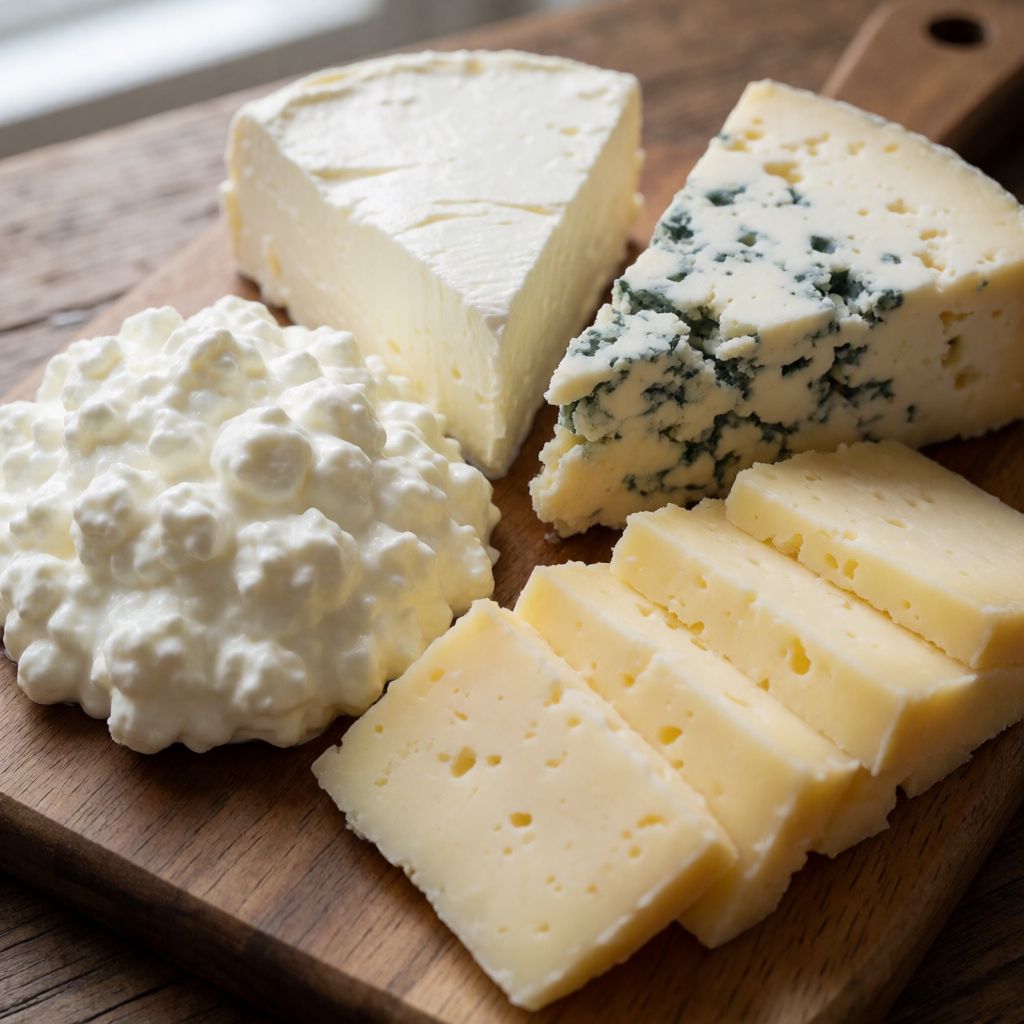
 AI photo
Cheese Board
A generous cheese board with cured meats, pickled pears, caramelised onion relish, candied nuts and fresh fruit.
Labels are worked out automatically from the ingredients and can be wrong. Check the packaging if it matters to you.
Ingredients
- 175 g Westerhavsost cheese a hard cheese
- 175 g blue cheese a creamy cheese
- 175 g garlic cream cheese
- 200 g hard cheese
- 125 g serrano ham
- 125 g chorizo or a similar sausage
- 125 g prosciutto
- 3 pcs red onion diced
- 25 g butter
- 1 tbsp apple cider vinegar
- 1 tbsp honey
- 1 tbsp muscovado sugar or brown sugar
- 1 tsp dried thyme
- salt
- black pepper freshly ground
- 2 pcs pear diced
- 1 tbsp ginger fresh
- 50 g sugar
- 100 g mixed nuts to your taste
- 100 g brown sugar
- 1 pcs orange juiced
- ½ pcs lemon juiced
- ½ pcs vanilla pod
- 100 ml water
- 150 g grapes
- 4 pcs figs fresh or dried
- 125 g olives
- 75 g olives
- 100 g salted almonds
- 50 g pickled gherkins
- 200 g crackers
- 200 g baguette



















Steps
Melt the butter in a frying pan over medium heat and add the diced red onion.
Let the onion fry and caramelise over medium heat for 10 minutes, without stirring.
10 minStir well and add the apple cider vinegar, honey, thyme and muscovado sugar.
Simmer for 5 minutes and season with salt and black pepper to taste.
5 minSpoon into a sterilised jar and serve as an accompaniment to the cheese board, or with burgers and sandwiches.
Keeps in the fridge for 4-5 days.
Put the diced pear, ginger and sugar into a pan for the pickled pear.
Heat over medium heat until the sugar dissolves and the pear starts to release its juice.
Simmer for 10 minutes and spoon into a small bowl.
10 minServe chilled — it's the perfect accompaniment to a cheese board, especially lovely with blue cheese.
Keeps in the fridge for 4-5 days.
Put the brown sugar, orange and lemon juice, vanilla pod and water into a pan for the nuts.
Bring the syrup to the boil and simmer uncovered over medium heat for about 30 minutes.
30 minAdd the nuts to the syrup and simmer for a further 10 minutes. Spoon the candied nuts into clean, sterilised jars.
10 minKeeps in the fridge for about 1 month.
A cheese board isn't a recipe in the usual sense — it's an assembly problem. You're not cooking a dish, you're building a grazing table where three or four small cooked things (an onion jam, a pickled pear, some candied nuts) do the actual work of making bought cheese and bought meat taste considered. The cheese itself you don't cook at all. The whole exercise is about contrast: hard against creamy, salty against sweet, something acidic to cut through all that fat so your mouth doesn't give up after the third slice.
What decides whether it works isn't skill, it's restraint and timing of temperature. Cheese tastes of nothing straight from the fridge — fat mutes flavour until it softens, so it needs to sit out and come up to room warmth before anyone touches it. That's patience, not negligence; twenty minutes on the counter does more for a cheese board than any extra ingredient. The three preserves are where you actually cook, and each one has a single visual cue that matters far more than the clock: onions that have gone from white to the colour of weak tea, pear that's turned translucent and swimming in its own syrup, nuts that are glossy and clinging rather than sitting in a puddle.
Some people think a cheese board is just "put cheese on a board" — no, because an unseasoned plate of fat and protein is monotonous within minutes. The jam, the pickle, the candied nuts aren't garnish, they're the seasoning for cheese you can't season any other way once it's cut.
Start with the onion jam, because it teaches the whole mechanism of the board. You melt butter — fat, not oil, because butter's milk solids brown and add a nutty note oil can't — and tip in diced red onion, then you leave it alone. This is the bit people rush and ruin: stirring too soon scrapes up the sugars that are just starting to stick and caramelise on the pan, and you get steamed onion instead of browned onion. No stirring means the sugars get a chance to actually colour before you disturb them. Vinegar and honey go in after, because acid added too early would stop the onion softening properly — sequence matters here, not just ingredients. The muscovado brings a molasses depth that white sugar simply doesn't have; if you haven't got it, ordinary brown sugar is the honest substitute, it just won't taste quite as dark.
The pickled pear is the same logic in miniature: fruit, fresh ginger, sugar, heat until the sugar dissolves and the fruit starts weeping its own juice — that weeping is the cue, not a number on a clock. It's put next to blue cheese specifically because blue cheese is aggressive and salty, and a pear pickle with a clean sweet-sour edge is one of the few things that doesn't just sit beside it but actually answers it.
The candied nuts need a longer simmer precisely because you're not cooking the nuts, you're reducing a syrup — orange juice, lemon juice, vanilla, water, sugar — down to something thick enough to coat rather than drown them. Thirty minutes uncovered is a lower bound, not a deadline: the real marker is the syrup going from thin and bubbly to slow and ribboning off a spoon. Add the nuts too early, before that stage, and they'll just taste boiled, not candied.
On the cheeses themselves: the brief calls for four, and the logic is texture and intensity, not a shopping list you must match exactly. A hard cheese like Westerhavsost (or any firm, nutty cow's-milk cheese — a mature cheddar does the same job) gives something to slice cleanly. Blue cheese brings the sharp, salty note that needs the pear. Garlic cream cheese is there for spreading on bread or crackers — soft texture, mild enough that garlic can carry it. The second hard cheese is just variety, so no two slices taste the same; swap in whatever firm cheese your shop does well, a Gouda, a Manchego, it's the category that matters, not the name on the label.
The meats — serrano, chorizo, prosciutto — follow the same rule of contrast: two dry-cured hams that are subtly different, and one cured sausage with spice and fat to break up all that leanness. If chorizo isn't to hand, any cured, spiced sausage that slices thin does the job; the point is a savoury, fatty counterweight, not the specific Spanish name.
Everything else — grapes, figs, olives, almonds, gherkins, crackers, baguette — is there to give your hand and your palate something to reset on between the heavier bits. Bread and crackers aren't filler, they're what stops you eating cheese on its own, which gets tiring fast; a gherkin or an olive resets your tongue the way sorbet resets a tasting menu, just with far less ceremony. None of it needs a recipe. It needs a board wide enough to spread out on, four people with some patience for the fridge to let the cheese warm up, and the sense to taste as you go rather than trust a clock that was only ever a rough guide to begin with.