
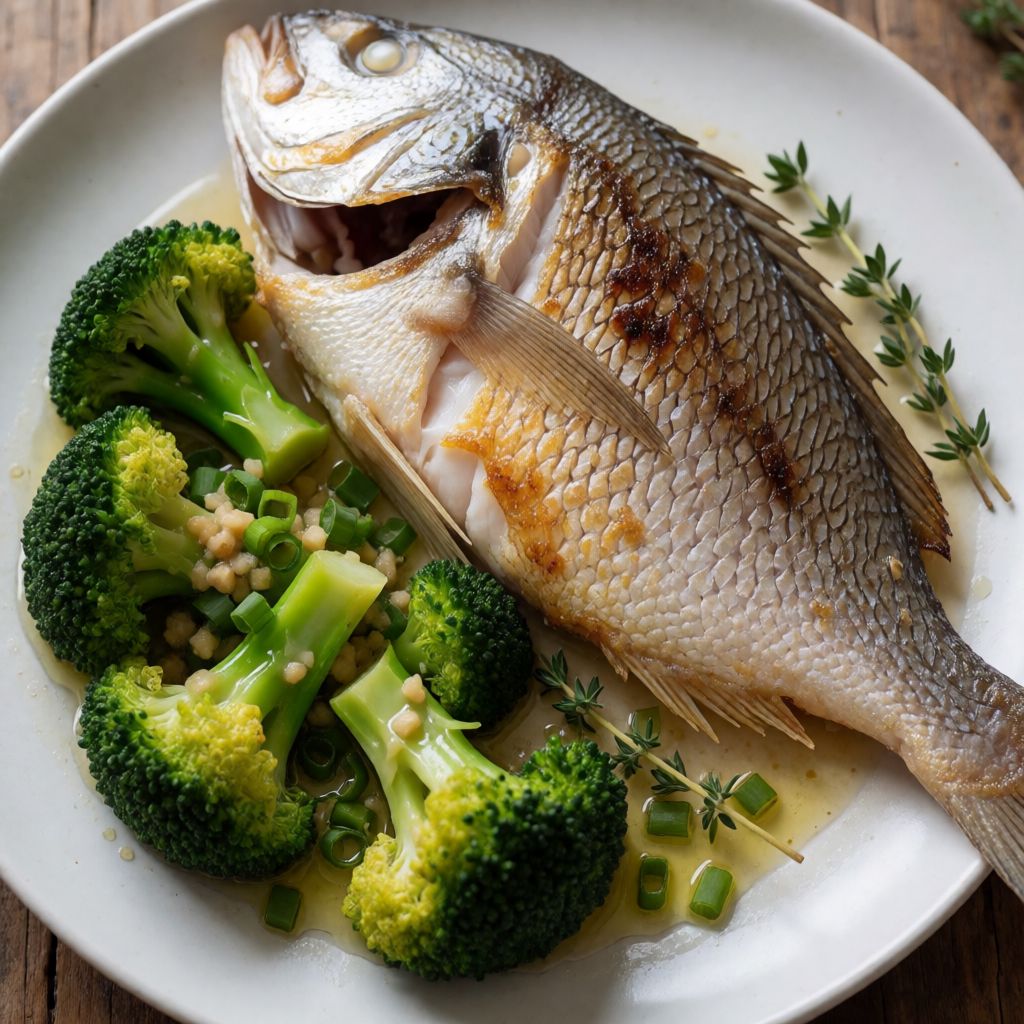
 AI photo
Pan-Fried Sea Bream
A simple pan-fried sea bream with broccolini, garlic and thyme.
Labels are worked out automatically from the ingredients and can be wrong. Check the packaging if it matters to you.
Ingredients
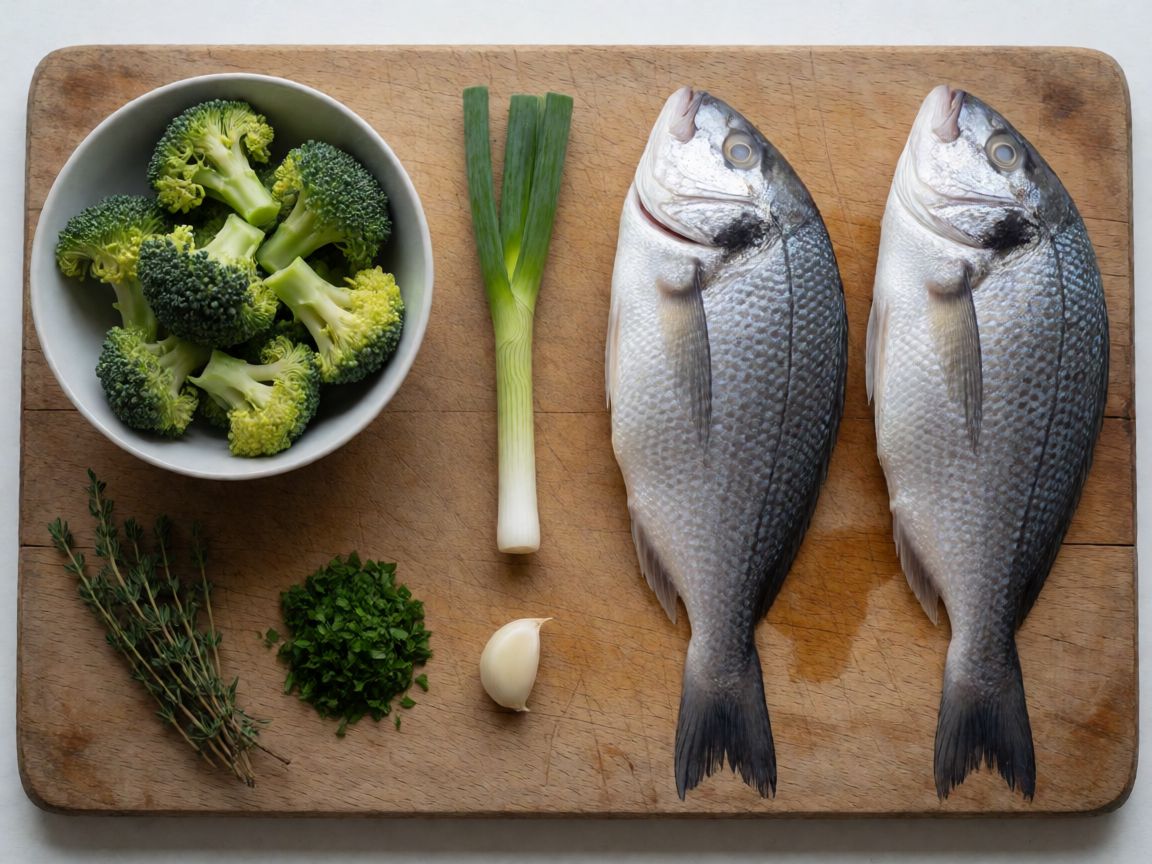
- 2 pcs Sea bream about 400 g each
- Olive oil to taste
- 150 g Broccolini
- 1 pcs Spring onion
- 1 clove Garlic
- Thyme to taste
- Parsley to taste
- Salt to taste
- Black pepper to taste








Steps
Cut the broccolini into small pieces, and slice the spring onion into rings.
Pour olive oil into a non-stick frying pan, add a clove of garlic in its skin and fry for a few minutes, then remove it.
Place the sea bream in the pan, add the broccolini, sprigs of thyme and the spring onion. Season with salt and pepper to taste.
Cover the pan with a lid and cook over medium heat.
7 minCarefully turn the sea bream with a spatula, trying not to damage it.
Cook for about another 7 minutes. Doneness: the thickest part should reach 63°C.
7 minSprinkle with fresh parsley and serve together with the vegetables.
A whole sea bream, skin on, laid into oil that's already been taught a lesson by a crushed clove of garlic. That's the whole idea of this dish: the fish does almost nothing to you, and you do almost nothing to the fish. No filleting, no sauce built in three stages. You put it in a pan with some broccolini and a sliced spring onion, you cover it, and you wait for the skin to tell you it's ready.
What decides whether this works is heat control on a domestic hob, which is a different animal from a restaurant burner. "Medium heat" on your cooker is whatever keeps the oil at a steady shimmer without spitting — not smoking, not silent. Too hot and the skin blisters and tears before the flesh near the bone is even warm; too gentle and the fish stews in its own moisture instead of crisping, and you get grey, slack skin that tastes of nothing. The lid isn't there for show — it's doing the job a kazan's curved sides would do, trapping enough steam to cook the fish through without you needing to flip it every ninety seconds.
The garlic clove, skin left on, fried and then thrown away, is a trick worth noticing. You're not trying to get garlic flavour into the fish — a whole bream doesn't need it, and the flesh is too delicate to carry raw garlic heat. You're perfuming the oil itself, so by the time the fish goes in, the fat already smells of something. The skin stays on the clove so it doesn't catch and burn, which would ruin the oil for everyone who touches it after.
Sea bream, about 400g each, whole — that's one fish per person, which is both generous and practical. A fish that size has a short enough distance from skin to bone that a covered pan can cook it through without burning the outside first; go much bigger and you'd need to finish it another way, probably in an oven, because the steam under that lid only reaches so far. If your fishmonger doesn't have bream, ask for anything with the same build: firm white flesh, skin thick enough to crisp, a size you can lift whole with a spatula without it folding. Bass works. Mullet works. What doesn't work is anything delicate and flaky like plaice — it'll fall apart the moment you try to turn it.
Olive oil "to taste" sounds vague until you realise what it's actually choosing: enough to properly contact the skin across its whole surface, not so much you're deep-frying. The criterion for the oil itself is simple — anything with no strong smell of its own, so it doesn't fight the garlic and thyme. A good olive oil is traditional here because it's what was on hand in the places this dish comes from, not because some other oil would ruin it. Sunflower or a mild rapeseed will do the job if that's what's in your cupboard.
Broccolini and spring onion aren't garnish, they're doing a specific job: soaking up whatever juice and fat the fish releases while it steams under that lid. This is the whole reason they go in the same pan rather than being cooked separately and plated alongside — they're cooking in fish stock you didn't have to make. Cut the broccolini small enough that seven minutes under a lid is actually enough to soften it past raw-crunch into something you'd want to eat; too large and you'll bite down on a stem that's still arguing with you.
Thyme goes in as sprigs, not stripped leaves, because you want its oil released slowly by the heat, not scattered through the dish losing all its character in the first minute. Parsley, by contrast, goes on at the very end, off the heat — chopped herbs cooked for even a few minutes turn bitter and dull, which is the real reason you finish with it raw rather than some rule about freshness for its own sake.
On doneness: a thermometer reading the thickest part at 63°C is the honest answer, better than counting minutes, because bream vary and so does your hob. If you don't have a thermometer, press the thickest part near the spine — it should give slightly and the flesh should look opaque rather than glassy right through. Some say you can tell a fish is done by the eye going white or the flesh "flaking easily" — flaking easily usually means you've already overcooked it and it's falling apart on you, not a sign to aim for.
Patience here isn't passive. It's resisting the urge to lift the lid every minute to check, which lets heat escape and stretches your actual cooking time without telling you. Trust the seven minutes as a floor, not a deadline, and let the fish and your nose tell you the rest.