
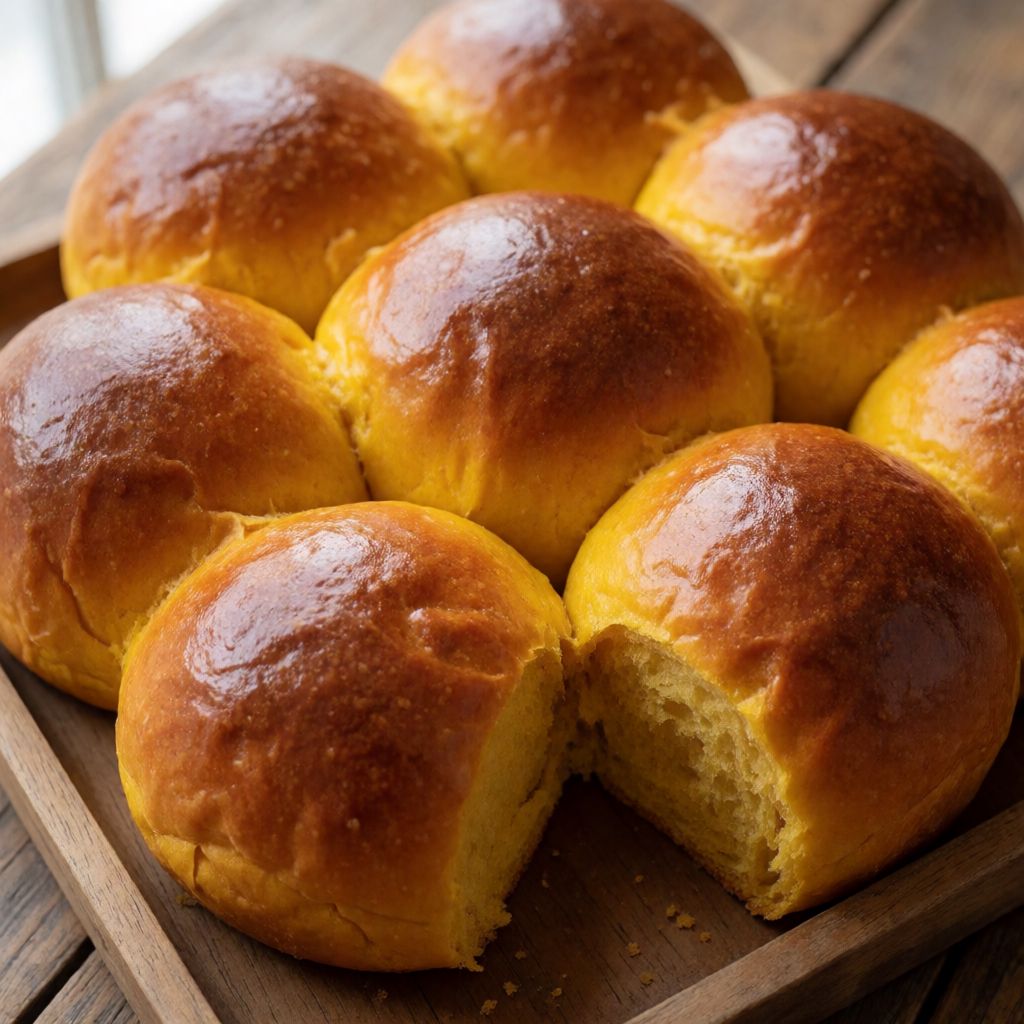
 AI photo
Pumpkin Patch Halloween Rolls
Soft pumpkin yeast rolls tied with string before baking to look like little pumpkins, perfect for Halloween.
Labels are worked out automatically from the ingredients and can be wrong. Check the packaging if it matters to you.
Ingredients
- 200 g Pumpkin diced
- 100 ml Milk at room temperature
- 20 g Yeast
- 1 tsp Cardamom ground
- 2 pcs Eggs
- 50 g Caster sugar
- 10 g Salt
- 50 g Wholemeal flour
- 60 g Butter soft, at room temperature
- 500 g Plain flour
- 1 pcs Egg beaten, for glazing
- 2 pcs Candied orange peel cut into small pieces for stalks




Steps
Put the diced pumpkin into a covered pan with water, bring to the boil and cook for 10 minutes.
10 minDrain and blend the pumpkin into a thick, creamy purée, then chill in the freezer until completely cold before adding to the dough.
Dissolve the yeast in the milk, add the cardamom, eggs, caster sugar, salt and wholemeal flour, and mix well.
Add half of the plain flour and work the soft butter into the dough once it becomes smooth.
Add the chilled pumpkin purée and gradually add the remaining flour, kneading the dough on low speed for 10 minutes.
10 minTransfer the dough to a bowl, cover with a towel and let it rise for 1 1/2 hours.
90 minTurn the dough out onto a floured surface, divide and shape into round rolls.
Place the rolls on a parchment-lined baking tray and leave to prove, uncovered, for 15 minutes.
15 minCarefully tie kitchen string around each roll to create a pumpkin-wheel pattern.
Leave the rolls on the tray to prove for a further 30 minutes, covered with a towel.
30 minBrush the rolls with beaten egg and bake in a preheated fan oven at 175°C for about 16-18 minutes.
17 minLet the rolls cool slightly on a wire rack, carefully snip and remove the string, then insert a small piece of candied orange peel as a stalk before serving.
What was changed
The decorative stalk uses Candied orange peel instead, since licorice root sticks are not sold in local shops.
These are sweet, cardamom-scented yeast rolls dressed up as tiny pumpkins — the trick is string, not icing. You boil pumpkin, purée it, chill it hard, work it into an enriched dough, then after the first rise you tie kitchen string round each ball before the second prove. The dough swells against the string and gets pushed into four or five fat lobes, and when you snip the string off after baking you've got a pumpkin shape for free. No carving, no piping, no edible paint — physics does the decorating.
What decides whether this works is the chilling of the purée and the timing of the string. Pumpkin purée is mostly water held in cell walls; warm, it will slacken your dough and the yeast will start working on contact instead of on your schedule. Chill it properly and it acts like any other cold, dense addition — it goes in without dumping heat or extra liquid into a dough that's trying to build gluten. And the string has to go on after the first long rise but before the second, short one: tie it too early and you throttle a dough that hasn't built any structure yet; tie it after full proof and there's no rise left to carve the lobes — you'll just get a flat tourniquet mark.
Fourteen rolls from this is a Sunday-roast-sized Halloween batch — enough for a family tea with something left for the lunchboxes. Treat the quantities as a baker would: everything in grams because yeast dough doesn't forgive guesswork the way a stew does.
The pumpkin itself isn't there for pumpkin flavour — boiled and puréed, it mostly disappears into the crumb, giving moisture and a faint orange tint, the way carrot does in a carrot cake. Some say you need a specific "baking pumpkin" variety or the dish fails — no, because any dense squash flesh that holds its shape when diced and breaks down to a smooth purée will do; butternut works, as does a tin of plain pumpkin purée if you drain any excess liquid and chill it. What you're avoiding is wateriness, not a particular cultivar.
Cardamom is doing the work most people expect from cinnamon or nutmeg. It's there because it's aromatic without being heavy-handed, and because it's the spice that turns up in enriched Scandinavian and Middle-Eastern sweet breads this dough is really descended from — a bun dressed for Halloween, not a pumpkin pie dressed as bread. Use nutmeg or a little mixed spice if that's what's in the cupboard; just use less, because nutmeg is sharper.
The yeast and the warm milk are a pairing, not two separate ingredients: yeast needs moisture and a gentle temperature to wake up, and milk at room temperature — not fridge-cold, not heated till it stings your wrist — gives it that without stunning or scalding it. If your yeast is the instant, "no need to dissolve" kind, you can mix it straight into the flour; dissolving in milk first is mainly insurance for fresh or slightly tired yeast, letting you see it's alive (it should foam a little) before you commit the rest of the ingredients to it.
Wholemeal flour alongside the plain flour is a small addition, but it's not decorative — a touch of bran and germ gives the dough something to grip, a bit more structure and flavour than an all-white dough would have, without making the rolls dense. If you haven't got wholemeal, swap in plain flour and don't expect the texture to suffer badly; you'll just lose a little character.
The butter goes in soft, worked into the dough only once it's already come together smooth — not before. Fat coats gluten strands; add it too early and it gets in the way of the proteins linking up in the first place, and you end up with a slacker, weaker dough that struggles to hold the pumpkin-wheel shape under the string. Soft butter, added at the right moment, instead gives you a dough that's tender without being limp.
For the glaze and the stalks: beaten egg brushed on before baking gives you colour and shine — it's the Maillard reaction doing its thing on sugars and proteins at the crust, nothing more mysterious than that. Milk alone browns less; egg wash with a splash of milk browns a touch slower and more evenly, if you want to adjust it. And the candied orange peel stalks are purely for show, pushed in once the rolls are cool enough to handle — any firm, bright scrap would do the same job, a clove, a strip of candied lemon peel, even a sliver of green apple skin if you're feeding children who'll pick it off anyway. Patience is the real ingredient twice over here: once while the dough takes its full hour and a half to rise, because a hurried rise gives you a dense, sorry little bun with none of the lightness enriched dough is capable of; and once again at the end, waiting for the rolls to cool before you cut the string — hot dough is soft dough, and you'll crush the very ridges you spent two proves building.
·