
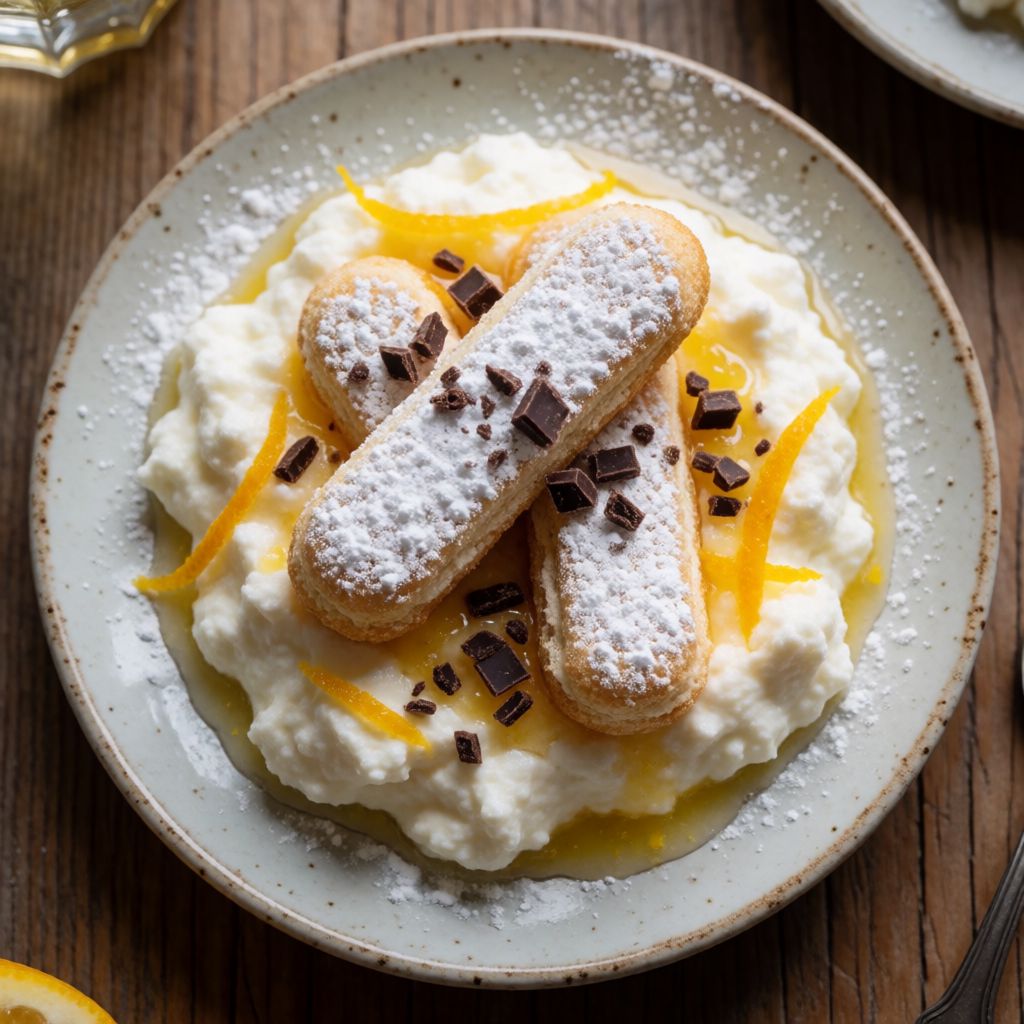
 AI photo
Orange and Chocolate Truffles
A no-bake truffle made from sponge biscuits, ricotta, orange juice and zest, and dark chocolate.
Labels are worked out automatically from the ingredients and can be wrong. Check the packaging if it matters to you.
Ingredients
- 300 g Savoiardi biscuits
- 120 g Icing sugar
- 250 g Ricotta
- 90 g Orange juice
- 1 pcs Orange zest
- 80 g Dark chocolate
- Cocoa powder to taste





Steps
Blend the savoiardi biscuits in a food processor until they form a fine, powder-like crumb.
Tip the crumb into a large bowl, add the icing sugar and mix.
Add the ricotta and mix thoroughly until smooth.
Pour in the orange juice and add the orange zest, then mix.
Melt the dark chocolate in a heatproof bowl set over a pan of simmering water, or in the microwave, then stir it into the mixture until smooth.
Cover the bowl with cling film and chill in the fridge for 30 minutes, so the mixture is easier to shape.
30 minShape the mixture into small balls, taking a little at a time and rolling it between your hands.
Roll each truffle in icing sugar or cocoa powder.
Keep the finished truffles in the fridge until serving.
These aren't truffles in the Belgian sense — no tempered chocolate, no ganache cooled to a precise snap. They're a no-bake trick: stale biscuit crumbs bound with ricotta and a little juice, rolled into something that looks like a truffle and tastes like orange cheesecake you can eat with your fingers. The whole dish is really a question of ratios, not technique.
What decides whether it works is moisture, not flavour. Savoiardi are dry and absorbent — that's their entire job here, the same way they soak up coffee in tiramisu without collapsing. Ricotta and orange juice are wet. Get the balance wrong and you have either a dry, crumbly ball that falls apart in your hand, or a wet paste that won't hold shape at all. You fix this by feel, not by following the gram count blindly: if the mixture sticks to your palms like wet sand, it's too loose — more crumb. If it won't compress, it needs a touch more juice.
The chilling isn't optional padding in the recipe — it's the mechanism that makes rolling possible. Ricotta is soft at room temperature; cold, its fat firms up just enough that the mixture holds a ball shape instead of slumping. Thirty minutes is a floor, not a target — in a cold English fridge that's usually enough, but if your kitchen's warm or the ricotta was still mild from the shop shelf, give it longer. You're watching for a mixture that holds a dent when you press it, not one that springs back wet.
Savoiardi are the backbone, and they're chosen for being dry — properly dry, the way a biscuit left out of its packet for a week goes. That dryness is what lets them act as a sponge for the ricotta and juice instead of turning the mix to soup. If you've only got digestives or shortbread, they'll work as a crumb base too, but they bring their own fat and sugar, so cut back the icing sugar a touch or the whole thing turns sickly. What you're really buying when you buy savoiardi, historically, is a biscuit made cheap and shelf-stable precisely so it could survive weeks in a larder before espresso or liqueur ever touched it — this recipe just borrows that shelf life for a different job.
Ricotta does two things: it's the moisture and the fat, since there's no butter or cream in this recipe. Buy the firmer tub kind, not the wet, watery one sold loose — if yours is sitting in liquid, tip it into a sieve lined with kitchen roll for ten minutes first, or your crumb-to-wet ratio is thrown off before you've even started mixing. No ricotta in the cupboard — mascarpone works, though it's richer and sweeter, so ease off the icing sugar again.
Orange juice and zest aren't interchangeable jobs. The zest carries the actual orange flavour — the oil sits in the skin, not the flesh — so don't skip it to save time peeling; juice alone gives you sweetness and a faint citrus note but none of the punch. Squeeze your own if you can; bottled juice tends to be thinner on aroma because it's been pasteurised and stored, which boils off the volatile oils that make zest worth bothering with in the first place.
The dark chocolate is there for bitterness and body, not sweetness — that's what icing sugar is already covering. Any dark chocolate with no added flavourings of its own works; the higher the cocoa percentage, the more it'll cut through the sweetness of the biscuit-and-sugar base, so if you like these less saccharine, reach for 70% over something milkier. Melt it gently — a bowl over barely simmering water, not touching it, because chocolate seizes and turns grainy the moment water gets into it, which is the one real way to ruin this step.
The coating — cocoa or icing sugar — isn't decoration. It stops the truffles sticking to your fingers, to each other, and to the plate while they sit in the fridge waiting to be served. Cocoa gives a bitter contrast that plays against the sweet centre; icing sugar doubles down on sweetness and gives a cleaner white look. Either is fine — it's a finishing choice, not a structural one.
This recipe scales to ten modest servings, meaning a small plateful for tea rather than a dessert course on its own — a good fit alongside tea with milk after a Sunday roast, when nobody wants another heavy pudding but a sweet bite or two feels right. Make the mixture a day ahead if that suits your Sunday better; just remember patience here isn't flavour maturing, it's firmness setting, and firmness is what lets you roll a ball instead of fighting a smear.